

The recent headline sounds benevolent, even charitable.
“Osage Nation Donates $100,000 To Seven Lake of The Ozarks Community Organizations”
What the article does not tell you is that the Osage Nation is attempting to establish a tribal casino at the Lake that would be exempt from all state and local taxes and would not have to abide by any state or local laws. So what is the Osage Nation’s purpose in making these donations in an area where they currently have no business operations? To build local support for their proposed tribal casino of course. You see, despite some of their press releases, an Osage Nation Tribal Casino at the Lake is far from a done deal. And while it sounds good, $100,000 is a drop in the bucket from an entity, that if successful, would pay no other state or local taxes. That should make every taxpayer in the state cringe. That is the bad news. The good news is there is a much better alternative.
As has been widely reported, another area group known as Osage River Gaming (ORG) is also working to establish a casino at the Lake. ORG has been spearheading the process to amend the state constitution to allow casino gaming at the Lake. (Missouri currently has 13 state-regulated casinos; however, they are limited to a proximity of within a thousand feet of the Missouri and Mississippi Rivers.) ORG has been working with more than a dozen state legislators and officials to pass legislation that would add the Osage River to the permissible areas for gaming and pave the way for a state-regulated Lake area casino. In addition, the proposed legislation will also add a fourteenth license specifically for this area. If ORG is successful in their efforts, the state-regulated casino (such as the size they have scaled) would generate nearly $75,000 in state and local tax revenue PER DAY. The 13 state-regulated casinos currently located in Missouri, as a group, generate approximately ONE MILLION DOLLARS PER DAY in state and local tax revenue. An Osage Nation property would generate ZERO.
A tribal casino would also be exempt from any sales tax on their ancillary operations such as hotels, fuel stations, entertainment/live music venues, restaurants, gift shops, etc. In the case of the size property proposed by the Osage Nation, state and local officials would forego an additional $10 million in lost sales tax revenue.
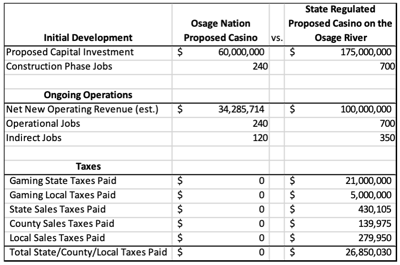
Below are summary economic highlights comparing the two projects:
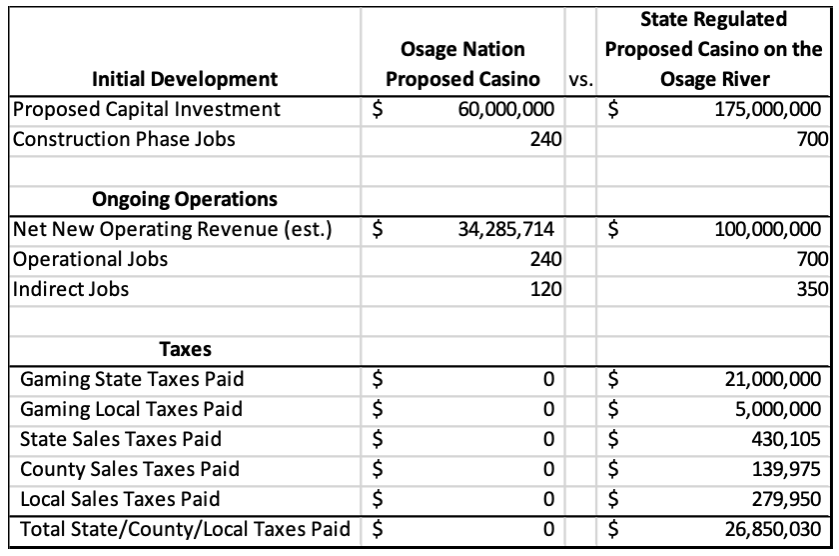
The contrast is striking.
Consider this. In 2022, the Osage Nation made donations to a handful of local businesses totaling $25,000 with the remaining $75,000 being paid to the following local government entities:
• Lake of the Ozark Police Department: $25,000
• Miller County Sheriff’s Department: $25,000
• Lake Ozark Fire Department: $25,000
To put it in perspective, in one year, the Osage Nation donated $75,000 to the local jurisdictions of these entities. However, a state-regulated casino would generate nearly $6 million in annual tax revenue for these same jurisdictions. That is more than $16,000 per day. Stated differently, a state-regulated entity would match the 2022 donations of the Osage Nation in the first 5 days of operation. The donations no longer seem so generous. Nor would such donations be mandatory, recurring or required, unlike the state and local mandated tax revenue. In virtually every other market, tribal donations have been a negligible source of income for local municipalities and jurisdictions.
The disparities of a tribal casino vs. a state-regulated casino are not only economic. As a sovereign entity, a tribal casino would be subject to virtually none of the state and local laws and regulations. This means that they set their own gaming rules, regulations, and payouts. Historically, in many cases, such rules, regulations, and payouts have been far less favorable to patrons. Moreover, the physical security of the actual property would not ordinarily be overseen by local law enforcement. Some tribal casinos have contracted with local law enforcement for such services while others simply manage their own law enforcement with no state, county, or local oversight. Regardless of how it is structured, such services are procured solely at the discretion of the tribe. As a Lake resident or visitor, you should consider that carefully. It is no secret that some tribal casino properties across the country are known for their lax enforcement of self-imposed rules.
The tribal threat to other local Industries will eventually extend beyond casinos. In many states, tribes have expanded far beyond gaming and casinos to include truck stops, travel plazas, convenience stores, and gas stations. These entities operate on tribal land, pay no state or local taxes, and generally are not subject to any state or local regulations. For example, the fuel tax in Missouri is currently 22 cents per gallon (with a scheduled rise to nearly 30 cents by 2025). It is easy to see the competitive disadvantage a state-regulated and tax-paying truck stop or convenience store would have when in direct competition with a similar tribal enterprise. And it is not just fuel purchases since any other merchandise sold at a tribal enterprise would also be exempt from state and local sales tax. In some competitive markets, tribes have used their tax-exempt status to undercut prices and force state-regulated enterprises to close their doors. In addition to the economic damage imposed on such unfortunate enterprises, it has also cost state and local taxpayers billions in lost revenue.
For example, imagine that the Osage Nation begins retail fuel sales at their current location in Lake Ozark. If they undercut the local competition by just the amount of fuel tax (ignoring sales and other taxes), the Casey’s located just across the street would almost certainly be forced to close. Consumer’s, most not even knowing about the unfair competitive playing field, will simply flock to the cheaper fuel. Fueling stations operate on a profit margin of approximately 5 cents per gallon (sometimes less), so it is easy to see how a 22 cent (soon to be more) tribal cost advantage would likely eliminate some competitors. While most consumers won’t change their behavior for a one, two or even five cent per gallon price difference, most would for a 22 cents per gallon price difference. Our economic modeling forecasts at least three Lake area fueling stations being forced to close their doors and additional price pressure being placed on dozens of others. If you live in Eldon, Camdenton or Sunrise Beach, would you purchase much cheaper fuel in Lake Ozark? The answer is yes if it were convenient. At least that is what has happened in other markets. Consider the tourists frequenting the Lake area making certain they “filled-up” before their long treks back to Omaha, Des Moines, Wichita, Chicago and elsewhere. Even tourists from St. Louis and Kansas City would likely take advantage of the lower prices. So total fuel sales would most certainly increase but only to the benefit of the tribe. In other markets, in many cases, tribal entities decimated competing industries. Most certainly the Osage Nation would argue that no jobs would actually be lost, just transferred from Lake legacy businesses to tribal members. So if you are a legacy Lake business, listen up.
Under federal law, the Osage Nation certainly has the legal right to pursue their proposed casino project. A proposed legislative initiative is scheduled for an upcoming legislative session to amend the state constitution to bring a state-regulated casino to the Lake. Such a facility would have a far greater positive impact than what the Osage Nation is proposing. A state-regulated casino would be regulated and policed by state, county, and local officials and would produce tax revenue not only for the state but also for the local community. There is a strong argument for a state-regulated casino at the Lake.
It would seem gaming is coming to the Lake in some form, one way or the other. Shouldn’t we want it to come with the most favorable terms possible for the Lake area?
For a detailed Q&A regarding a state-regulated casino at the Lake click the following link:

Earlier this year, I penned an OpEd outlining five bold new initiatives to stimulate Lake ar…


