

Republicans faced a national reckoning on Tuesday, Nov. 3. The results surprised few who were paying much attention; if anything, many Republicans who expected to take losses were surprised at the magnitude and location of those losses.
Some have speculated that Republican voters stayed home, frustrated by the past two years of Trump policies. But a look at Missouri's vote totals raises another question. Did Republican voters stay home? Or did they vote Democrat?
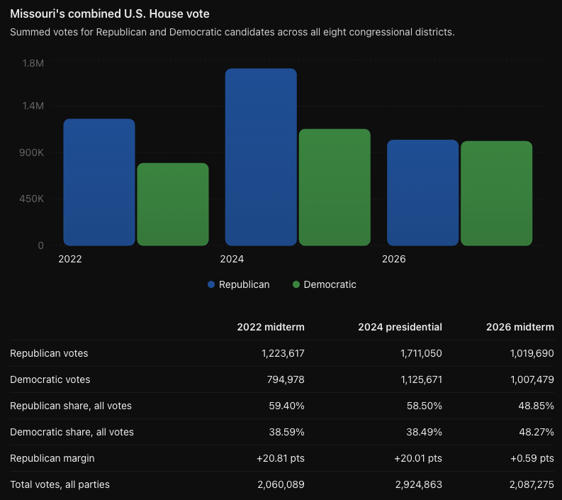
Comparing the Republican vs Democrat congressional candidate vote totals in the 2022 Missouri midterms with the state's 2026 midterms (unofficial as of now) reveals a few remarkable data points:
1. The Number Of Votes Was Higher In 2026
Missouri's population has grown by about 91,000 people since 2022, according to the U.S. Census Bureau (that's total residents, not exclusively voters.) And the number of congressional votes cast was higher in 2026 than in 2022, by about 27,000 votes.
Total votes for all Congressional candidates (all parties):
2022: 2,060,089
2026: 2,087,275
That's a 1.3% increase in total votes cast in 2026 vs 2022.
2. The Total Republican Vote Margin Nearly Evaporated

In 2022, Republican Congressional candidates received 1,223,617 votes. Democrat candidates received 794,978.
In 2026 Republican Congressional candidates received 1,019,690 votes. Democrat candidates received 1,007,479.
That's a 16.7% decrease in the number of Republican votes and a 26.7% increase in the number of Democrat votes... while turnout actually increased. So, did many Missouri Republican voters switch sides?
State Auditor Scott Fitzpatrick's vote totals reflect this trend almost perfectly. In 2022, Fitzpatrick — a Republican — received 1,219,553 votes. In 2026, he received 1,058,853 votes.
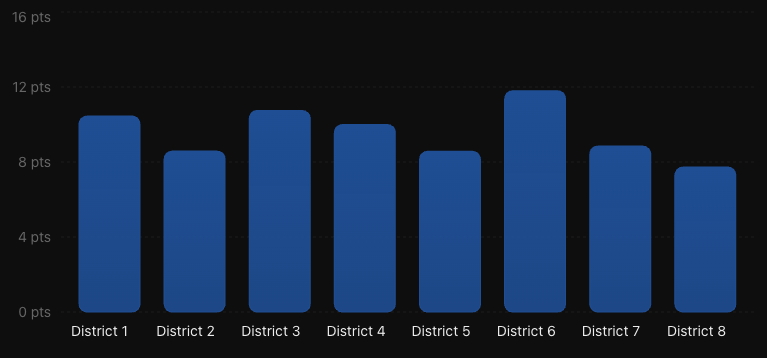
3. Every Congressional District Moved Toward Democrats
Democrats picked up a new district — District 2, where seven-term incumbent Ann Wagner was defeated by Democrat Fred Wellman, who got 51.14% of the vote.
But in every single one of Missouri's eight congressional districts, Democrats increased their share of votes by 7 to 12 percentage points.
4. 428,639 → 12,211
Republicans' edge over Democrats went from 428,639 votes to 12,211 votes.
That's remarkable in a state where Donald Trump won with 59% of the vote just two years ago and that has been considered solidly red for more than a decade.
In conclusion? At least one of the following likely occurred:
• Democrats mobilized more voters, while Republicans failed to. Definitely possible.
• Democrats' positions aligned more closely with Missouri voters in this election cycle.
• About 200,000 Missouri voters used the midterms as an opportunity to punish the Republican party.


