

OSAGE BEACH, Mo. — The City of Osage Beach is considering an ordinance to strictly regulate the development of data centers within city limits.
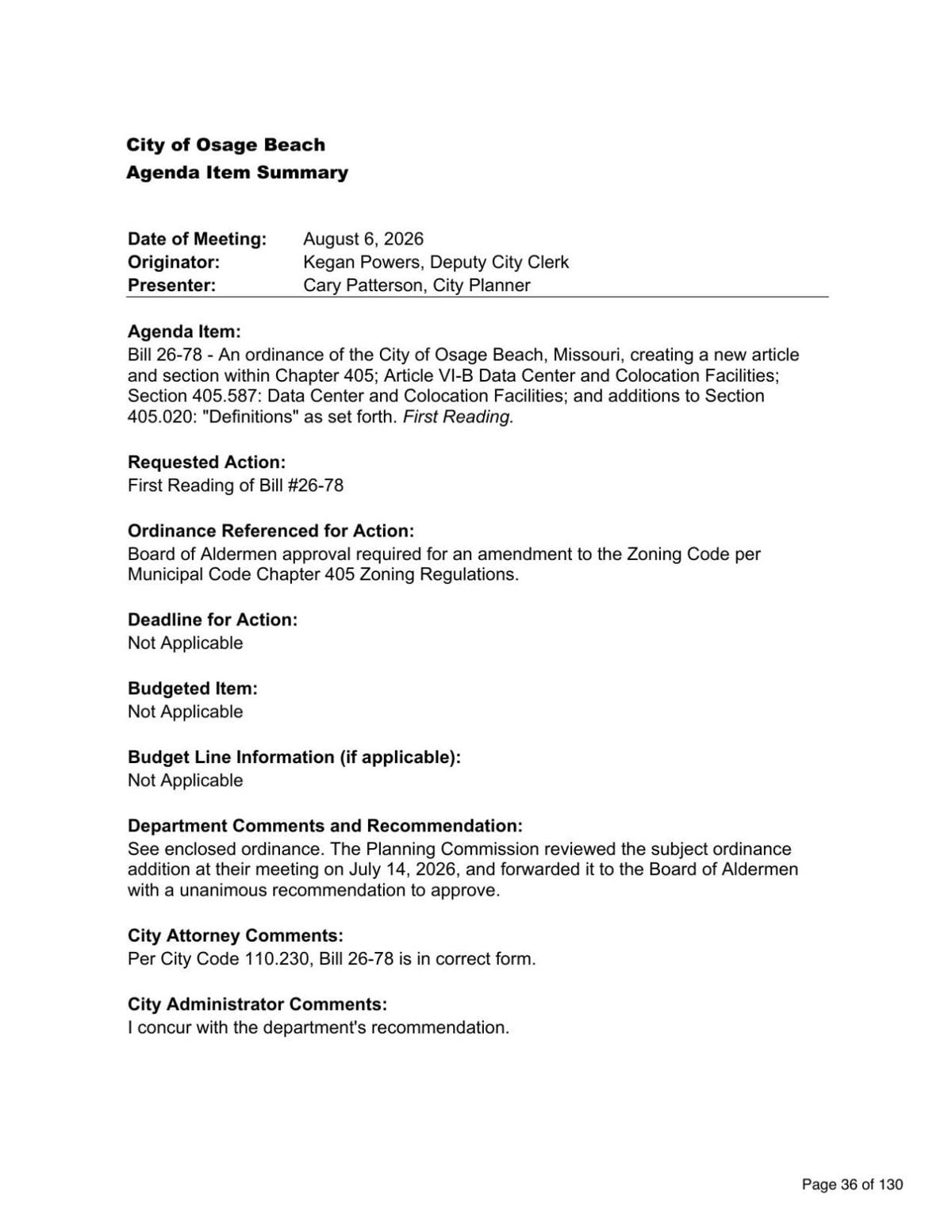
The City Board of Aldermen will discuss and potentially vote on the first reading of Bill 26-78 at their Thursday, Aug. 6 regular meeting. If passed, the bill would impose a wide range of restrictions on the development of any data centers. The City's actions follow similar actions by other local governments, as the topic of data centers has become red-hot among public debate locally and nationally.
Osage Beach Mayor Richard Ross told LakeExpo the catalyst for developing the proposed ordinance was to create a framework for any future data center; he said that — to his knowledge — no one had approached the city with a request to build a data center.
Ross noted counties and cities cannot outright ban data centers, but they are allowed to regulate them — including where they may and may not be placed, their utilities usage, etc. He also pointed out that the restrictions were written to be much more rigorous for large-scale data centers than for what he called "micro" data centers, noting the main public outcry over data center development has been over large centers.
Some of the most significant points of the lengthy proposed ordinance are below.
Proposed Osage Beach Data Center Ordinance
Types of Data Centers
1. Micro Data Center
- Less than 10,000 square feet
- Less than 5 megawatts maximum power demand
- Can be considered in some commercial and mixed-use districts with a Special Use Permit, in addition to industrial zoning.
2. Standard Data Center
Not actually defined in the ordinance, presumably this is the category between Micro and Major, which would be
- 10,000–250,000 square feet
- Under 30 MW (assuming it doesn't meet the Major threshold)
It's listed in the use table but lacks an explicit definition.
3. Major Data Center
Defined as:
- More than 250,000 square feet and less than 500,000 square feet, or
- 30 megawatts or more of maximum power demand.
4. Colocation Facility
This isn't a size category but a type of operation: A third-party data center where multiple businesses rent space, power, cooling, and security for their own servers. The ordinance specifically says a data center includes a colocation facility.
Rules About Data Centers
1. Standard and Major data centers would only be allowed in industrial zones.
Standard and Major Data Centers would only be allowed in industrial zoning and would still require a Special Use Permit approved by the Board of Aldermen. They would be prohibited everywhere else.
2. 1,000-foot setbacks
A standard or major data center would have to be at least 1,000 feet from:
- any residence
- residentially zoned property
- churches
- schools
- daycares
3. No data centers on lakefront property.
The ordinance says plainly, "No Data Center shall be permitted on a property that is contiguous with the Lake of the Ozarks."
4. Minimal visual impact and not visible from the road
The ordinance says the facility:
- shall minimize lighting
- minimize aesthetic impact
- shall not be visible from a public roadway
This would be accomplished through using berms, landscaping, topography, fencing, etc.
5. Decibel limits
During normal operations, measured at the property line:
- Maximum 80 dBA during the daytime
- Maximum 70 dBA at night and on weekends
For comparison, 80 dBA would be about the same volume as standing on a sidewalk next to a busy city street; 70dBA would be about the level of a vacuum cleaner, from the operator's position.
The ordinance would also require:
- professional acoustic study before approval
- another during permitting
- another six months after opening
- future testing if necessary
The permit could also be revoked for noise violations.
6. Water Rules
The ordinance would require:
- closed-loop or otherwise water-minimizing cooling
- no cooling discharge into Lake of the Ozarks
- proof adequate water exists
- if using wells, a detailed hydrogeologic study to calculate the impact on neighboring wells, groundwater, streams, and springs
7. Power
Developers would have to show:
- the power providing utility company has capacity to serve the data center
- the utility company agrees to serve them
- known impacts on electric rates or availability
8. The city would keep broad discretion.
The Board would still be able to require:
- Public Impact Agreements
- infrastructure improvements
- emergency coordination
- additional conditions
- outside consultants (paid by the applicant)
- a 125% performance bond for decommissioning
The proposed ordinance, as of Friday, July 31, is below.
Related Stories
LakeExpo's exclusive coverage of the Lake of the Ozarks community as it grapples with the possibility of data centers.


