



In April 1934, as the ground was still settling beneath the newly-created Lake of the Ozarks, a landowner about 40 miles north of the Lake unearthed a mystery.
J.D. Crain raised Hampshire hogs on a 340-acre farm in Clark's Fork Township, in Boone County. Blocking the view outside his home were five, stately white oak trees on a mound, so Crain decided to remove them.
As he began to level the ground beneath the trees, Crain unearthed several broad, flat stones arranged in a symmetrical mound. That in itself was curious, but the mystery deepened. Beneath those stones: giant bones, bleached white with time.
There were seven skeletons, according to the tale, and at least one of those skeletons was, by J.D. Crain’s accounting, at least eight feet tall. Along with the bones were seven stones resembling the shape of human hearts.
J. D. Crain counted the rings in those trees and reported they numbered at least 100, suggesting the dead had fallen and been buried in the early 1800s, or even earlier.
Nearly a century later, there are still more questions than answers about this mysterious find on the edge of the Ozarks. And the biggest problem is: no one knows where the bones are, or even where to start looking.

[representational image] -- Flickr photo by Elliot Margolies -- CC 2.0 License
Crain’s story came to the public’s attention with a Springfield Daily News report, dated April 25, 1934, and it might have been consigned to yellowing archives had the Springfield News-Leader not unearthed the story in a "This Week in History" article submitted by the Springfield-Greene County Library District.
From the April 25, 1934 Springfield Daily News:
A large mound with five white oaks growing atop it blocked the front view at the farm of J.D. Crain near Lake of the Ozarks. After several days spent removing the trees and much of the dirt, Crain came upon broad and flat rocks. Removing the rocks, Crain was astonished to find seven skeletons. While six of the skeletons were of normal size, one measured 8 feet, 4 inches. No valuables were found with the skeletons, but seven pieces of petrified material in the shape of human hearts were found. Eventually, Crain and others dug a hole near his front porch, placed the bones in a box and reburied them.
That article came to the attention of LakeExpo.com, and we had to dig deeper.
Housed and maintained through the Secretary of State’s office in Jefferson City with more 9,000,000 records digitized and online, Missouri’s archives provide the ancestry of J.D. Crain in a History of Cooper County, Missouri, published in 1919 by W.F. Johnson. (A transcribed version online incorrectly refers to the man as "J.D. Grain.") The massive historical record references Clark’s Fork Township where the 340-acre farm was located. The resource reveals that Crain’s land was originally owned by a family with the name of Lanjers (alternately spelled Lonjers).
From Johnson's History, pg. 1607:
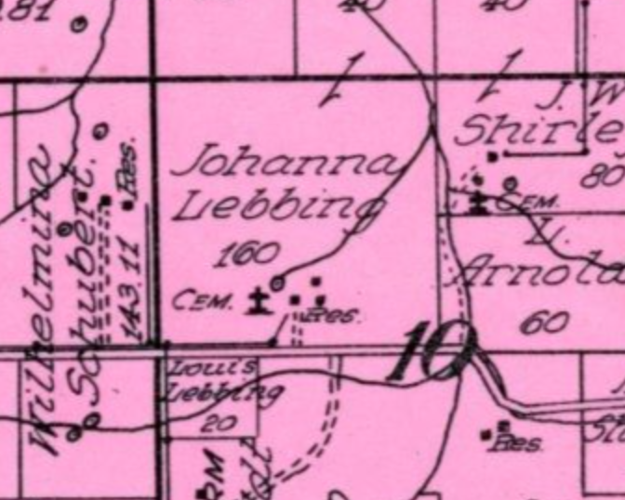
[In] 1918… [Crain] bought the Lebbing heirs’ place, where he now lives, formerly the Herman Lonjers farm. The substantial farm house was erected more than 50 years ago, and is in good condition. Nearby is the grave of Marinus Lonjers, surrounded by an iron fence and neatly kept. The headstone notes that Marinus Lonjers was born March 2, 1827, and died on June 28, 1874. This farm has 270 acres of bottom land, the rest being upland, and has two sets of improvements. There are two fine springs on the farm, providing an inexhaustible supply of water. Mr. Crain raises registered Hampshire hogs.
Marinus Lonjers was one of the founding members of the German Evangelical Lutheran Church in Clarks Fork. A record states that he was buried on private land because he committed suicide and could not be buried at the church cemetery. His son, Herman Lonjers, died in 1912 and was buried in Trinity Lutheran Cemetery, where his tombstone still stands.
The Lanjers/Lonjers name shows up on maps identifying private family burial plots and that revelation helped narrow the possibilities for the burial mound’s location.

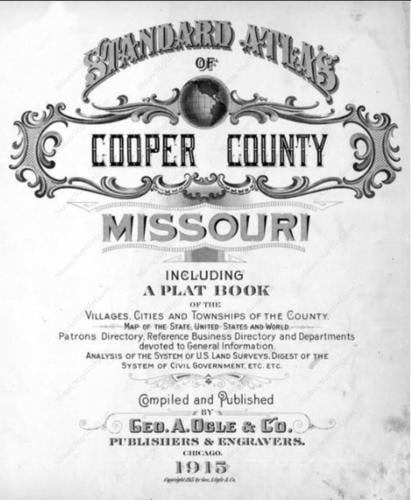
An entry in Cooper County records indicates county plat books (atlas maps) show a cemetery on the property, on the Lebbing land in 1915.

Cooper County’s Recorder of Deeds added to the facts by sending records for the area from the 1930s to the present.

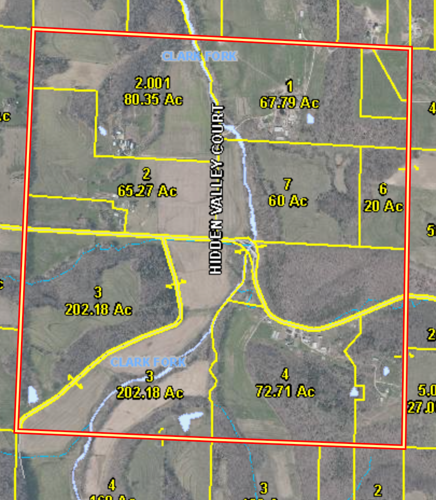
But the original farm has been parceled, so following a map to a single, standing home once owned by J. D. Crain and that front porch view of five white oaks isn’t possible. However, communication with a Mennonite farmer in the area suggests the main elements of the story are true: the farmer (who does not want to be identified for this story) confirmed to LakeExpo that he found the little graveyard on a hill. He also found stones laid-out in a "house foundation" orientation nearby. Could that have been the Crain home?
Still, there’s not a strong enough point of reference to use in a search for the box of bones and seven artifacts that Crain supposedly reburied near his porch: it would require a massive excavation project, which could potentially violate state or federal law if embarked upon without proper permissions.
Even if the box and bones were found, it wouldn’t rule out an elaborate hoax. After all, the Piltdown Man, announced in 1912 as the Missing Link, was proven to be a hoax 41 years later. The human will to believe has often overshadowed archaeological and historical evidence, so someone more familiar with Missouri’s indigenous people, mound burials, and archaeology was consulted.
Eric Fuller, resident archaeologist at Smallin Cave and Ph.D. candidate studying Missouri’s indigenous tribes, listened to the details of this story of phantom bones. In a subsequent telephone call, Fuller said he doesn’t believe Mr. Crain’s newspaper story is a hoax. Fuller thinks the artifacts found are not petrified hearts as Crain imagined; they are more likely hammerstones or handheld stone hammers, used to cut through leather, grind nuts, or chip pieces of flint to make arrow heads.
Fuller suspects the mound is much older than 100 years, however. Small burial mounds are more characteristic of cultural practices as old as 5,000 to 3,000 B.C. during the archaic period.
Could one of the buried people have been a giant? Fuller notes the Osage dating from the 17th century were observed to be taller than most Europeans, so it’s conceivable that their North American ancestors were tall as well. The earliest men had thicker skulls and larger jaws, but dating the remains requires finding them and testing them. When that day arrives—and before opening the box—Mr. Fuller suggested that archaeologists be invited to an exhumation so that the site might be registered properly and facts can be verified in this Ozarks ghost story.
Until the day when someone pinpoints Mr. Crain’s old front porch, or when sophisticated imaging gives us the ability to peer below the soil, those old bones will wait for the day when their story has a full and complete end.

photo by Al Griffin


