Most people don't think about which ambulance service will be responding when they call 911. They just expect someone to show up.
And many in Miller County may not even realize they live within the Miller County Ambulance District (MCAD) — a tax-funded district that is responsible for ambulance service throughout the entire county, with a headquarters in Eldon and bases in Kaiser, Iberia, Tuscumbia, and St. Elizabeth. There's an ambulance at each base.
So, some voters may be surprised when they see a proposed tax increase on the ballot, during Missouri's municipal elections on Tuesday, April 7.
Jason Elliott, Chief of EMS for the Miller County Ambulance District, admits he doesn't like tax increases.
But Elliott looks at the numbers on a daily basis, and he says the district is between a rock and a hard place. The budget has been cut to the bone, he says, but costs are rising and the district has only two options: raise revenues or reduce services. That could mean removing one of the district's five ambulances from service.
That's why the Miller County Ambulance Board has placed a 1/2-cent sales tax (which translates to 50¢ for every $100 spent) on the ballot.
It will be up to Miller County residents whether they want to raise their own taxes, but Elliott says if the proposal fails, the district will likely have to reduce its number of ambulances. The outlying areas would feel the effects of that the most, Elliott said, noting response times to the county's most rural residents would likely go up.
The Problems: Higher Costs, Stuck Revenues
The district is struggling with a problem that Elliott says many ambulance districts across the state are facing: increasing costs from one side and stuck revenues on the other side. "If a private business had to operate like us, they wouldn’t make it," he mused.
The district purchased its most recent ambulance in 2019, and the vehicles have gone up dramatically since then: a new one is now $350,000, before equipment. With ambulances typically on a 7-to-8-year replacement plan, the district will be needing to buy new vehicles fairly soon.
And as employers across the nation deal with increased wage cost, Elliott admits the district is not competitive. An EMT fresh out of school will make $15.50/hr at Miller County Ambulance. But Elliott says with Missouri's minimum wage increases over the past few years, those EMTs could make that same money in lots of places, and the ambulance district doesn't have the prerogative to just raise prices, like a restaurant or grocery store.
Sure, they could bill-out ambulance services at higher rates, he said, "But it does you no good." Medicare, Medicaid, and insurance companies pay whatever they want, and the ambulance district has no power to make them pay more.
With those entities paying lowball rates and many uninsured individuals simply bailing on their ambulance bills, Elliott says it puts districts like Miller County in a nearly impossible position. "Zero leverage."
"We’re providing a service, and that service is expensive," he explained. State law requires the district to respond to all medical calls, regardless of the person's ability to pay. However, because ambulances are considered a "nonessential service," he said the district is ineligible for most federal and state grants.
In an interview about the district's dilemma, David Stokes, Director of Municipal Policy at the Show-Me Institute, wondered whether MCAD couldn't work harder to collect on those unpaid bills.
Elliott responded that while the district does send delinquent bills into collections, they only represent a small fraction of their total accounts receivable. To illustrate, in 2025, here's the breakdown for billings in the district:
Medicare — 44%
Medicaid — 27%
Insurance — 24%
Self-Pay — 5%
In cases of self-pay patients and those whose insurance only covers a portion of the bill and requires the patient to cover the rest, the district may turn the bill over to a collections service if it goes into delinquency. But in 2025, the amount sent to collections was under $300,000.
Mostly, Elliott says, the district is hamstrung by the low rates paid by Medicare/Medicaid and Insurance. Last year, Miller County Ambulance only saw a collection rate of 56.2% from those providers. In other words, for every $100 invoiced to them, the district was only paid $56.20. That's due to large-scale contract negotiations that the district has little to no power over.
And why not raise rates? "Raising rates does not offset what insurance companies do not cover," Elliott answered, explaining those entities have already decided what they're going to pay for services, and they won't pay more.
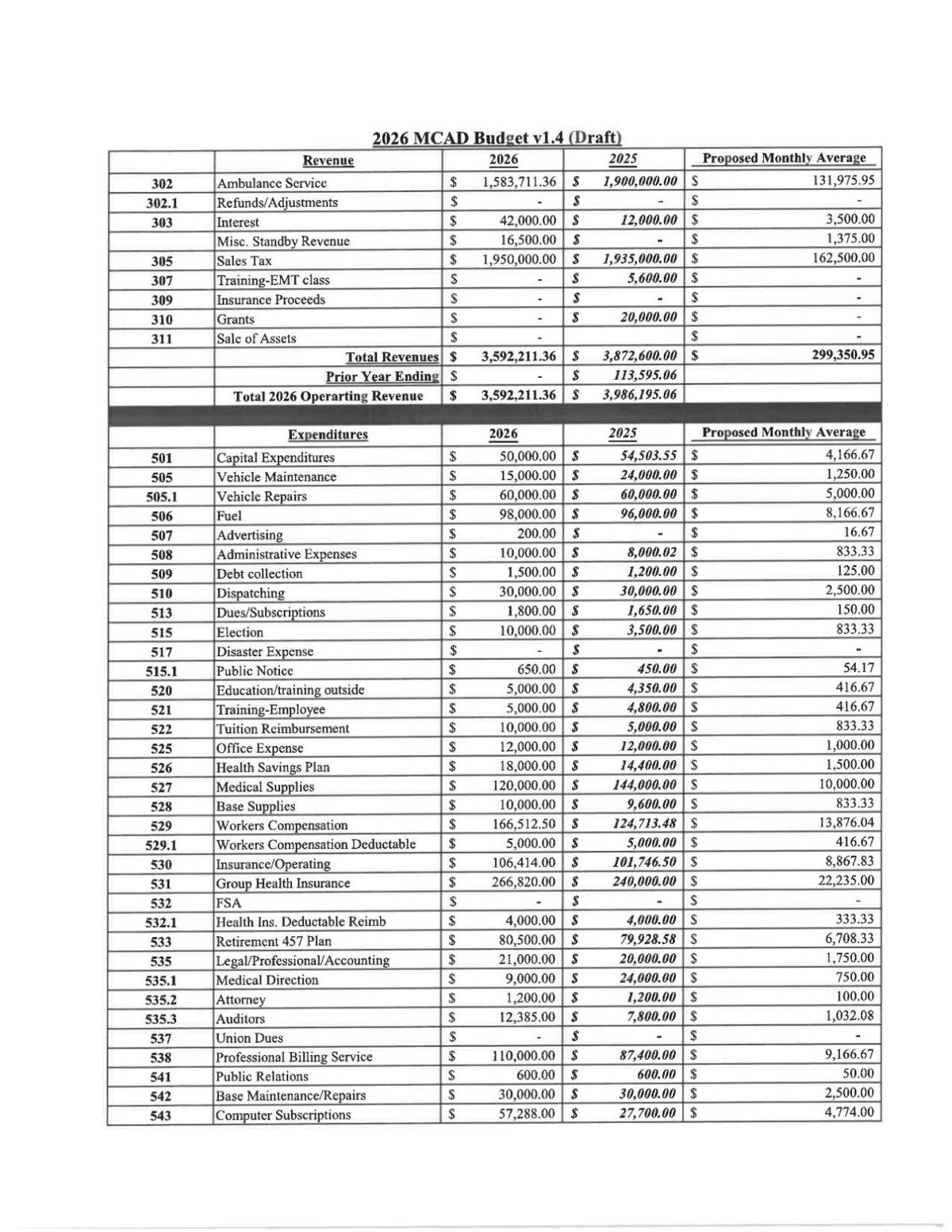
The result is a sizable and widening gap between revenues and the cost to run ambulance service in a county with a growing population. Elliott says the current 1/2-cent sales tax revenues — in addition to whatever the district can manage in billings — isn't cutting it. The district's projected sales tax revenues are $1.9 million for 2026, but Elliott says even with billings, that leaves the district with a $750,000 deficit on the 2026 budget. "We’re bare-minimum, unless you want to start cutting people’s wages," he said.
Alternatives
Stokes also contends the district should consider funding through a property tax, not a sales tax. "We should be funding more of our local governments with property taxes," he said.
He broke down the numbers for Miller County. The assessed property valuation in the county is about $400 million according to state records; so a property tax of 50¢ per $100 of assessed valuation would lead to $2 million in revenue for the district. That would increase the property tax bill by $950 a year for a million-dollar home and $475 a year for a half-million-dollar home.
The difference between a property tax and sales tax is that a sales tax arguably spreads the tax burden to visitors rather than on homeowners.
Though, Stokes points out, a large portion of the real estate value at the Lake is contained in waterfront houses that serve as secondary homes.
Miller County Ambulance District has existed since 1974. And Elliott says once upon a time, the district was funded by a property tax. Voters opted to change that in 2008, moving to a 1/2-cent sales tax instead.
Also, Elliott pointed out, state statute creates an interesting relationship between sales tax and property tax for EMS services.
"When a sales tax is voted upon and passed, the property tax has to be reduced by 50% of the amount of sales tax collected in the preceding year. In 2008 the sales tax was passed with the understanding that property tax would be reduced," he explained.
"The way MCAD is currently structured with the sales tax is comparable and common among EMS services across the state," he said. "Very few are sales tax and property tax supported, and honestly, I cannot think of one off the top of my head that is structured that way."
And while Missouri has over 100 publicly funded ambulance districts, not every community has one. In some places, Elliott said, private ambulance providers will contract with communities to offer services. Those private companies are not under the same requirements as a public, taxpayer-funded ambulance district, he explained, and they can refuse service to anyone they think will not pay. "If you’re a self-pay, they’re not gonna take ya... it’s a business, you have to make money to stay open." Other private ambulance providers only offer transfer services on contract between hospitals, because they're guaranteed to be paid.
Could Miller County Ambulance be merged with another entity — a fire district or another regional ambulance district? Yes, in theory, Elliott said, but it would require several votes by residents in the district — to dissolve the current district, remove the current 1/2-cent sales tax, and form whatever new entity was being proposed.
The Vote, And How They'd Spend The Money
For this April's election, a property tax, district mergers, or privatization are not on the menu. Voters will simply have to choose between increasing the sales tax or — according to Elliott — likely forcing cuts at the ambulance district.
If Miller County voters approve the increase — essentially doubling the estimated $1.9 million in projected tax revenues this year — Elliott said it would create "longevity."
"We can improve our infrastructure. Provide good bases, good quarters for everybody… a good training facility, a good schedule for rotating trucks and cardiac monitors, and stay up to standards. And make sure our wages stay competitive so we make sure we’re not losing people to other services." He said in spite of the county's current wages, some EMTs still find the opportunity appealing. Miller County Ambulance is one of the lowest-paying districts in the region, but the district's employees like the schedule — 2-days on, 4-days off (48/96). "And we have a good atmosphere, a family-style atmosphere," he said. But employees also know they could make more elsewhere. "And right now I can’t compete with that."
The ambulance board issued the following statement related to the proposed tax increase: "Emergency medical services are a lifeline for Miller County residents, and demand for ambulance services continues to grow each year. This tax increase is essential to ensure the Miller County Ambulance District can maintain fast response times, retain highly trained paramedics, and invest in the equipment and resources needed to serve our community. When seconds matter in an emergency, our residents deserve a system that is fully prepared to respond."
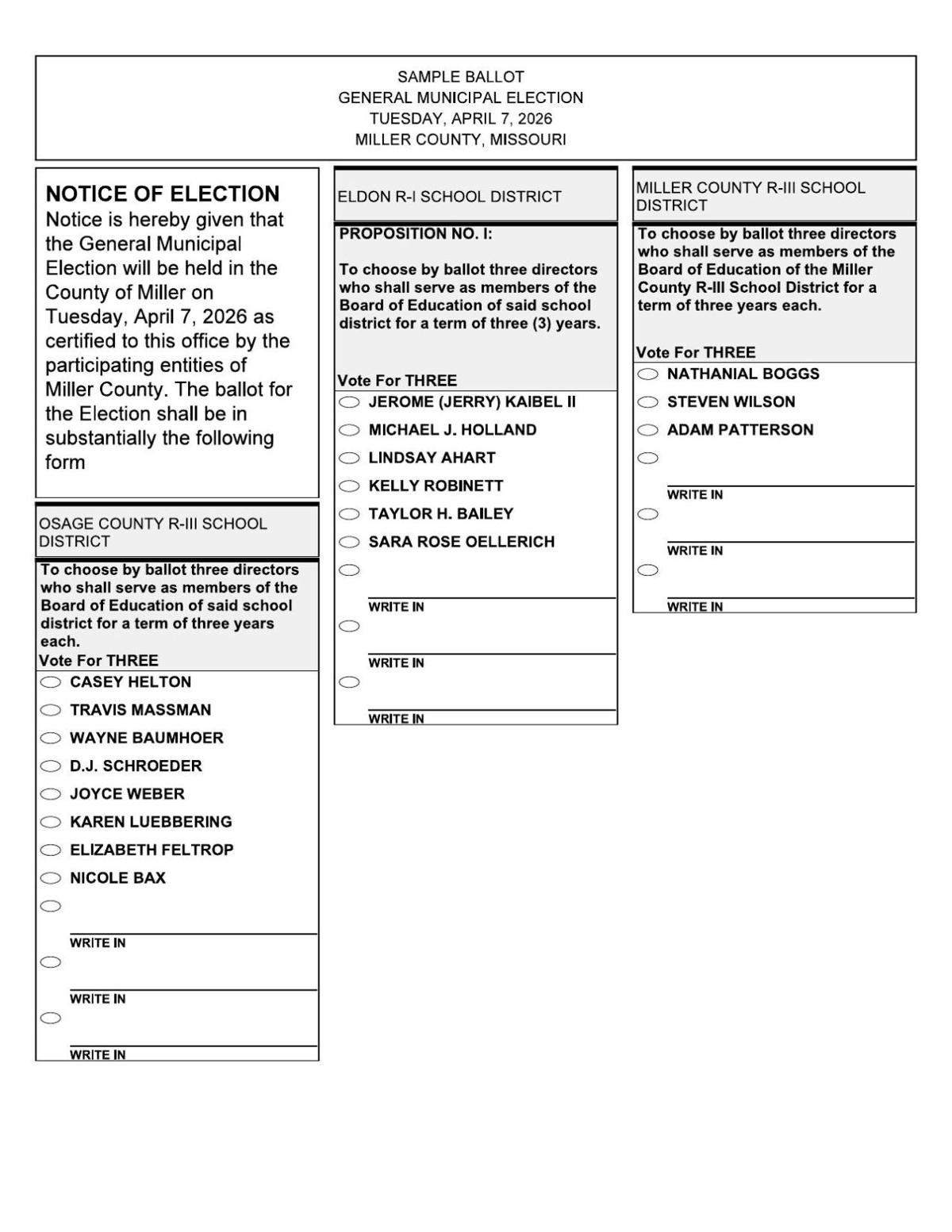
Municipal elections will be held on Tuesday, April 7. View the sample ballot for Miller County, below: