
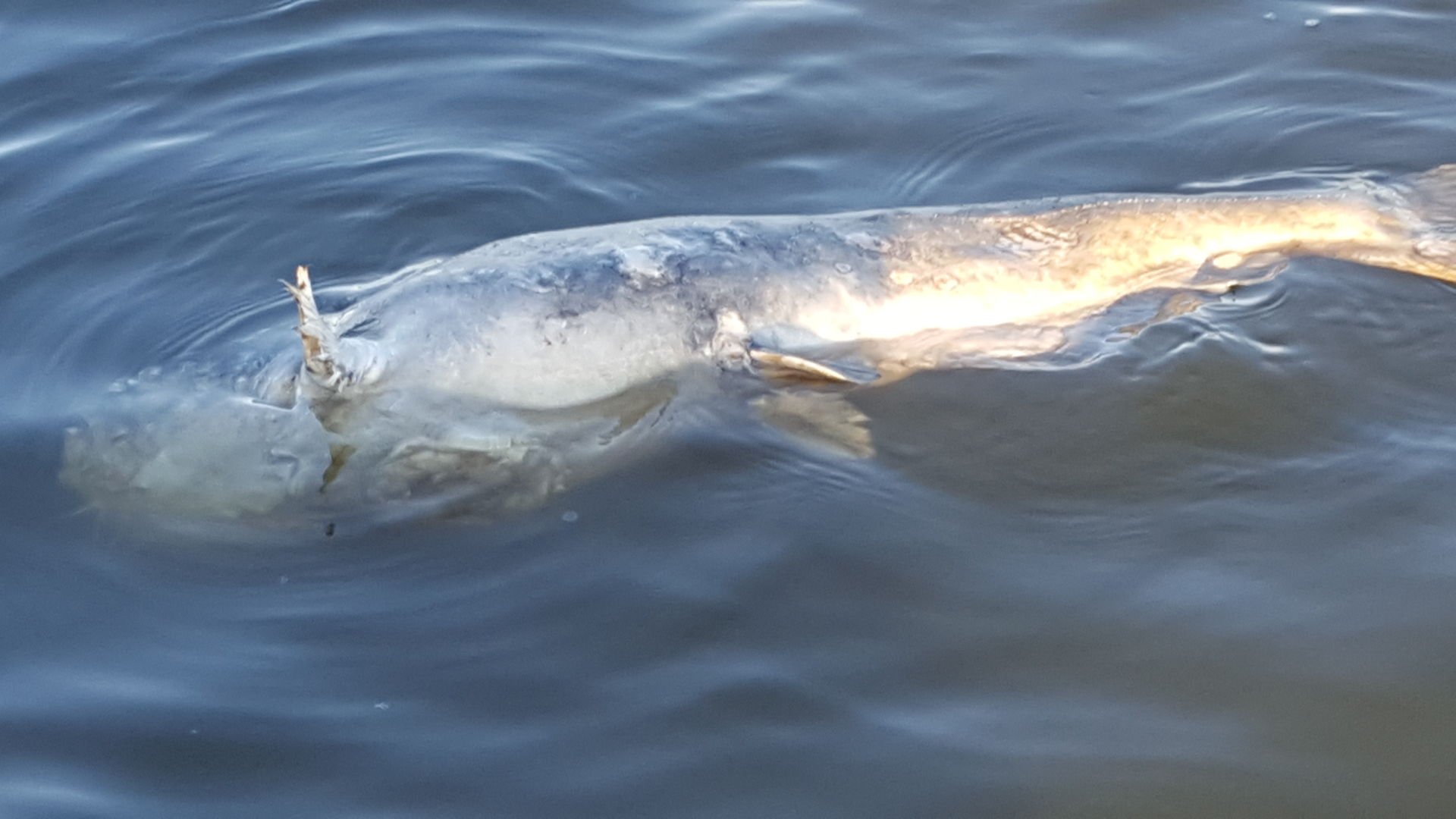
Fish were pushing up daisies quite a bit in June on Lake of the Ozarks, according to a Missouri conservationist. Greg Stoner, Fisheries Management Biologist for the Missouri Department of Conservation, says three separate "kills" or "die-offs" struck pockets of fish at the Lake, and left boaters wondering what was going on.
The first of the fish to go belly up were in the Lower Glaize Arm beginning June 10. A short time later, a larger die-off showed up in the Gravois Arm. A third die-off also showed up between the 60-70 mile markers, but was smaller and only seemed to affect young shad. According to Stoner, the die-offs usually only last two or three days.
The Gravois Arm sees this kind of thing every year, but conservationists say the extremely hot weather combine with lack of rain in early June was a recipe for more die-offs.
Fish sometimes die in groups because of a fish-specific bacteria or disease, which conservationists say the Lake of the Ozarks saw in 2017 (fish-specific diseases pose no risk to humans, experts emphasized). Read more about the 2017 die-off. But experts say recent floating fish were essentially asphyxiated due to a natural phenomenon in the water. To explain, it helps to understand the changes a body of water like Lake of the Ozarks goes through annually. The recent warm weather has fostered algae growth, which can work as both friend and foe for gilled animals like fish, which absorb dissolved oxygen (DO) through their gills.
Just like any other plant, algae needs nutrients and sunlight to grow. When it’s growing, it photosynthesizes, or takes in sunlight to produce its food, and it will also absorb carbon dioxide (CO2) from the water and release oxygen (O2), increasing the dissolved oxygen levels in the water around it. However, algae can suck oxygen out of the water when it dies because as it dies it consumes the dissolved oxygen. If something stops the growth of a large amount of algae, like a few cloudy days in a row cut off sunlight, then a large amount of algae can die off and lower the amount of DO available for fish.
The lack of rain up until recently means nutrients that are normally flushed out of the Lake through the dam have been building up in the water. In shallow waters, the water heats up quickly, and when that combines with a high nutrient content, it fosters the perfect place for algae to grow. “It's like a garden, it just explodes,” said Craig Gemming, Fisheries Regional Supervisor for Missouri Department of Conservation.
So algae flourishes for awhile; but then when it dies quickly, DO levels plummet and it has a domino effect on fish, who begin to die too.
Gemming emphasized that this process is natural and happens every year. What is abnormal is the timing of this die-off. “This type of die-off usually occurs in late July or August,” he said.
No matter when it occurs though, the fish killed from low amounts of DO in the water are perfectly fine for other animals to eat: they continue to feed the food web as raccoons, possums and turtles take advantage of the die-off.
While die-offs are normal for many lakes and ponds, they can be shocking for Lake-goers to see, especially because the fish that die first tend to be large. “Usually larger fish are affected first because they need more oxygen to survive,” Gemming explained. Since smaller fish can survive on low amounts of DO, they can survive these natural cycles. And while recreational boaters are simply struck by the bizarre look of a local fish die-off, the phenomenon can be particularly alarming for another group: anglers. For them, Stoner has words of reassurance: "It looks like a lot of fish, but it’s a drop in the bucket compared to what’s out there.”
A fourth fish kill was reported by neighbors at the 1 Mile Marker around June 24.


