

Texting while driving? That's now illegal in Missouri.
Missouri's new hands-free law — known as the Siddens Bening Hands-Free Law — went into effect on Monday, Aug. 28.
In short, the law prohibits drivers from using their hands to operate a portable electronic communication device (e.g. - a cell phone, tablet, laptop, video game device, or even... a pager).
Specifically, the law says drivers may not:
• Hold or physically support an electronic communication device
• Write/send/read any text-based communication on an electronic communication device
• Make any communication that requires the use of their hands
• Visit a website or type anything at all on the keyboard
• Watch a video
• Record a video
Violations can land the driver with a $150 fine the first time, $250 the second time, and $500 after that. Anyone who hurts someone in a crash while breaking the new hands-free law could face criminal charges as a result, up to a felony depending on the severity of the harm caused.
However, legislatures figured on a learning curve. So between now and Jan. 1, 2025, law enforcement are not permitted to issue citations for violations: the law says they may only issue warnings until then.
Exceptions
Law enforcement officers may not stop a driver solely for a violation of the new law.
The law doesn't apply to law enforcement officers or operators of emergency vehicles while performing their duties.
The law doesn't apply to radios or built-in stereo systems for the vehicle.
Drivers can use voice-activated devices to make calls or send messages.
Drivers can use phones to access/view a map for navigational purposes.
Devices whose sole purpose is to monitor vehicle activity are exempt.
Commercial vehicle operators have certain exemptions, including the use of permanently-installed message-displaying devices.
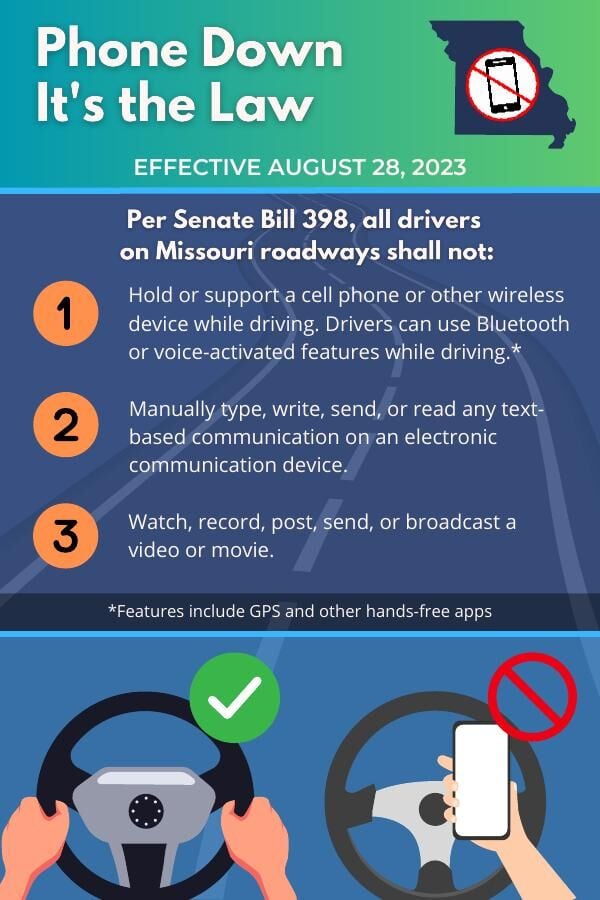
The legal summary of the new law is below:
OPERATION OF MOTOR VEHICLES WHILE USING ELECTRONIC COMMUNICATION DEVICES THE HANDS FREE LAW (Sections 304.820 and 304.822 RSMo)
This act repeals the current prohibitions against operation of motor vehicles while using hand-held electronic wireless communications devices (Section 304.820 RSMo), as defined by law, and enacts different prohibitions in lieu thereof (Section 304.822 RSMo).
The act creates the "Siddens Bening Hands Free Law," which prohibits a number of uses of electronic communication devices while operating motor vehicles, as detailed in the act. Among other restrictions, operators of motor vehicles can no longer physically hold or support, with any part of their body, an electronic communication device; write, send, or read any text-based communication; or make a phone call without the use of the hands-free or voice-operated feature or function.
The act specifies penalties for violations of these provisions, including enhanced penalties for repeat offenders, violations occurring in a work zone when workers are present, violations occurring in a school zone, and violations that are the proximate cause of property damage, personal injury, or death.
Law enforcement officers who stop a noncommercial motor vehicle for a violation of these provisions shall inform the operator of the operator's right to decline a search of their device. No warrant shall be issued to confiscate or access an electronic communication device based on a violation of these provisions unless the violation results in serious injury or death.
Violations of these provisions shall not be used to establish probable cause for any other violation, and the provisions of the act shall be subject to racial bias reporting as required by law.
This act preempts local regulation of the use of electronic communication devices by the operators of vehicles.
Prior to January 1, 2025, a law enforcement officer who stops a noncommercial motor vehicle for a violation of these provisions shall not issue a citation for the violation, and shall only issue a warning.
No person shall be stopped, inspected, or detained solely for a violation of these provisions.
For a detailed list of the restrictions and exceptions to the Siddens Bening Hands Free law, refer to the Senate Bill 398 link above.


