
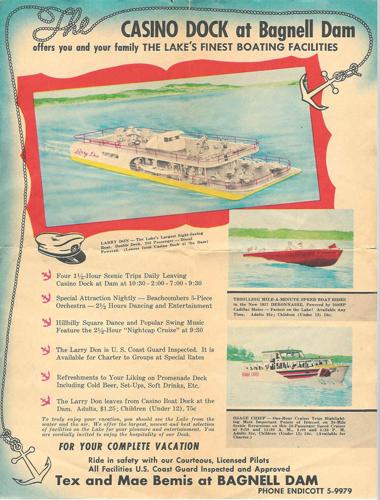


To hear some tell it, the Lake has already had one. In the 1930s, Lakeside Casino was built by Union Electric after finishing the dam. The venue offered visitors restaurant and cafe dining with a view of the Lake and new dam. The Lakeside Casino was home to a restaurant and dock and later became known as Casino Pier. Drawing an eclectic group of folks for many years, one of the first chefs at the restaurant, Larry Albright, was known to drive his Cadillac around on sweltering summer days with the windows rolled up so folks would think he had air conditioning. Casino Pier was also home to the Captain Larry Don excursion boat, which cruised for decades on the Lake of the Ozarks as an event and party boat.

Built on the budding frontier of the Lake of the Ozarks, Lakeside Casino was not a public or legal gambling location, but especially in those early prohibition days, plenty of things are rumored to have happened behind closed doors.
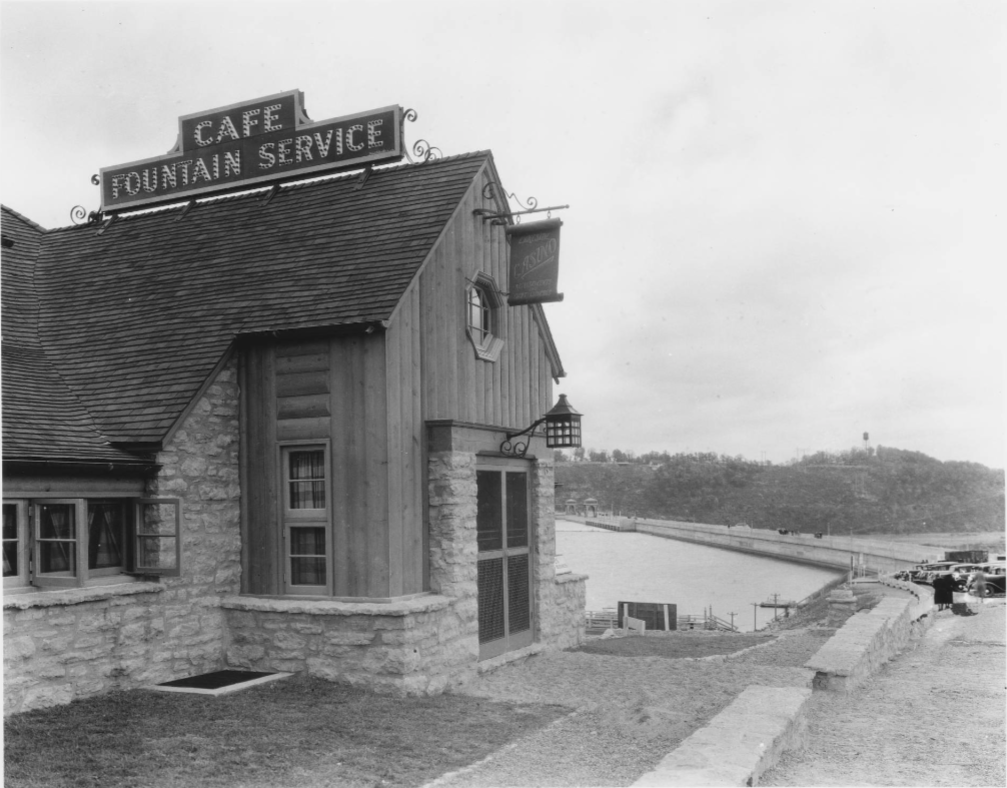
Trefts, Charles, Charles Trefts Photographs (P0034). P0034-2224. The State Historical Society of Missouri, Photography Collection.
Lakeside Casino in the 1930s was rumored to be a refuge for scandalous activities, hid in the shadows away from the cities. In fact, at one point while dam construction was in progress, Union Electric paid the Miller County Sheriff’s department to staff 35 deputies at an area near the dam that housed laborers. The site was saturated with bootleg liquor, gambling and “vice.”
A Lake of the Ozarks casino has been pursued multiple times since then. In 2002, the Osage Indian tribe explored the possibility of putting a land-based casino at Lake of the Ozarks, but community leaders and local pastors stood against it, citing practical as well as moral arguments. Some eighty years after the construction of the Lake’s first definitely-not-a-casino Lakeside Casino, in January 2020, Missouri State Rep. Rocky Miller (R-124) proposed a bill that would have offered the chance for casino gambling at (though not on) Lake of the Ozarks. A local group of investors says a casino on the Lake is “inevitable.”
Decades of drama make perfect storytelling material, and the writers of the Netflix series Ozark, clearly saw the opportunity. Plot points in Ozark seasons two and three follow main characters Marty & Wendy Byrde’s shady maneuvers to develop a casino on the Lake. For the Byrdes, this could be an easy way to launder money for a Mexican cartel. Ozark season three launched as Miller’s bill refused to die in the Missouri legislature. Fans of the Netflix series began to wonder: “Is fact inspiring fiction? Or vice versa?” Is Ozark mirroring reality?

The short answer: yes, but with ample artistic license. Before a casino can be built—in reality, or in the Emmy-winning show—casino investors must overcome three barriers:
1) A state cap of 13 casinos
2) A rule requiring water-bound casinos
3) A coveted (and not guaranteed) operating license from the MO Gaming Commission
Here’s how Ozark’s plot compares with the real-world challenge of bringing a casino the Lake...
The Casino Cap
FICTION: Season two of Ozark saw Wendy glad-handing politicians at prayer services and luncheons as she lobbied to pass necessary legislation, to raise the state’s casino cap from 13 to 14. Partnering with Charles Wilkes, the two resorted to some less-than-ethical tactics to sway the vote and—in the end—successfully raise the cap.
FACT: There is indeed a limit to the number of casinos permitted in Missouri; it is capped at 13. The casino cap is codified in the constitution and cannot be changed by the legislature alone; it must be voted on by citizens. The legislature can place an amendment on a state ballot, or any private group can do so through a Citizen’s Initiative Petition (CIP). A CIP bypasses the Missouri legislature and puts a constitutional amendment straight to the voters. Legislative processes in real life can be tedious, so Ozark writers streamlined the process to speed up the storyline.
Float Or Flop
FICTION: In Ozark, a casino is legal if it sits on the waters of—or a tributary to—the Missouri River. As the Lake of the Ozarks is the result of damming the Osage River, and the Osage River feeds into the Missouri, the Lake of the Ozarks is considered a tributary to the Missouri River.
FACT: While it’s true Missouri casino law does relate to rivers, Ozark creators fudged the details a bit. A 1994 constitutional amendment allowed “games of chance” to be played on boats on the Mississippi or Missouri Rivers. The idea was: these would be floating excursions with gambling diversions.
One wonders whether Ozark writers saw the irony of making a riverboat casino the setting for money laundering, drug deals, KC mobster meetings and cartel kidnappings. When the Missouri gambling amendment was originally dreamt up in 1991 it limited games of chance to the river in hopes of keeping the gambling experience quaint and historic: an event where Mark Twain’s words might echo through the air as people cruised the Mighty Mississippi, rolled the dice and had a grand ole’ time.
But casino developers did what they could only have been expected to: they found loopholes. In reality, Missouri’s riverboat casinos are far from quaint excursion vessels. They are enormous “floating” buildings. In 1998 an additional amendment allowed the floating structures to be within 1,000 feet of the Mississippi or Missouri rivers. Casino KC in Kansas City (built two years before that amendment passed) floats on a manmade pond about 400 feet from the Missouri River. The pond was, of course, constructed solely for floating the casino, and the entire project cost about $110 million.
Rocky Miller’s House Joint Resolution 87—the bill that would have offered the chance of casino gambling at Lake of the Ozarks—died after a tenacious run in 2020. HJR 87 would have asked voters to add the Osage River below Bagnell Dam to the list of Missouri waterways on which casinos are permitted. It would not, however, have allowed a casino on Lake of the Ozarks.
Missouri Gaming Commission
After their successful political machinations, the Byrdes’ final challenge before launching their casino is to obtain a coveted license from the Missouri Gaming Commission. Things get even shadier, because (why not?) the KC Mob is involved.
FICTION: In the world of Ozark, the Missouri Gaming Commission and the KC Mob are at odds. The Mob agrees to help Marty & Wendy lift the state’s casino cap; in exchange, Marty and Wendy must build and run the new casino with union workers. Once the deal is done, however, the Byrdes meet resistance from the gaming commission. One commissioner supporting the “Right-to-Work” agenda offers to make it all go away, if the Marty and Wendy betray the union and the Mob. The plot thickens!
FACT: The Missouri Gaming Commission does exist and is, in fact, responsible for handing out licenses to qualified casinos, although they have not handed out a license since 2012 when Isle Casino (now Century Casino) Cape Girardeau opened.
As for the more dubious parts of Ozark’s story? Well, the Lake does have a rumored history of illegal gambling and shady political connections. In addition to the Lakeside Casino from the 1930s, there’s Louis Egan, the Union Electric President who oversaw the building of Bagnell Dam. In 1943, Egan was found guilty of demanding kickbacks from lawyers and contractors, which he then used to buy-off politicians and newspapermen, and enrich himself. Egan was fined $10,000 and spent two years in prison. The whistleblower? A Union Electric VP fired by Egan, who went to a journalist with an axe to grind and a story seemingly made for television.


