

LAKE OF THE OZARKS, Mo. — With waters still warm from the summer sun, freshwater jellyfish are once again getting attention at the Lake.
KRCG recently reported a family swimming off their dock at Lake of the Ozarks noticed what one of them thought thought was plastic in the water. The family caught and released several jellyfish last weekend.
Though the jellyfish’s presence here is for the most part innocuous, there is a possibility that it could have an effect on the fish population during a bloom.
Freshwater jellyfish eat microscopic organisms, worms, and even larval fish. Their hunting tactic consists of swimming gracefully upward until they reach the surface of the water. They then float down through the water column with tentacles extended to capture their prey. It is unclear what impact they have on the productivity of fisheries, but anglers have reported decreased catches during large blooms.
And though they are non-native, freshwater jellies are not completely devoid of predators. While most fish are generally uninterested, crayfish and turtles seem to find them appetizing.
Not much is known about what environmental factors trigger jellyfish blooms. Their appearance has been described as sporadic and unpredictable. Their numbers may swell in a body of water one year, and then not return for many years, if at all.
The best time to look for jellyfish at the Lake is from July until late September, when surface water temperatures reach 80 degrees. In a good jellyfish year, they may be as numerous as snowflakes on a wintry Ozark day.
The freshwater jellyfish is known to biologists as Craspedacusta sowerbyi. Like all jellyfish, it possesses stinging cells along its tentacles. And like all jellyfish, it uses these stinging cells to paralyze prey and ward off predators. However, unlike some of the species’ notorious cousins, there is no conclusive evidence to suggest that freshwater jellyfish stinging cells are dangerous to humans.
Jellyfish have a two-part life cycle. There is a medusa, or free swimming stage, and a polyp, or attached stage. In jellyfish the medusa is the commonly visible stage, though the medusa of the freshwater jelly is only about the size of a quarter when fully grown. It has an umbrella shape with a fringe of up to 400 tentacles and is translucent in appearance.

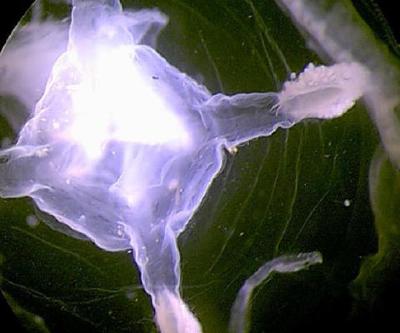
Dorsal (aboral) view of a female jellyfish about to release eggs. Note the cup shaped dorsal surface of the gonads on the perradial canals. Lisa Gershwin photo.
Freshwater jellyfish are sometimes misidentified. Compare photos of any specimens found with those at www.freshwaterjellyfish.org
The polyps are inconspicuous and live in colonies attached to tree stumps, rocks, or submerged plant roots. Polyps reproduce by budding. In this process, new individuals break off from the parent. This usually produces more polyps, but when conditions are right, budding can produce free-swimming medusae. A medusa will be either male or female and reproduces in a more conventional manner: eggs are fertilized and settle to the floor to become new polyps.
There are two theories as to how this non-native species made its way to North America. The first places the blame squarely on our love of flowers. This notion suggests the freshwater jellyfish originated in the upper Yangtze River basin in China. However, in the late 1800s, the jellyfish was discovered in water lily tanks in London’s Regents Park, having presumably arrived in the polyp stage on the roots of the imported flowers. There are no specific records as to how the freshwater jelly made its way from London to North America, but one could assume that it spread with the trade in water lilies.
The second theory is that the jelly originated in South America and made its way north in the bilge water of ships.
Regardless of how it got here, the species was found in Pennsylvania by the 1880s, and the first official record of a freshwater jelly in Missouri came in 1930. Despite this long history, most people are surprised to learn of the existence of jellyfish in Missouri waters. To date they have been reported in all but 4 of the lower 48 states, and occassionaly a new report of a fresh sighting surfaces at the Lake of the Ozarks.


