




Conscientious parents who would never let their children go boating without life vests often don’t think twice about letting them jump off their dock into the Lake.
But that leap into the water could bring about an unimaginable tragedy.
That’s what happened at Lake of the Ozarks during the busy Independence Day holiday in 2012, when a 13-year-old girl and her 8-year-old brother were swimming near a private dock. Suddenly, they began to scream. By the time the siblings were pulled from the lake, they were unresponsive.
Both children were pronounced dead after being transported to Lake Regional Medical Center. About two hours later, in Cherokee Lake in Tennessee, a 10-year-old died and his 11-year-old friend was mortally injured in a similar manner. During the same week, a 26-year-old woman also died at Lake of the Ozarks.
Their deaths weren’t typical drownings. In all five cases, 120-volt AC leakage from nearby boats or docks electrocuted the swimmer. This often-unidentified killer is called Electric Shock Drowning, or ESD, and these deaths were entirely preventable.
“That holiday weekend in 2012, I think, opened a lot of people’s eyes about the potential danger of electrocution on the Lake,” said Dave Hotz of Dock Realty at Lake of the Ozarks. “In my business listing docks for sale, I see a lot of scary wiring on some of them.”
The problem only grows worse during flood conditions. Even properly wired docks can become damaged when struck by debris and waves. The damage that occurs when the Lake is at or above flood pool might go undetected while residents stay off the Lake. But when the water recedes and the temperatures warm, the afternoon swim off the deck could have catastrophic consequences.
Hotz has an answer for those concerned about the safety of their family and friends. After the local electrocution deaths in 2012, he partnered with John Figura who has an electrical engineering degree, and put his own computer engineering degree to good use as they began working on a device that would warn people of hazardous electricity in the water.
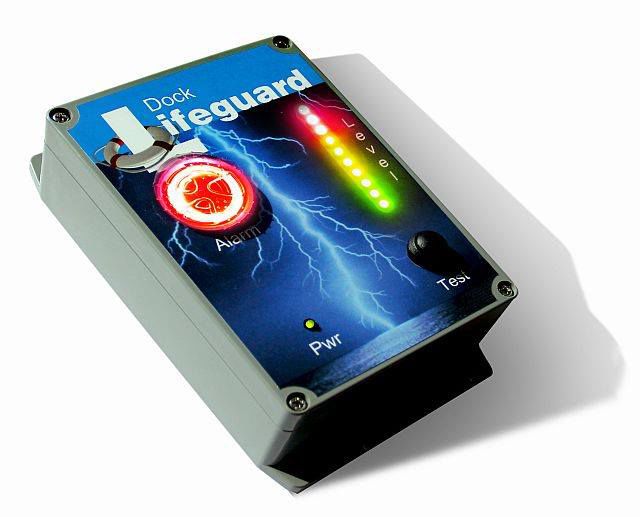
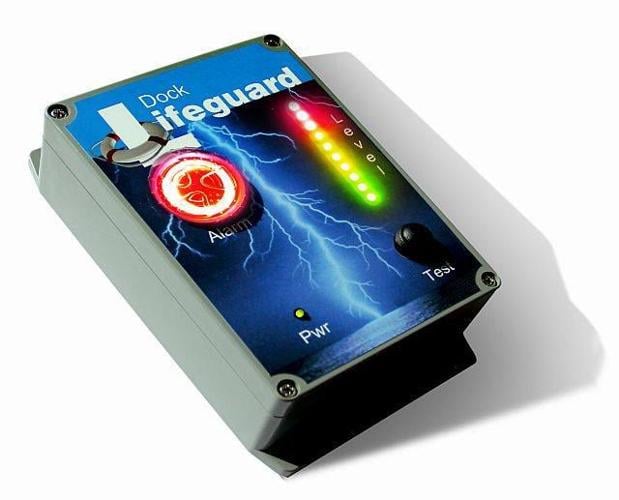
The result was Dock Lifeguard, a device that detects electricity on a dock and in the water within about 40 feet of the dock. When hazardous electricity is detected, the device sounds an alarm and flashes a bright strobe.
“Electricity can’t be seen. It can’t be heard,” said Hotz. “Dock Lifeguard provides a visual and audible warning if hazardous electricity exists around a dock. Just because your dock has been inspected and checks out, doesn’t mean your neighbor’s dock isn’t sending current into the water.”
The stray electricity from a frayed wire or a faulty ground will find its easiest ground source. That could be a properly wired and maintained dock. The water around a dock could be carrying lethal amounts of electricity even if the source is hundreds of yards away.

photo provided
The solution to this hazard, short of keeping people out of the water, is for every boat and dock owner to make every effort to comply with safety standards established by the American Boat and Yacht Council (ABYC). ABYC standards require an equipment leakage circuit interrupter (ELCI)—similar to the ground fault current interrupter outlets in modern homes—to be installed in the shore-power circuit. It’s recommended that older boats be inspected and brought up to current ABYC shore-power standards. The National Fire Protection Association and National Electric Code also offer guidance to prevent ESD at marinas. But awareness remains low, and many dock owners simply aren’t as diligent as they should be.
So how do families protect themselves and their friends from this potential silent killer?
Hotz says Dock Lifeguard can truly provide peace of mind. It uses a sensing probe to provide a signal to the computerized base unit, which sounds an audible alarm and triggers a flashing strobe to indicate detection of current in the water. The sensor will detect voltage on your dock and in the water around your dock.
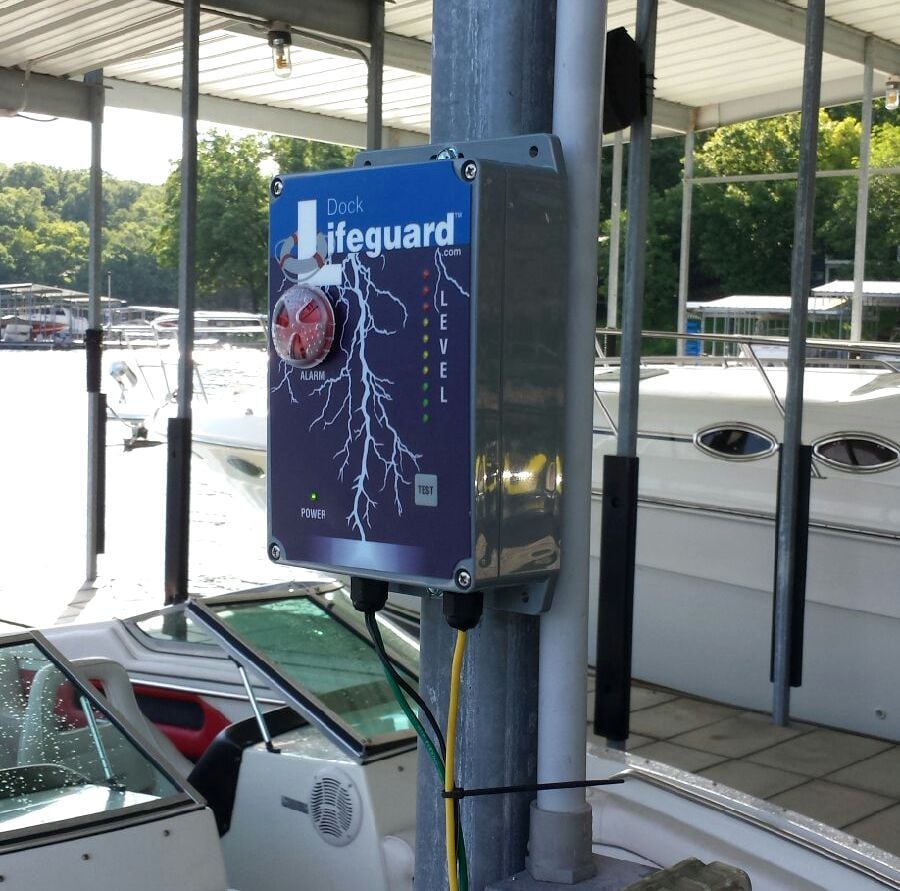
photo provided
Hotz said the Dock Lifeguard can sense stray voltage as low as 0.15 volts and triggers an alarm at around 3 volts. Typically, electricity as low as 6 to 8 volts can become lethal, depending on the person. Even if a dock is protected by safety measures life GFCI outlets, electrified water might be generated from another source, such as a faulty generator on a boat. In such cases, dock circuitry would be unable to detect the charged water.
“As an example, I had a report of a Dock Lifeguard alarm leading to tracking down stray electricity that was being fed by a transformer that was hit by lighting,” Hotz said. “The lightning fused the neutral wire and ground wire, and the voltage came back on the safety ground that fed it to the dock. No GFCI were tripped on the dock, but there was 27 volts of electricity on the dock frame.”
Hotz said there have been reports at the Lake of the Ozarks where an electrical source was traced to faulty wiring on a dock 300 yards from where the stray current was detected. That’s why Dock Lifeguard is so crucial. The unit detects stray electricity around a dock, regardless of its source.
Dock Lifeguard could have made the difference for 15-year-old Carmen Johnson who drowned in April after being electrocuted at the family’s boat dock on Smith Lake in Winston County, Ala. Since then, Carmen’s parents, Casey and Jimmy Johnson, have made it their mission to educate the public about electric shock drowning.
“I truly believe with this device installed my daughter would still be here today,” Johnson wrote to Hotz. “Although there is no substitute for keeping a close check on your wiring or even having no wiring, this device can and will save lives.”
A customer at Lake of the Ozarks explained the peace of mind she derives from having Dock Lifeguard installed on their dock on Woodhaven in Four Seasons.
“I pray we will never hear the warning alarm, but I have a greater peace of mind knowing it is part of my dock safety program,” the customer, Stacey, wrote to Hotz. “Please continue to promote Dock Lifeguard to all dock owners at the Lake of the Ozarks. Thanks again for helping me to protect my family, friends and other lake lovers.”
If the Dock Lifeguard alarm sounds:
- If you are in the water, do NOT swim toward the dock.
- Swim away from the current and away from the dock. Swim to the middle of the cove and have someone pick you up by boat.
- If you are on your dock, get off the dock and call 911 and your electrician.
- Turn off power off to the dock.
- If a swimmer reports pain, tingling or numbness in the water do not go into the water. Instead, quickly turn off the electrical source to the dock and throw a life ring to the swimmer, row out to them, or, if possible, reach out to grab them.


