
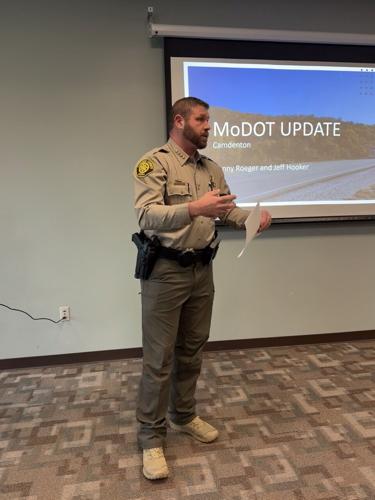

CAMDEN COUNTY, Mo. — Camden County Sheriff Chris Edgar came into office in January 2025 with the intent to clean house. And now, having nearly completed his first year as sheriff, Edgar says his organization is in better shape than it’s been in a long time.
At a meeting with a small group of community and business leaders, hosted by the Camdenton Chamber of Commerce on Thursday, Dec. 11, Edgar detailed many of the changes he’s made over the past 11 months.
Flashbangs, Non-Bulletproof Vests & Grant Money
Edgar says he faced multiple extremely concerning questions when he first took office.
The first: What happened to all those flashbangs?
According to Edgar, 372 flashbangs — explosive devices that emit a loud sound and bright light and are intended to momentarily stun an opponent — were unaccounted for when he took office. He reported them as stolen.
The second: What happened to the grant money?
Edgar says questions had been raised about how certain federal grant funds received by the sheriff’s office had been used. He said he chose to self-report those concerns to the federal government for investigation.
The third: Why are deputies wearing ballistic vests that can be penetrated by the most commonly used bullet?
The most likely bullet a deputy would face while in the line of duty is a 9mm full metal jacket, Edgar said. Yet, his deputies’ ballistic vests were not rated to stop such a bullet. Those ballistic vests have been replaced with more stout vests that offer better protection.
Better Guns & Better Gun Policies
The disappearance of the flashbangs highlighted a more structural problem: their weapons policy was abysmal. Guns, flashbangs, and ammunition were being kept in a locker in the men’s dressing room.
That policy changed. Now, he said, the weapons are all being kept in a separate armory room. The only people who have access to that room are his Armorers — deputies approved for that task and assigned a key. And access to the room requires two keys — in other words, two deputies. The room also has camera-monitoring at all times.
Most of the sheriff’s office’s rifles were not operational when Edgar took the helm this year. In fact, he said some deputies were opting to use their own personal AR-15 rifles while on duty — which was allowed, but not optimal, in part because in the case of an officer-involved shooting, that rifle would be seized as evidence and the deputy would have lost their rifle for quite awhile. One such case occurred this year.
So, Edgar said the department has been liquidating and resupplying. They traded-in guns that were either not operational or were not being used, and have now ordered new rifles from Black Rain Ordnance, Inc., a firearms company based in Neosho, Mo.
He said the department has also moved all deputies to the same handgun style: a Glock 45 (9mm) with green-dot sight. He noted green-dot optics have been shown to double shooter accuracy in high-stress situations, compared to iron-sights.
Edgar also criticized the office’s former firearms certification process: essentially just shooting at a paper target from varying distances. He has dramatically toughened that certification, he said, including requirements for deputies to shoot accurately in more strenuous circumstances. For example, one part of the certification requires them to hit a target while shooting with a rifle out of the passenger window of their patrol vehicle, then they are required to quickly exit the vehicle and hit the target from a different position.
Growing The Force & Improving Their Visibility
Currently the sheriff’s office has 30 deputies, with five or six typically active during a shift. Those deputies have responded to 18,295 calls this year; that’s an average of about 53 calls per day, with a deputy responding to an average of 9 or 10 calls per shift.
Edgar says his office would be fully staffed at 43 deputies, and he hopes to hire into those 13 positions by summer 2026. He says the pipeline is already filled with recruits.
His office has also grown its number of K-9 units to a total of three. And he hired a mental health and wellness director to serve deputies. In past times, he said, if a law enforcement officer indicated they were struggling, “the first thing they would do is take away your badge and your gun… which is the worst thing you can do for a guy.” He emphasized his intent to more carefully attend to the mental health of his force, acknowledging the unique pains and strains that come with such a job.
Edgar also acknowledged the sheriff's office had received requests from citizens in the outlying areas of the county, who wished they would at least occasionally see a visible law enforcement presence in their areas. As a result, he said he has instructed deputies to make rounds through those areas, and his patrol vehicle monitoring system allows him to ensure they are doing so.
Current Challenges? A Full Jail & A Budget Cut
The Camden County Jail — which is administered by and funded by the Sheriff’s Office — is a 130-bed facility. But, Edgar said, during the summer tourist season, it’s not uncommon for them to have 150 inmates. That forces a terrible choice: deciding which are the “worst of the worst” to keep housed in the jail.
To exacerbate the problem, the Missouri Department of Mental Health has been requiring county jails across the state to house more than 500 individuals who have been charged with a crime but deemed unfit for trial. The Camden County Jail is currently holding four such individuals, according to State Rep. Jeff Vernetti, who represents Camden County and also spoke at the event on Thursday. Vernetti says it’s an outrage that the DMH would keep such individuals in legal limbo and on overburdened counties’ budgets — since the department does not compensate the counties for keeping those individuals. And while the average cost to house an inmate is around $100 per day in Missouri (Edgar says it’s about $120 per day in Camden County), Vernetti said because these inmates from DMH often have mental health issues and require additional medication and treatment, it can cost even more. He says he intends to file a bill to address this problem during the 2026 legislative session.
Worse, Edgar says, his office was informed by the county auditor that they would need to cut $3 million from their 2026 budget — $1.5 million from the jail side and $1.5 million from the sheriff’s office side. “All it’s gonna do is hurt our citizens, and I’m not gonna accept that,” he said. However, he added, “I think we have some solutions.”

Commissioner Ike Skelton, who addressed the group after Edgar, agreed. Skelton said the county commission plans to reallocate revenues from a sales tax that was approved by voters in 2007. Skelton says that tax was supposed to be earmarked for Road & Bridge’s budget, according to the ballot language, but in fact about 90% of the revenues from it — more than a million dollars per year — have been going all other departments in the county. Skelton says the commission plans to reclaim those funds for the 2026 budget, with plans to split them between the sheriff’s office and the Road & Bridge department. He also added that revenues from the county’s Use Tax would be reallocated to more heavily fund Road & Bridge and the sheriff’s office.
“The other departments are going to have to figure out how to cut their budgets,” he said plainly, noting most citizens want two things from their county government: good roads, and law and order.
Related Coverage

CAMDEN COUNTY, Mo. — When Brandon Wisdom was arrested in February 2024 and charged with mult…


