
The Freedom From Religion Foundation is demanding Camden County remove two images from the county courthouse.
In a letter dated Nov. 9, 2018, the Wisconsin-based group has requested Camden County remove two religious displays from the Camden County Courthouse in recognition that they “represent an unconstitutional government endorsement of religion.”
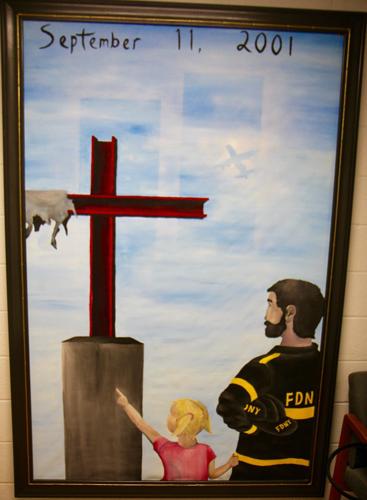
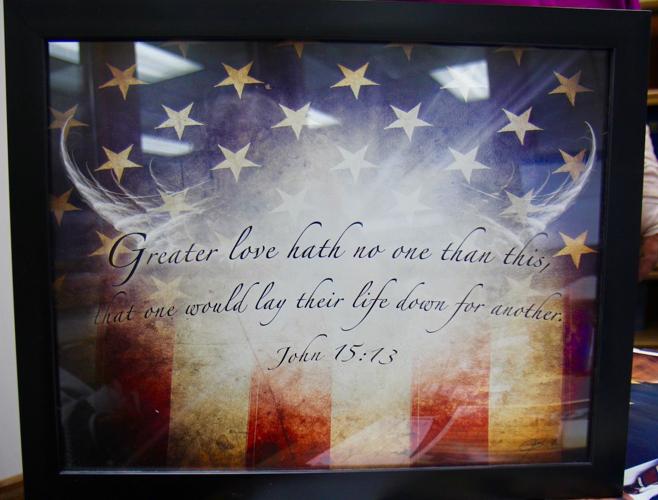
According to the letter, an unidentified complainant in the community alerted the foundation to the displays. The two images at issue are a 9/11 Memorial Painting and a Bible verse.
1. 9/11 Memorial Painting
The Freedom From Religion Foundation (FFRF) says the county must remove a wall-length painting of a scene at the 9/11 Memorial in New York City. The painting is located on the wall of the second floor of the courthouse, across from the elevator. A local artist painted the mural, which depicts a New York firefighter with a small girl who is pointing to a cross at the 9/11 Memorial. According to Camden County Presiding Commissioner Greg Hasty, the painting is of an actual scene that took place at the 9/11 Memorial.
“The World Trade Center Cross,” also known as “Ground Zero Cross,” is a formation of 17 ft. steel beams found by rescue workers among the debris of the World Trade Center in Lower Manhattan, New York City, following the September 11, 2001 attacks. The beam formation is so named because it resembles the proportions of a Christian cross. The Ground Zero Cross is displayed in the World Trade Center Museum along with 1,000 artifacts, a staircase workers used to escape the towers, and pictures of approximately 3,000 victims.
2. Bible Verse With Flag Background
The second display is a picture on the wall in an employee area of the Camden County Clerk’s office. That picture includes the Bible verse John 15:13 -- “Greater love hath no one than this, that one would lay their life down for another.” According to Camden County Clerk Rowland Todd, the picture was added by an employee because it has a red, white and blue stars and stripes background and the office was being decorated in a red, white and blue patriotic theme.
Establishment Clause
The FFRF cited the Establishment Clause, which they say prohibits government sponsorship of religious messages. In the letter they listed multiple cases where federal courts upheld restrictions on religious displays by employees on government property because such restrictions exist to avoid Establishment Clause violations.
The FFRF holds that the county clerk’s office cannot fulfill its mission of serving all members of the community while also sponsoring a message that excludes minority religious and non-religious citizens.
The FFRF requested assurances that the county will provide all citizens with an environment free from religious endorsement by removing the "exclusionary" displays. They ended by requesting the county respond in writing, detailing the actions they will take so that they (FFRF) may notify the complainant.
Commissioner Hasty said he contacted the Department of Labor and was told that an employee has a choice to hang whatever they want in their own private work area.
“Sadly, I have some grave concerns about where our country is headed,” Commissioner Hasty said. “I am a little frustrated with having this type of thing crammed down my throat over and over again, when the documents used in the founding of this nation clearly referenced directory, or indirectly, our Creator." Hasty mentioned the Declaration of Independence: “We hold these truths to be self-evident that all men are created equal, that they are endowed by their Creator with certain unalienable rights, that among these are Life, Liberty and the pursuit of Happiness."
“I hate to see something that is such a big part of the foundation of our country be undermined,” he said. “People have a right to believe, or not to believe, and it is very disappointing that our employees are not afforded the same right.”
Hasty and Todd had not spoken with county legal counsel as of the writing of this article. “If there is something that does not correspond with these individuals’ rights to not have them exposed to these displays in a governmental setting then we will make any necessary changes to comply with federal law as defined by the department of labor,” Hasty said.
The county commission has jurisdiction over the courthouse and the courthouse grounds. “We have not had an opportunity to get together to discuss this, but I will put it on the agenda,” he said.
Todd said that this was not the first complaint of this kind that the county has received.
Separation of Church and State
The U.S. Constitution does not contain the phrase, “Separation of Church and State.” The American Center for Law and Justice explains the phrase originated after the Constitution was written, in a letter from Thomas Jefferson to the Danbury Baptist Association. The Danbury Baptists wrote to President Jefferson in October of 1801 concerning their fear of government restrictions on their ability to continue as a minority religion in Connecticut (“religion” was used in the sense of a denomination of Christianity). [1] President Jefferson responded by encouraging their desire for religious liberty. [2] He agreed with them that officially established, government-mandated state denominations were harmful. President Jefferson mentioned a “wall of separation between Church and State” to protect the church from the coercive power of the government being used to regulate the internal affairs of local congregations. [3]
The First Amendment's Establishment Clause forbids the government from establishing an official religion or denomination. The Supreme Court of the United States has interpreted the Establishment Clause of the First Amendment to mean that government action is unconstitutional if its primary purpose or effect is to advance or inhibit religion (or a particular religious viewpoint), or if it creates an excessive government entanglement with religion. [4]
The Supreme Court noted, in Lee v. Wiseman, that the First Amendment’s two religion clauses “mean that religious beliefs and religious expression are too precious to be either proscribed or prescribed by the State.” [5]
According to an article in the New York Times, Judge Deborah A. Batts of the Federal District Court in Manhattan, rejected the argument of a nonprofit atheist’s group which filed a lawsuit against the operators of the National September 11 Memorial and Museum in 2011 on Constitutional grounds, contending that the prominent display of the cross constituted an endorsement of Christianity, diminishing the contributions of non-Christian rescuers.
Judge Batts wrote that the cross and its accompanying panels of text helped “demonstrate how those at ground zero coped with the devastation they witnessed.” She called its purpose “historical and secular,” and noted that it would be in the “Finding Meaning at Ground Zero” section of the museum, with placards explaining its meaning and the reason for its inclusion.
“No reasonable observer would view the artifact as endorsing Christianity,” the judge said. She added, “The cross does not create excessive entanglement between the state and religion.” She said the plaintiffs also failed to find any form of intentional discrimination or cite any adverse or unequal treatment on the basis of religious beliefs.
Freedom From Religion Foundation's History In The Lake Area: Tipton School District
In 2016, the Tipton School District acquiesced to demands made by the Freedom From Religion Foundation to stop praying at board meetings. The school district also agreed to stop including the song "Blest be the Tie That Binds" at future school sponsored events. The song was part of a Tipton High School Candlelight Awards Program in May 2016. A picture of Jesus that had hung in the school for 70 years was also removed. The picture was donated to the school by a local family as a memorial to a son they lost to polio.
References
Sekulow, Jay, 2018, December 5, Does the Separation of Church and State really exist? Aclj.org
[1] Letter from Nehemiah Dodge, Ephraim Robbins, & Stephen S. Nelson on behalf of the Danbury Baptist Association to President Thomas Jefferson (Oct. 7, 1801) (on file with Princeton University’s collection: The Papers of Thomas Jefferson, https://jeffersonpapers.princeton.edu/selected-documents/danbury-baptist-association).
Associated Press, 2019, March 9, Judge Dismisses Suit Over Steel Cross at 9/11 Museum, nytimes.com
[2] Letter from President Thomas Jefferson to Nehemiah Dodge, Ephraim Robbins, Stephen S. Nelson, & the Danbury Baptist Association (Jan. 1, 1802) (on file with the Library of Congress, https://www.loc.gov/loc/lcib/9806/danpre.html).
[3] Jefferson ended his letter with these words: “I reciprocate your kind prayers for the protection & blessing of the common father and creator of man, and tender you for yourselves & your religious association, assurances of my high respect & esteem.” Id.
[4] Lemon v. Kurtzman, 403 U.S. 602, 612–13 (1971).
[5] Lee v. Wiseman, 505 U.S. 577, 589 (1992).


