


ST. LOUIS, Mo. — Ameren Missouri, the largest energy-provider in the state, has announced big changes to their future energy generation plans, including an accelerated timeline toward being "net-zero."
The plan is available at AmerenMissouri.com/Clean, along with detailed information about clean energy and energy efficiency programs for residential customers and businesses. The company announced the accelerated timeline in a press release this week.
Highlights of the updated plan include:
• Accelerating Ameren's companywide net-zero carbon emissions goal to 2045.
• Increasing the 2030 carbon emissions reduction target from 50% to 60% based on 2005 levels.
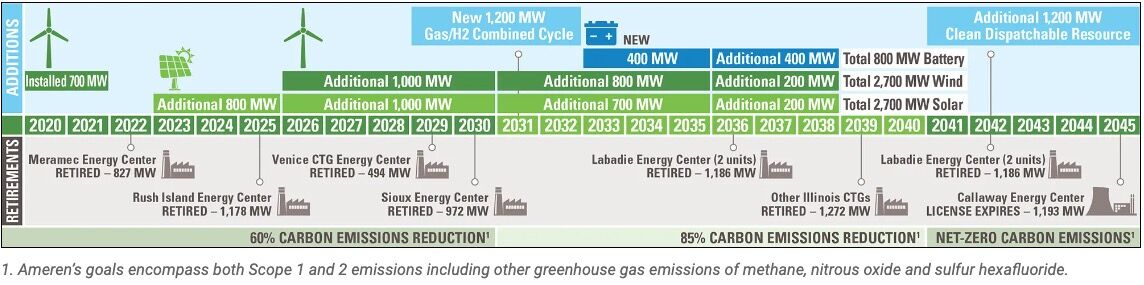
• Retiring three of their four Missouri coal-fired plants by 2030. That will remove more than 3,500 MW from Ameren's coal energy production 2030.
• Adding 2,800 MW of wind and solar generation by 2030, a potential investment of approximately $4.3 billion.
• Adding a total of 4,700 MW of renewable generation by 2040, which reflects a potential investment of approximately $7.5 billion.
• Deploying 800 MW of battery energy storage, representing a potential investment of approximately $650 million.
Ameren Missouri reports its total generating capacity is approximately 10,800 MW; coal plants compose 47% of the company's total generation in Missouri. (In the entire tri-state area of Illinois, Iowa, and Missouri where Ameren operates power plants, about 65% of the company's generation comes from coal, according to SourceWatch.) By contrast, Ameren Missouri's wind facilities generate 699 MW at max capacity and its solar facilities generate 16.2 MW.
The company plans to retire the coal-fired Meramec Energy Center by the end of 2022. That is Ameren Missouri's oldest and lowest-generating coal plant.
The coal-fired Rush Island Energy Center, which generates 1,182 MW and is located south of St. Louis, was originally slated for retirement by 2039. But federal crackdowns on emissions landed Ameren in hot water, and accelerated that timeline to closing the system by the end of this year, according to the Wall Street Journal. But the Midcontinent Independent System Operator (MISO) put a stop to that. MISO is in charge of managing the grid spanning much of the Midwest, and—the Journal reported—the organization warned that shuttering the Rush Island plant so soon could result in rolling blackouts for Midwesterners. Ameren's newest plan includes closing Rush Island by 2025. The litigation over that plant is ongoing.
The coal-fired Sioux Energy Center in West Alton, Mo. is now expected to be closed by 2030.
And the Labadie Energy Center, by far Ameren Missouri's heaviest-hitter when it comes to energy production, will be closed in two phases, with half of it powered-down by 2036 and the other half by 2042, per the new plan. Labadie generates 2,372 MW at max capacity—more than three times as much energy as Ameren Missouri's wind and solar farms combined. It also played a key role during the infamous winter storm of 2021. Known as Winter Storm Uri, it plunged Missouri into lengthy single-digit and subzero temps, froze-over Lake of the Ozarks, and wreaked havoc in southern states, Labadie was key in keeping Missourians' lights on and houses warm. The energy station sits on the Missouri River, but ice damming upstream had threatened the water flow required for cooling the generators. Ameren made-up for that diminished flow by releasing more water from Bagnell Dam, which impounds the Osage River and Lake of the Ozarks. That ramped-up water release boosted power generation through the dam but also sent water downstream to Labadie via the Osage River's confluence with the Missouri River, thus allowing Labadie to continue providing Missourians with energy. Ameren acknowledged a need for reliability in light of Winter Storm Uri, in the company's Integrated Resource Plan.
(story continues below)
LakeExpo Coverage Of Winter Storm Uri

LAKE OF THE OZARKS, Mo. — Lake of the Ozarks has dropped to a five-year low, with the water …

LAKE OF THE OZARKS, Mo. — During February's Arctic blast, Bagnell Dam ran at nearly full gen…
To make up for the gap between the 3,500 MW of energy lost from the coal plants and the 2,800 MW of projected energy gained from the wind and solar farms, Ameren says they plan to lean on new technology, including hydrogen. "To maintain energy reliability and resiliency for customers after the retirement of three coal-fired energy centers by the end of 2030, the company plans a 1,200 MW combined-cycle energy center to be in service by 2031. Plans call for this dispatchable resource to be capable of utilizing a portion of hydrogen fuels and the ability to be retrofitted for carbon capture and storage once those technologies become fully mature. The location of the planned energy center has not yet been determined."
Ameren said they feel confident their plan accounts for spikes in energy needs, saying, "The Company has also performed rigorous analysis to ensure that its new Preferred Resource Plan will deliver the reliable service customers count on. This includes ensuring that the plan meets the expected requirements of MISO's proposed seasonal capacity construct, which considers differences in customer demand and electric resource capabilities on a seasonal basis in addition to the annual summer peak that has traditionally been the focus of resource adequacy."
Ameren also says they plan to help customers reduce their energy needs by continuing their energy-efficiency programs (which include incentives and rebates for more energy-efficient home appliances), expecting to reduce energy needs by more than 1,200 MW by 2030.
In the press release, Ameren explained, "The company also plans to continue robust, cost-effective customer energy efficiency and demand response programs with peak demand reduction of more than 1,200 MW by 2030 and cumulative energy savings surpassing 2.5 million megawatt-hours by 2030. That's enough energy to power more than 220,000 homes for a year. Since 2019 and inclusive of preliminary 2021 data, these programs have saved approximately 800,000 megawatt-hours."
"Our newly updated long-term energy plan accelerates the addition of clean wind and solar energy sources and further reduces emissions by 2030," said Mark Birk, chairman and president of Ameren Missouri. "By thoughtfully transitioning energy generation sources, we continue to get the energy we provide as clean as we can, as fast as we can, without compromising on reliability, resiliency or affordability for our customers."
Ameren acknowledged that their predictions about their ability to generate energy in the future were subject to a wide variety of conditions, including market volatility, cost of resources like coal and uranium, renewable energy requirements from the state of Missouri, and "the impact of weather conditions and other natural phenomena on us and our customers, including the impact of system outages and the level of wind and solar resources."


![[VIDEO]: Ferris Wheel Now Standing Tall At The Oasis](https://bloximages.chicago2.vip.townnews.com/lakeexpo.com/content/tncms/assets/v3/editorial/6/45/645bc455-286b-4556-b486-8f36b333dff4/6ab5949ebf5bf.preview.png?crop=1263%2C1263%2C0%2C60)

![Dinner With THIS View?! Inside 1932 Reserve At Lake Of The Ozarks [FLYTHROUGH]](https://bloximages.chicago2.vip.townnews.com/lakeexpo.com/content/tncms/assets/v3/editorial/b/40/b4047402-5958-4f34-92e1-36da52740fea/6aada39fabf69.preview.jpg?crop=1119%2C1119%2C240%2C0)


