
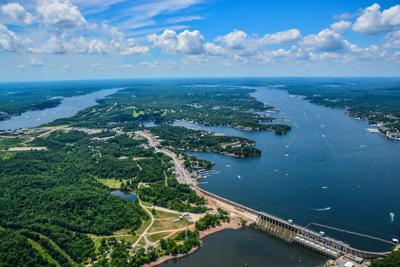
LAKE OF THE OZARKS — A tropical storm that made landfall Tuesday is drenching the Mississippi River Valley and could even bring localized flooding to central Missouri this weekend.
According to the National Weather Service, a cold front moving into central Missouri will likely bring heavy rain and lightning on Wednesday night. But the front is expected to stall over central Missouri as Tropical Storm Gordon moves inland. The NWS noted “the exact storm track and precipitation amounts will likely vary over the next few days,” but said central Missouri could receive several inches of rainfall on Saturday, which may lead to flooding.
On Wednesday afternoon, Lake of the Ozarks’ water level was measuring 658.65 feet of elevation, with minimal discharge flowing through the dam: 1,563 cubic feet per second (cfs). The Lake level target is 659 feet, for this time of year.
Bagnell Dam operators walk a tightrope in pending flood situations: they are governed by rules (established by the Federal Energy Regulatory Commission) about how much they can flood the Osage River, but can lean on standard practices and computer forecasting models to know when they ought to begin taking action.
Bagnell Dam operators watch the forecast closely when heavy rains are expected, but Bagnell Dam Operator Warren Witt told LakeExpo.com, “You never make significant moves based just on a forecast.” Ameren (which owns and operates Bagnell Dam) says dam operators will be making small changes, with slightly increased power generation on Wednesday and Thursday, but will not make any major moves until the rainfall is more imminent.
With the floodgates wide open, Bagnell Dam can pass upwards of 225,000 cubic feet of water per second. That converts to 1,683,116 gallons per second. The worst flood on record at the Lake of the Ozarks was in 1943. During that infamous flood, the dam was operating at 220,000 cfs.
View hourly Lake of the Ozarks and Osage River levels
After massive flooding in late-December 2015 damaged homes and docks around the Lake of the Ozarks area, many people were asking why Ameren had not lowered the Lake of the Ozarks level in anticipation of the forecasted rainfall. Witt explained to LakeExpo.com at the time, “As we know, predictions can often change significantly.” He pointed out if the Lake had been lowered by several feet in anticipation of the rainstorm, but the weather had not behaved like forecasters predicted, dam operators would have been in hot water—with people downstream flooded for no reason, and an abnormally low Lake level without rain to refill it.

LAKE OF THE OZARKS, Mo. — In 2015, the Lake of the Ozarks has seen two of its 10 worst flood…

Homes, docks and property went under water as the Lake of the Ozarks experienced massive flo…


