
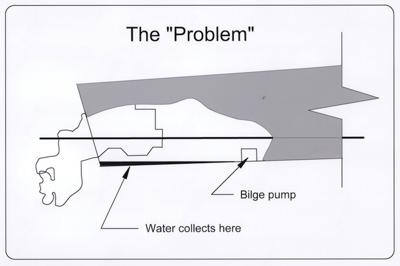
One of my co-workers at the boat store was complaining to me a couple of weeks ago. It seems he had a problem with water collecting in the stern of his boat, under the engine. The boat had a slightly stern low attitude that allowed bilge water to flow aft, under the engine. He had bilge pumps aboard, but they were located in front of the engine. The only way he had of draining the water was to send the crew to the ”pointy end” of the boat so the water would run forward into the bilge pumps.
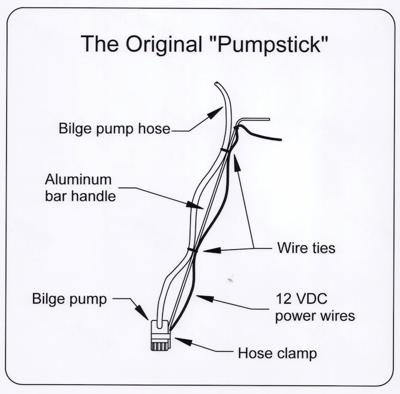
I immediately thought of a gadget I had put together for one of my boats, something I called the “pumpstick”. The bilge on that boat was only a couple of inches deep, too shallow for a regular bilge pump installation. In addition, I had two stern lockers that I could not get to seal properly, even after many tries. These were constantly filling up with rainwater.
I cobbled together a portable pump that I could plug into the cigarette lighter style accessory power socket and move around the boat to pump out these areas. Here’s how I did that project.
I used a small, 360 GPH bilge pump, available for about 16 bucks in most marine stores. I clamped the pump onto a piece of aluminum bar stock with a couple of hose clamps. I bent the bar stock to form a convenient handle and tied the pump wires and output hose to the aluminum handle with wire ties. The wires and hose were long enough to reach any place on the boat.
To keep things neat, I used two-wire duplex cable for the power cord. Take extra care to make sure the connection to the existing pump wire is waterproof. I used butt connectors with sealant and then shrink wrap tubing over those, again with sealant inside. The pumpstick” will be in water, so take the time to do the connection right.
With the pumpstick plugged into the cigarette lighter socket, it was quick work to keep the bilge dry and the stern lockers empty. I also had a pigtail with alligator clips on one end and a female cigarette lighter socket on the other. This allowed me to hook the pump up to any 12-volt battery, on or off the boat.
This setup would also make an excellent portable pump for use around docks. Put a 12-volt battery on a dock cart and it could be used anywhere. The handle allows the pump to be accurately placed and held there, something you can’t do with just a loose pump hooked up to a hose and a couple of wires.
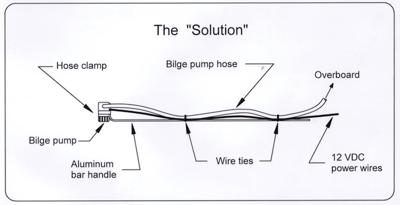
That project was the idea behind the solution I came up with for my co-worker. In his case, the end of the aluminum bar stock was bent at a right angle and the pump clamped to it. The aluminum bar was left long enough to push, under the engine, to the stern of the boat. The output hose and pump wires were taped to the aluminum bar. The hose was left long enough to reach overboard and a couple of alligator clips provided a connection to a 12-volt battery.
While this setup could be permanently installed, my friend decided to leave it portable. At the very least, it would be easy to pull the pump out to clear a clog or move to another location.
This isn’t a complicated or time-consuming project and the diagrams provide all the details necessary for you to build your own version of the “pumpstick”.


