



You know the saying... "If you don't like the weather in Missouri, wait five minutes."
It's true: Missouri weather is infamous for being all over the place, not just from season to season, but sometimes even from hour to hour. After a comparatively mild winter, Missourians suffered a downright Arctic weekend, withs lows in negative territory and highs in the single digits or teens at Lake of the Ozarks.
Sunday's (Jan. 14) temps barely climbed out of the single digits, setting a new record in the Lake area for that day, for a new low maximum temperature (the previous record was 18 degrees, set in 1994). But last weekend's cold didn't even come close to record-for-Missouri cold. That record — the record for the single coldest night in Missouri — goes to a city at the far end of Lake of the Ozarks.
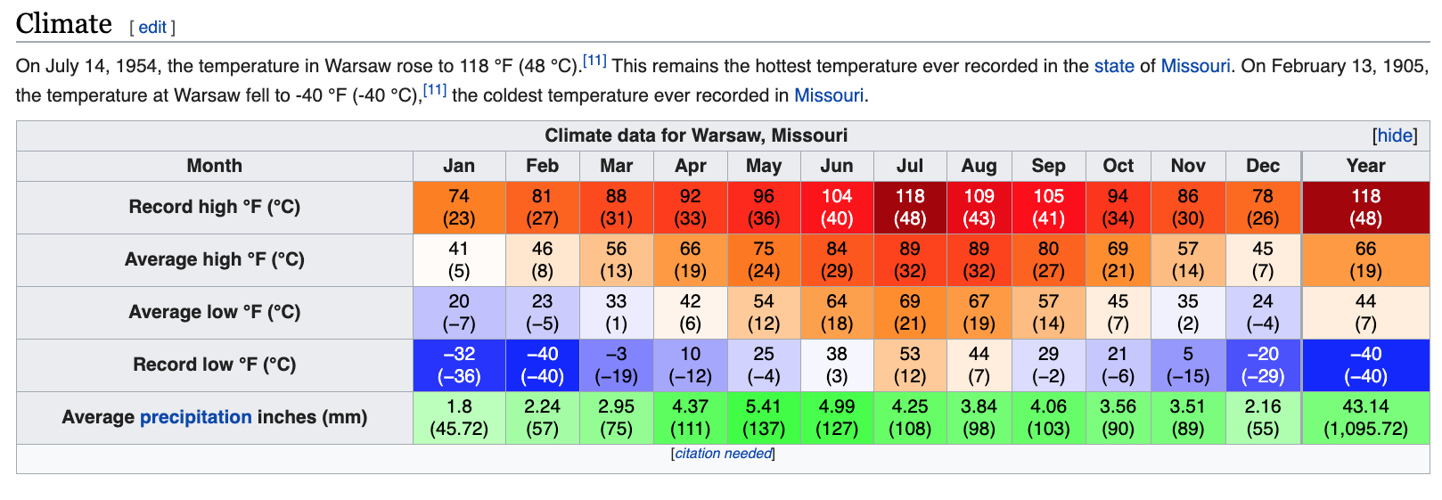
Warsaw, Mo. sits at the intersection of Truman Lake and Lake of the Ozarks and holds the record in Missouri both for the lowest and the highest temperatures ever recorded in the state.

According to Wikipedia, on February 13, 1905, Warsaw's temperature plummeted to the state's lowest-ever recorded temperature: a bitterly piercing -40 degrees. That's frosty. And while in 1905, there was no Lake of the Ozarks to freeze-over, it's safe to assume the Osage River did. In the photo above, from the Missouri Historical Society, a woman can be seen walking across the very-frozen Mississippi River in St. Louis, in February 1905, with a line of St. Louisans in the background doing the same thing.

Lake of the Ozarks frozen-over in the February 2021 Arctic blast -- photo by Erick McDaniel
Then, 49 years, 5 months, and 1 day later, on July 14, 1954, the temperature in Warsaw rose to 118 degrees, which remains the hottest temperature on record for the state. That's hot even in Sahara Desert terms. And while air conditioning was becoming more widely adopted by 1950s America, even modern units would struggle to keep a house cool in that kind of horrific heat. On the bright side: by 1954 there was a Lake of the Ozarks to jump into. (Truman Lake wouldn't be built until 1979.)

Missouri experiences extreme temperatures due to its location in the middle of the United States, where there are no large mountains or oceans nearby to moderate those temperatures. Additionally, Missouri's climate is within reach of cold air from Canada and the Arctic as well as heat and humidity from the Gulf of Mexico. We even occasionally receive the final remnants of a Gulf of Mexico tropical storm or hurricane.
In the summer, temperatures rarely top 100 degrees but frequently rise to 90 degrees or higher, whereas winters in Missouri usually dip down to zero temperatures a few days each year. Regions throughout the state typically experience anywhere from 70-110 days of below freezing conditions, depending on location within the state.
Extreme temperature fluctuations of 20-40 degrees within a 24-hour period are also common, and it isn't unheard of for a warm and sunny day to be followed by a cold and snowy evening. On November 11, 1911, temperatures all across Missouri beat records by reaching the lower 80s, only to plunge near-freezing in less than two hours.
How do Missourians cope with these extremes? Well, in the winter the lucky ones head south; the rest of us just bundle up. And in the summer? Just take a look at Highway 54 on a Friday afternoon: Missouri's cities flow straight into Lake of the Ozarks.


![Take A Tour Of This Stunning Lake Of The Ozarks Home, Built By Otto Construction [VIDEO]](https://bloximages.chicago2.vip.townnews.com/lakeexpo.com/content/tncms/assets/v3/editorial/c/bd/cbdbe220-5646-4f0d-8da8-07771504e638/6ac80ce70114c.preview.jpg?crop=720%2C720%2C280%2C0)


