
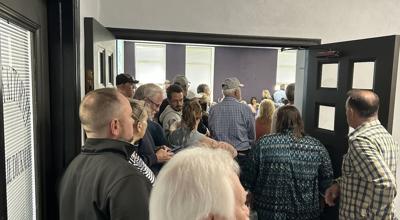
CAMDEN COUNTY, Mo. — It was standing-room-only on Thursday, April 30 for the Camden County Commission meeting, as the commissioners met to discuss whether to recommend a tract of land within the county for federal Opportunity Zone (OZ) status.
The turnout came from fears that a proposed development within that tract would be used to construct a large data center. In the end, the commission voted not to recommend the tract for federal approval of OZ status.
Federal Opportunity Zones have existed since 2017, and one already exists at Lake of the Ozarks, in Sunrise Beach. But the Big Beautiful Bill passed by the federal government in 2025 gave OZs new life. The designation of an area as an Opportunity Zone means developers can buy and sell the real estate within it without having to pay capital gains taxes: an incentive widely viewed as attractive to developers. For an OZ to be approved, it would need letters of support from local municipalities and then would be submitted by the governor to the federal government, which would make the final designation.
The Camden County tract proposed as an Opportunity Zone would have included more than the approximately 2,000 acres sought by Mo Lake Development, a company owned by local siblings and Camdenton High School graduates Blake Hodits and Brandi Freese. But it was a comment by Freese combined with speculation about behind-the-scenes discussions with city and county officials that sparked worries over a data center.
Freese's comment came at the Camden County Commission meeting on Tuesday, April 28, as the commission was considering a county ordinance to define and severely restrict the construction of data centers — an ordinance that the commission passed in that meeting. Freese had attended to answer questions about Mo Lake Development's plans and encourage a vote of recommendation for the OZ designation. When one commissioner asked her, "And there won't be any medium or large-scale data centers in that area, right?", Freese replied, "You never know."
While Hodits' team had been vague about its plans in public communications — not uncommon for developers in the earliest stages — he told LakeExpo on Wednesday that he had mentioned to local officials that the development could potentially include a data center as one component. However, he said he had no interest in bringing development that would be harmful or damaging to the community or environment, and said any data center would be built with "a path to water and power independence." The newly passed county ordinance requires that.
Leading up to April 30, a text message by Camdenton City Administrator Jeff Hooker began circulating on social media; in the message, Hooker informed City aldermen that at an upcoming work-session, "[Hodits] will be discussing Opportunity Zones and a 500,000 square foot data center." In 2022, the city had approved a pre-annexation agreement with the developer, who was also seeking such an agreement with Linn Creek for a portion of the area that abutted that city.
Hooker says he had been pushing the city and county to work on their ordinances regulating data centers, noting multiple large buildings in the city could theoretically be bought and converted into data centers
"I don't want a data center. I live [next door to the proposed development]," he said. He said Hodits first made mention of a large data center only in a recent conversation, saying he'd like to discuss a 500,000 square foot facility with the board. That was the trigger for his text to board members, Hooker says.
"His plan from the very beginning talked about a data and technical institute, like a college," he said, adding that he had no communication from Hodits about a large data center until Hodits mentioned it recently. He noted the developer's original plans also included possible hotels, housing, big box stores, and a Branson-style boardwalk.
As fears about the possibility of a data center began to mount, State Rep. Jeff Vernetti on Tuesday announced he was withdrawing his support for the OZ designation due to the possibility of a data center being developed at the site. Vernetti told LakeExpo he had been for the OZ designation until finding out a data center might be considered for part of it.
After the April 30 meeting, the City of Camdenton announced that at its Tuesday, May 5 Board of Aldermen meeting, it would be considering a motion to rescind its recommendation that the area be designated an OZ as well as a motion for a 12-month moratorium on data centers while the city considers how to regulate them.
As communities across the nation face the possibility of data centers, many have scrambled to pass ordinances preventing a free-for-all on development of these types of facilities. In addition to Camden County, Osage Beach and the City of Camdenton have been working on updating their codes to define data centers and create parameters around how and where they could be built.
Camden County's ordinance included the following stipulations (summarized):
- No incentives at all: no tax abatements, no TIF, no special districts
- Must generate their own power: 100%–110% of power has to be produced on-site
- No normal water sources allowed: cannot use wells, city water, or the lake. Only rainwater collection would be allowed as a water source for the data center
- Huge setback requirements: Up to 1,500 ft from homes/schools, and up to 6,000 ft (more than a mile) from the Lake of the Ozarks
- Strict noise limits: Heavy sound mitigation required
- Fines up to $50,000 per day for violations
- Heavy approval process: Conditional Use Permits, Development agreements, Studies and ongoing oversight
- Ownership restrictions: Limits on certain ownership types, including foreign involvement


![[VIDEO]: Ferris Wheel Now Standing Tall At The Oasis](https://bloximages.chicago2.vip.townnews.com/lakeexpo.com/content/tncms/assets/v3/editorial/6/45/645bc455-286b-4556-b486-8f36b333dff4/6ab5949ebf5bf.preview.png?crop=1263%2C1263%2C0%2C60)


