

Og Mandino wrote, “You never know what events are going to transpire to get you home.” Local Sunrise Beach Reverend James Stacey would agree. Events have brought him back to Missouri where his great-great-great-grandfather, a fugitive from the Cherokee Trail of Tears, staked his claim for freedom. William Stacey, an Irish immigrant, refused to abandon his Cherokee wife and eleven children. He marched west with them along the northern route, just one of three, even though he had a choice: march or desert your family. He chose family.
The Staceys survived the forced march from Kentucky to the eastern shore of the Mississippi River. They also survived a hard winter when more than 5,000 died due to starvation rations, inadequate shelter, and disease. With the Spring and after a successful river crossing, Stacey saw an opportunity to escape, and he did. He led his family into a cave probably well-known among Natives. Henry Rowe Schoolcraft called the cave Winoca; today it is Smallin Civil War Cave, a privately owned tourist destination just outside Springfield.
Reverend Stacey knew little about all of this. His family, like many, didn’t discuss their Native American heritage. Older generations had experienced prejudice and discrimination. His aunt, Eyvon Mendenhall, wanted to learn more however, and it was through her that James began to glimpse his strong-willed ancestors. That glimpse has led him to Smallin Cave more than once. He has stood where his ancestors stood when they began to create a new life. Today, one of the Staceys has provided a registry so that Stacey descendants can sign in when they visit.
The cave once belonged to all who sought refuge. Artifacts dating back to 9,000 B.C. have been identified. A few of these are on display in the commercial retail shop where today’s owners collect $16.95 per person over the age of 13 and $8.95 for children 3 to 12 years of age for daily, periodic one-hour tours. Also on display are rocks proving the artistic gifts of Wanetta Bright, author of a book about the cave titled Smallin Civil War Car, The Center of Ozark Culture and History. Civil War re-enactors may appreciate what the Brights describe as a “painstakingly researched section on the Civil War and its aftermath (in this area).”
Two other tours are available. The first is a two-hour lantern tour that begins at a campsite fashioned to resemble what Civil War soldiers might have set up. By campfire light, tourists will be served a simple supper of ham and beans while listening to Civil War tales. Then they will follow a guide into and through the cave relying upon lantern light.

The Smallin Civil War Cave sheltered soldiers from the north and south in the Civil War, and also gave shelter to a family fleeing the Trail of Tears.
photo by Al Griffin
Both Union and Confederate soldiers used the cave. During hot summer days, troops escaped the heat, using the cave for R & R. A swimming hole is seven-feet deep today and the temperature much cooler than outside the cave’s entrance.
James Stacey’s ancestors most likely used the rushing waters to wash clothes as troops and townfolk later did. It was a cool place to sit and work. The banks were also suitable for picnics and gatherings under shelter, and the site was well-known nationally, evinced by a book about caves in Missouri and a 1923 National Geographic photo. A nearby smaller cave was used for refrigeration before electricity made a steady, cool temperature possible.
In addition to daily tours featuring geological information and some history or Civil War Lantern tours, the Brights offer Off-Trail Wild Tours lasting approximately two hours. The price of admission is $75 per person with a minimum of two people required. They will wear helmets and boots to protect themselves from rock formations and 54-degree, knee-deep water. Part of the joy is spotting cave species, especially those that stay far from the light pouring in at the cave’s mouth and even farther from the sounds made by tourists.
Our guide was Eric Fuller, resident archaeologist at Smallin Cave. His patter is well-rehearsed and well-timed, seasoned with schtick and jokes designed to engage his listeners, but he has a depth and breadth of knowledge that impresses. He has recently completed special study about the Osage and is thus prepared to speak about a Black Walnut Marker Tree, also sometimes called Trail Trees or even Thong Trees. According to an article in Missouri Life, Osage Chief Jim Gray has confirmed the use of Trail Trees to point to water sources or caves and even sacred grounds. At one time before the Brights became owners and caretakers for Smallin Cave, people photographed themselves sitting on the horizontal marker of the tree, now at least 230 years old.
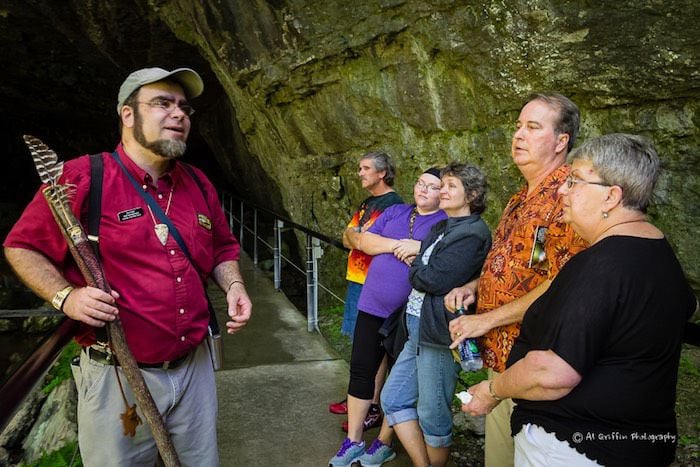
Reverend James Stacey gives regular tours at the Smallin Cave, which sheltered his great-great-great-grandparents as they fled the Trail of Tears.
photo by Al Griffin
Reverend Stacey appreciated what Eric Fuller brought to life during the tour. Stacey takes seriously his family’s heritage and enjoys revisiting Sparta, Missouri, just minutes from Springfield where his father and mother met. During those visits, he pieces together the family’s history recalling stories told by his parents, aunts and uncles. He also reads about those ancestors.
One book that brings to life Silas Scruggs Stacey, James Stacey’s great-great grandfather, is Let Us Build Us a City by Donald Harrington. The book is a fictional narrative blending history with the characteristics of travelogues and love stories to tell about Marble City, later known as Marble Falls, Arkansas. What Stacey appreciates about the book is its vivid descriptions of the Ozarks where Stacey’s ancestors walked, and he marvels that after living most of his adult life near Kansas City or in Syracuse, New York with an extended period in Switzerland, he has returned to the Missouri Ozarks as pastor for Unity Church in Sunrise Beach. This land has a powerful hold on him. In fact, he says, “one who appreciates land has more connection to it than one who has legal title.” Stacey has no legal title to Smallin Cave or Sparta or the old grounds near Jasper, Arkansas where Marble City rose, but he feels a powerful connection nevertheless.
“All that he knew was that the years flow by like water, and that one day men come home again.”
(from You Can’t Go Home Again by Thomas Wolfe)


