
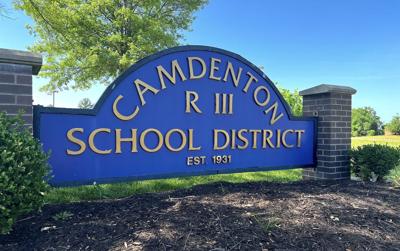
CAMDENTON, Mo. — The Camdenton R-III School District has increased its tax levy for the first time in six years, as the district faces rising costs and a lower-than-expected increase in revenues after the most recent reassessment.
In a tax levy hearing on Monday, August 14, pursuant to Amendment 2, the Camdenton R-3 School District Board of Education approved setting the school district’s 2023–2024-year tax levy rate at $3.06, as recommended by Camdenton R-3 School District Assistant Superintendent of Finances and Operations Dr. Mark Piper. The rate increased from $2.97.
According to Dr. Piper the rate in 2002 was $2.79 for 10 years, then it increased to $2.87 until 2016, and then was set at $2.97 in 2017, for six years.
The new rate, broken out by fund, is as follows: $1.37 Incidental Fund 1, $1.18 Teacher’s Fund 2, $0.31 Debt Service Fund 3, and $0.20 Capital Projects Fund 4.
The Waynesville school district is comparable in size to Camdenton. Camdenton has 4.4 million in Fund 4 (capital improvements) and Waynesville has $38 million in their Fund 4.
Board members Brian Butts, treasurer Jacob Neusche, Vice President Troy Risner, member Eric Walters, and Secretary Callie Henze voted yes. Board president Gail Griswold and member Shelley Creed voted no. The motion carried. There was no public comment.
The former tax levy rate was $2.97 for the 2022-2023 year, broken out by fund as follows: $1.33 Incidental Fund 1, $1.18 Teachers Fund 2, $0.31 Debt Service Fund 3, and $0.15 Capital Projects Fund 4.
Operating Levy Set at the State Minimum
The district also has an Operating Levy. The Operating Levy is a combination of fund #1 the Incidental Fund ($1.18), fund #2 the Teacher's Fund ($1.31), and fund #4 the Capital Projects Fund ($.20).
As Operating Levies go, Camdenton R-III is among the lowest in the state and was previously set to 9 cents below the state minimum. However, the district has opted to set the Operating Levy at the state minimum: $2.75.
“With this decision, we will set the operating levy to the state minimum. We are not able to increase it anymore unless we go to a vote of the people,” Neusche informed the board. “If the reassessment revenue continues to be lower than the cost of food, gas, and salaries, we will be in a bad position in a few years.”
Even with increasing the operating levy to $2.75, Camdenton R-III still has one of the lowest tax rates in the state and is at the state minimum. By contrast, Lebanon’s Operating Levy is $3.64 — $.89 higher than Camdenton’s Operating Levy.
Board discussion before the vote
2023 was a reassessment year for all real estate property within the state. By state statute, all real estate property must be reassessed every two years. (The next reassessment will be in 2025.)
According to Dr, Piper, reassessment valuation in the district increased 2.4 percent with only .22 percent coming from reassessment. The bulk of the increase was attributed to new construction. The board discussed the low assessed valuation, the rising cost of expenses, and possible future cuts which may need to be considered, including cutting excess spending.
“The .22 percent growth in revenue due to reassessment generated only an estimated $78,000 which was simply not enough to cover the inflation which has occurred with food, fuel, and salary increases. We have made significant cuts in our expenses while still maintaining student safety and staff salaries. We are running out of places to cut which do not include staff, and we are committed to our staff,” Camdenton R-3 School District Superintendent Dr. Sean Kirksey said.
“Can we make do without increasing the .9 to reach the state minimum? Yes, but it is not sustainable. I like the low tax rate the Lake has, and I support that, but I think our kids are worth the state minimum operating levy,” Kirksey said.
“Last year we were at a break-even point in our budget, and we are predicting the same this year,” Dr. Piper said. “When we have a break-even budget, our fund balance percentage naturally decreases as our expenses continue to rise due to inflation.”
The district has a goal to have a 30 percent fund balance in the reserves, and they are at 34 percent now, which amounts to $18 million in reserves. “We cannot cover our expenses throughout the year and especially our December bills before getting the lion’s share of our funding without a minimum fund balance of $14.3 million (26%)” Dr. Piper explained. “I fear if we don’t do something, we will be scrambling to pay our bills. We have to keep up with the Consumer Price Index (CPI).”
An example of the rising expenses: a new bus now costs approximately $140,000 and the district says it needed to purchase six last year.
Additionally, the district's adoption of a Chromebook for every student will soon create a major financial — and philosophical — crossroad.
The district went to a one-to-one ratio of students to Chromebooks in 2019. The bulk of the laptops were paid for by a grant, however, when it comes time to replace and update these devices, the school will have to pay for them.
The board has been in discussion about scaling back on the cost as well as the amount of time students spend in front of screens, especially the lower grades. The goal is to increase teacher/student and student-to-student interaction.
“I think we have an addiction problem that needs to be addressed,” Griswold said. “This is a philosophical question we can have at another time.”
Getting Squeezed
“The cost of doing business has gone up, and we made the choice to take care of staff,” Dr. Kirksey said. “We anticipated more of an increase through reassessment given the significant increase in home values over the last 2 years. When you get $78,000 instead of $2 million, it makes you have to look at other options. Taking care of teachers, our class sizes, and student safety, is most important.”
“I am a conservative. I like the low tax rate at the Lake, but we have to consider our kids. We made financial decisions based on the assumption we would be dealing with a realistic increase in revenue due to reassessed valuation, we expected realistic, and we didn’t get it,” he said.
“If we want the best people, and if we want to compete, and keep people here, we have to make choices,” Dr. Kirksey said. “The projected budget for last year included $370,000 in deficit spending. We made significant cuts in expenses and ended the year with a budget surplus. On the revenue side, we made good investment decisions, which increased our revenue from $132,000 in 2022 to $1.2 million last year, but we cannot rely on that every year.”
“And, if we take pride in being locally funded, we have to make sure those local funds keep up with the cost of running the school,” Neusche added.


