
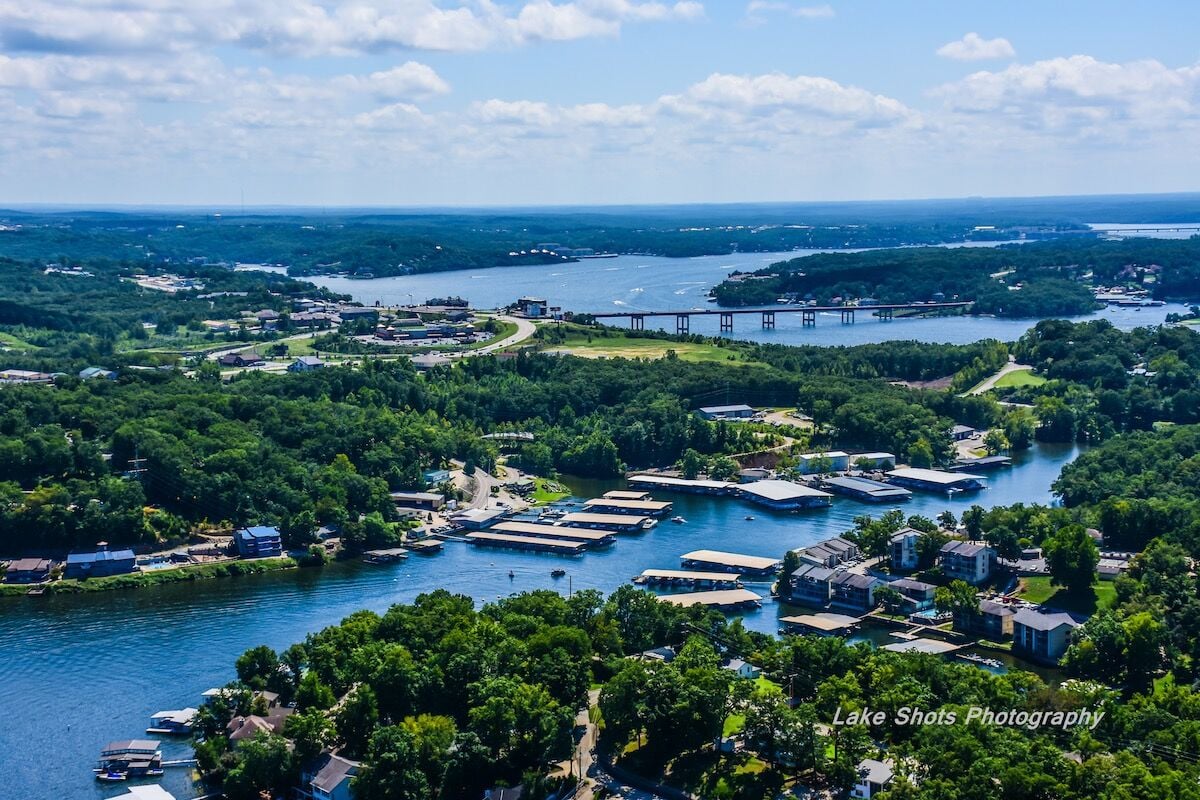
JEFFERSON CITY, Mo. — A vacation to Lake of the Ozarks just got cheaper.
A Missouri Supreme Court ruling this week put an end to the lodging tax at Lake of the Ozarks, ruling that the law which established a framework for the tax was unconstitutional.
The lodging tax has long been controversial, with some vacation rental owners refusing to pay it. Some of those have fought lengthy and expensive court battles as a result.
Opponents have argued that the business districts that levy the tax — which are established and defined by state statute — are unconstitutional.
It appears the Missouri Supreme Court agrees. In the opinion issued on June 25, 2024, the court struck down the statute that allows the Lake of the Ozarks business districts to exist and ordered an immediate halt to "any further collection of lodging taxes pursuant to the unconstitutional statutory scheme."
How It All Started
In 1993, Missouri House Bill 345 created the set of statutes allowing for "lake area business districts" to be created and to levy and spend lodging taxes.
The tax, first implemented in 1993, is levied and managed by various business districts around the Lake of the Ozarks, and some districts — 9 in all, separated by size (small, medium, and large) and county (Camden, Miller, and Morgan) — had different tax rates than others, as the tax had to be voter-approved.
The tax has been paid by visitors who stay in any transient guest lodging accommodation, and it is ultimately remitted to the business districts.
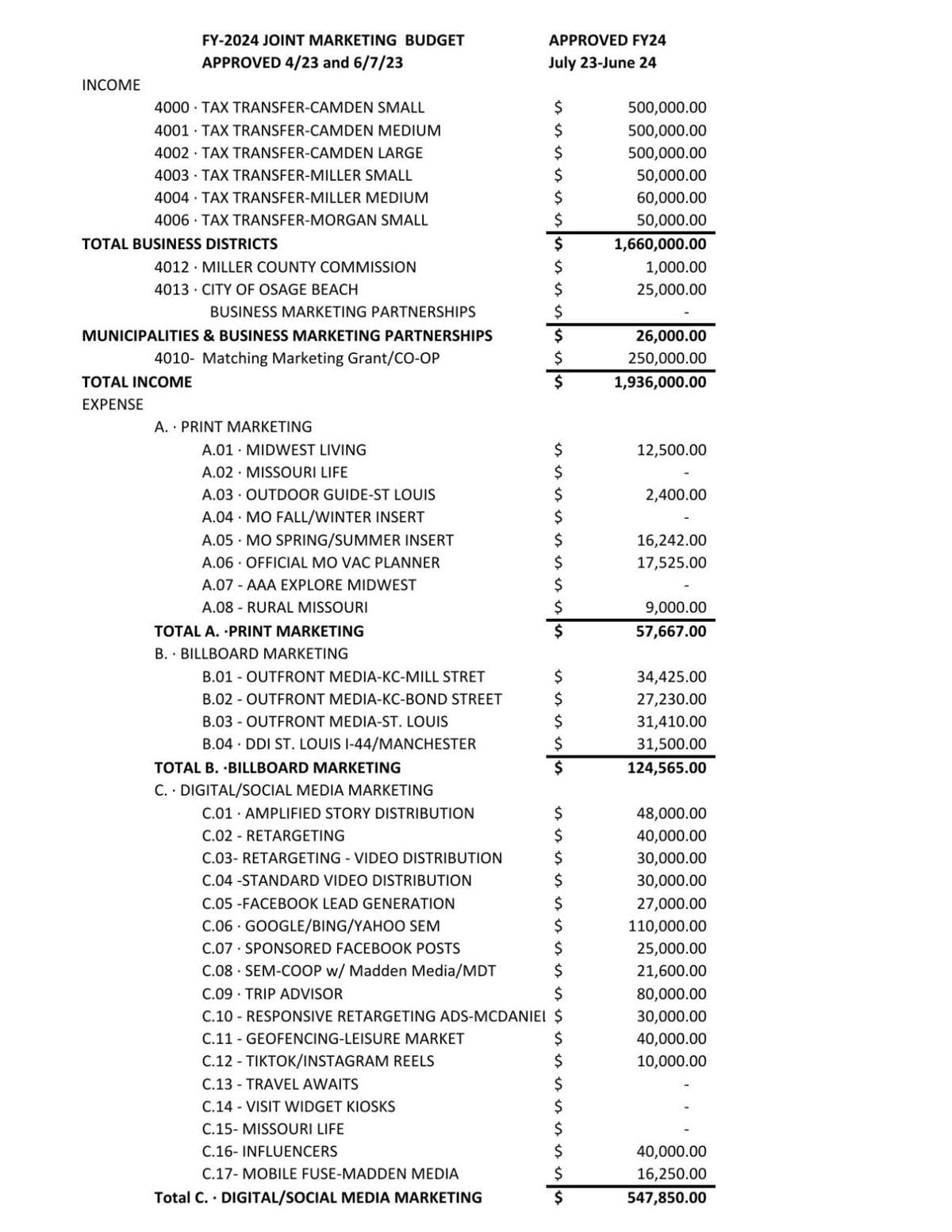
The tax revenues had been earmarked, per state statute, for the advertising and promotion of Lake of the Ozarks tourism. The Tri-County Lodging Association was commissioned with spending those dollars, and that group — which largely consists of board members of the various business districts — had historically contracted the Lake of the Ozarks Convention & Visitor Bureau (FunLake.com) to handle a major segment of those promotional efforts. Lodging tax dollars constitute a significant portion of the CVB's revenues: in 2024, TCLA budget ($1.9 million) allocated more than $250,000 for the CVB's efforts.
The Lawsuit
The trouble for the business districts started in 2019, with the proposal of a lodging tax increase.
In 2019, the lodging tax was at 5% in Miller County and 3% in Morgan and Camden counties. The law establishing the tax had capped it at 6%.
In a bid to bring additional visitors to the Lake through sports tourism, the CVB, TCLA, and some members of the Lake's business community began to campaign for a lodging tax increase in all three counties, to raise the tax to the maximum 6%. Since Missouri law requires any significant tax increases to be approved by voters, the group got the question on the ballot, in November of 2019.
The revenue from that increase would be earmarked for "the promotion of tourism in the District, including but not limited to the construction, operation, and maintenance of sports facilities," according to the ballot language. CVB's then-Executive Director Tim Jacobsen and TCLA then-Executive Director Jim Divincen said the revenue would be used to construct a destination soccer complex. The groups contracted with consultants for revenue projections, an economic impact study, and a construction plan/timeline. Tentative locations for the soccer complex were floated. Public meetings were held.
But a grassroots coalition of vacation rental owners, small resort operators, and other citizens and business owners pushed back. "Vote No" appeared on local billboards, yard signs, and social media pages... sometimes not far from "Vote Yes" signage.
Election day: November 5, 2019 came, and the lodging tax proposal went down in flames.
The vote:
1,610 - Yes
4,682 - No
Jacobsen soon left the CVB and Divincen retired from the TCLA.
Some of the grassroots "Vote No" group took the win and resumed their business activities; others doubled-down.
For a time, TCLA meetings — always open to the public but almost never attended by anyone other than the board members — had a packed gallery. Activists submitted a stream of Sunshine (open-record) Requests for thousands of pages of documents.
Laura Salamun, owner of Point View Resort, and Gail Griswold, owner of multiple local wineries and a local political activist, sued the TCLA and Business Districts. They argued the way the entities were structured and operated violated the Missouri Constitution.
The crux of their case was that the state statute that allowed for the creation of "lake area business districts" required those districts (political subdivisions), to grant public money to a private entity, and they argued such a requirement violated the Missouri constitution.
That was in May 2020.
In August 2020, a Missouri judge froze the business districts' distributions to TCLA until the issue was sorted out.
A court ruling in May 2023 left TCLA supporters hopeful that the issue would be resolved in their favor, and Miller County Business District advisory board member Russell Burdette told Lake Expo the court had released the funds to be distributed again to TCLA. But Griswold appealed the decision and eventually took it to the Missouri Supreme Court.
Then, the surprising reversal: on June 25, 2024, the state Supreme Court's ruling was handed down.
The court ruled that a lower circuit court should not have simply stricken a portion of the statute that it acknowledged was unconstitutional, but rather should have stricken the entire set of statutes establishing lake area business districts.
From the Missouri Supreme Court ruling:
The valid sections—section 67.1170 (creating) and section 67.1180 (dissolving) the lake area business districts—are so inseparably connected with and dependent upon the void sections that this Court cannot presume the legislature would have enacted the remaining sections without the void sections. Indeed, without the advisory board, there can be no lodging tax or an entity to spend the lodging tax. Section 67.1177.1 (allowing the advisory board to submit to the district residents, for majority vote, the lodging tax); section 67.1177.5. Without the lodging tax—to be used to promote tourism in the lake area business districts—there is no purpose for creating the lake area business districts and no need for a method to dissolve them. Because the remaining sections creating and dissolving the lake area business districts are inseparably connected with the void sections creating a governing body and its ability to impose and use the lodging tax, sections 67.1175 and 67.1177 cannot be severed. The entire statutory scheme must be stricken.
Conclusion
The judgment is reversed. Pursuant to Rule 84.14, this Court enters the judgment the circuit court should have entered and declares sections 67.1170, 67.1175, 67.1177, and 67.1180 constitutionally invalid and void in their entireties. As a result, this Court enjoins any further action by the county advisory boards and any further collection of lodging taxes pursuant to the unconstitutional statutory scheme. The cases are remanded to the circuit court for appointment of trustees to wind up and dissolve the Camden County and Miller County lake area business districts.
The Reaction
Burdette said he was "surprised and highly disappointed" by the court's decision.
"The reason I’m disappointed is because the business districts have been promoting Lake of the Ozarks for 20-plus years, and now there will be nobody promoting Lake of the Ozarks," he said. "People are going to lose their jobs, some businesses are probably going to struggle."
Burdette took issue with the way the plaintiffs had characterized the business districts and TCLA's relationship (a characterization the Supreme Court clearly agreed with). He said it's untrue that tax money was simply handed over to TCLA to spend as it saw fit; the business districts created a budget and required the TCLA to spend the lodging tax dollars in accordance with that budget, he said. So he and other business district advisory board members characterized TCLA as essentially the marketing mechanism of the business districts: a way for the business districts to spend money in a more unified way, but not a private entity given carte blanche to spend tax dollars however it saw fit.
But he said his biggest concern was the lack of marketing the Lake area would receive. "Any business quits advertising, people are gonna forget about it!" he pointed out.
The TCLA's 2024 budget can be viewed below. It included $124,565 for billboard marketing, $57,667 for print marketing in publications like Midwest Living and the Official Missouri Vacation Planner, $547,850 for digital marketing including $110,000 for Google ads and $40,000 for influencer marketing, and $219,849 for TV/Radio/Streaming.
Griswold, who said she was very surprised by the court's ruling, called it "a win for the mom-and-pop resorts," who she thinks didn't benefit from the lodging tax.
She says her main motivation for fighting the multi-year legal battle was because she genuinely believed the lodging tax was being implemented in an unconstitutional way, without proper representation. She compared the business districts' operations to something like a Homeowners Association, taking issue especially with the practice of proxy voting, in which vacation rental managers were allowed to cast a vote on behalf of the properties they represented, if they had permission from the property owners to do so.
She also points out that in the aggregate, Lake area lodging establishments and individual vacation rental owners spend much more advertising Lake of the Ozarks events, attractions, and their own properties than the TCLA has spent marketing the Lake of the Ozarks.
Griswold called concerns about a potential negative impact to the Lake "fearmongering."
"Do I think a lodging tax is needed to advertise the Lake?" she said. "No I do not."
What's Next?
Critically, the Supreme Court's ruling states that the lodging tax is unconstitutional and must cease from being collected.
So all transient guest hosts — from hotels to small resorts to individual vacation rental homes — no longer are required to (or are allowed to) collect a lodging tax.
The timing of that tax collection stoppage is complicated, however, since vacation rental platforms such as VRBO.com and AirBnB.com have for years been collecting the lodging tax for Lake of the Ozarks and other areas and automatically remitting that tax to the appropriate collector or revenue department.
The future of the TCLA and CVB are also in question. While the CVB has other revenue sources — magazine and digital ad income, memberships, and some other revenue streams — it relies heavily on lodging tax funding.
The TCLA has no other funding.
TCLA Executive Director Lagina Fitzpatrick and CVB Executive Director Heather Brown could not be reached for comment.
Burdette noted that Morgan County's business districts were not named in the lawsuit, but acknowledged that if the state statute is struck down, then there is no way for any of the three counties' lake area business districts to continue to exist.
As for the money in the business districts' coffers — millions of dollars — it appears that could end up being a windfall for those districts' respective counties. The Supreme Court ruling included a direction that the lower circuit court be tasked with the dissolution of the business districts in accordance with the original intent in the dissolution section of the business district statute, as much as possible. That section, which specifies a trustee should be appointed by the county commission to wrap-up the district, ends with the following: "When the trustee has closed the affairs of the lake area business district, and has paid all debts due by such district, he shall pay over to the county treasurer all money remaining in his hands, and take receipt therefor, and deliver to the clerk of such county commission all books, papers, records and deeds belonging to the dissolved lake area business district."


![[VIDEO]: Ferris Wheel Now Standing Tall At The Oasis](https://bloximages.chicago2.vip.townnews.com/lakeexpo.com/content/tncms/assets/v3/editorial/6/45/645bc455-286b-4556-b486-8f36b333dff4/6ab5949ebf5bf.preview.png?crop=1263%2C1263%2C0%2C60)

![Dinner With THIS View?! Inside 1932 Reserve At Lake Of The Ozarks [FLYTHROUGH]](https://bloximages.chicago2.vip.townnews.com/lakeexpo.com/content/tncms/assets/v3/editorial/b/40/b4047402-5958-4f34-92e1-36da52740fea/6aada39fabf69.preview.jpg?crop=1119%2C1119%2C240%2C0)


