
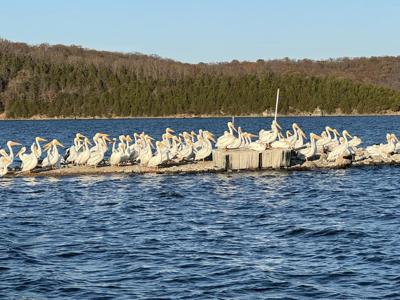
If you see large white birds swimming in — or flying over — the Lake, it may be the American White Pelican. The birds are making their fall stopover at the Lake of the Ozarks!
With their large bills and swan-like bodies, these travelers are also spotted across the Lake during the spring as they make their migration north.
But from September to November, the American White Pelican heads south to wintering grounds on the Gulf Coast, California, or Mexico. The pelican depends heavily on Missouri’s lakes and rivers for places to rest and eat, gathering strength along the way.
At this time of year, Lake of the Ozarks residents should see pelicans with paler yellow bills compared to their spring journey to the nesting grounds of the Northern Midwest, Canada, and the Western states.
The Lake of the Ozarks draws migrating pelicans with its wide-open waters and abundant fish. When hunting, White Pelicans work in groups to herd fish, rounding them up into tight schools, before scooping them up in their massive beaks. Pelicans swimming in a line make noise by splashing their feet and wings to get the fish moving in the right direction, and may even work as two or more lines of birds converging on each other to trap fish in the middle.
The characteristic skin pouch at the base of a pelican’s beak can hold up to four gallons of water at a time, which is more than four times the volume of its stomach. Excess water is expelled from the corners of the mouth before fish are swallowed.
Birds of this size, up to 30 lbs, need a lot of food. Pelicans consume up to four pounds of fish, crawfish, and amphibians each day. They mostly eat non-game species such as shad, chub, and catfish; their bad reputation for damaging commercial and sport fisheries is largely unearned. Lake of the Ozarks anglers have little to fear from their presence.
At one time, White Pelicans flew through the Ozarks in flocks numbering in the thousands. The Lewis and Clark expedition noted pelicans resting on sand bars along the Mississippi River too numerous to count. Populations declined until the 1960s, but have rebounded and stabilized over the past several decades. While the thousands-strong squadrons have not returned, flocks of up to 200 are not unheard of.
Enjoy the pelican season while it lasts! With chilling weather, the birds will quickly move on from their temporary home at the Lake. Keep an eye out for these long-billed waterbirds and you might get lucky enough to spot one, or a whole scoop.


