


The explosive growth and expansion of transient guest nightly rentals at the Lake has been good for homeowners and vacationers. Some families are opting to rent a home on the lake, where they can enjoy a kitchen and multiple living and recreational areas, rather than a hotel room. At the same time, nightly rental property owners are able to earn money and the Lake economy benefits as increased choices mean more visitors.
However, legislators are grappling with the challenges these “homestay” rentals have brought to traditional taxing and regulatory methods.
Vacation home rental owners, realtors and vacation management businesses are fighting against increased regulation and taxation. Meanwhile, in the past few years, many Camden County property owners have seen their property taxes change from a residential to a commercial rate.
Property owners also have concerns about new legislation that is being pushed by large online travel companies, which homeowners say has the potential to close them down through cost-prohibitive regulations. Realtors say they have clients interested in purchasing nightly rentals that are extremely concerned, and are pulling back on investing further due to commercial property taxation talk.
Proposed regulations in the Senate Committee Substitute for House Bill 1117, expected to be introduced in December, could make it a law that vacation home rental owners have a permit and comply with the same rules as motels and hotels in regard to building codes, health and sanitation, transportation and traffic control, solid and hazardous wastes and pollution control.
The bill also contains language that could alter the definitions of “residence” and “transient guest,” completely changing the playing field for vacation homeowners.
The stakes were clear as disagreements emerged between attendees and Expedia Lobbyist Bill Shoehigh at a Homestay Advisory Committee meeting held by Missouri District 123 Representative Diane Franklin on Thursday, Nov. 17 at Tan Tara in Osage Beach. Currently, Expedia earns a percentage of the nightly rental fees for bookings that go through the website. If HB 1117 is approved, Shoehigh said the company would like to be “partners in compliance” making them a portal of sorts to collect and remit taxes. Renters could also be required to have a permit to market their property. According to Franklin, this type of legislation is being introduced across the country.
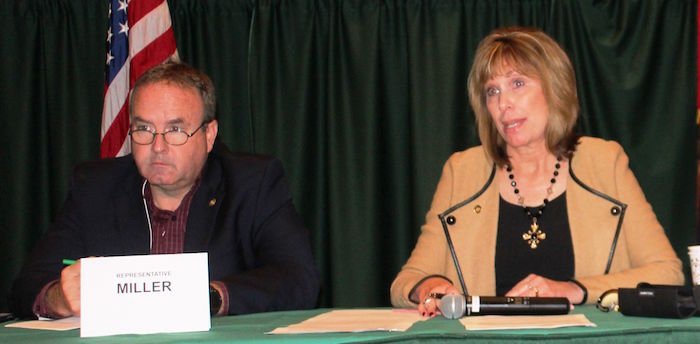
State Representatives Rocky Miller and Diane Franklin listen to stakeholders at a meeting to discuss vacation rental regulations, on Thursday, Nov 17 at Tan Tar A.
photo by Janet Dabbs
Sharing economy
“Recent research from Pew shows that one year ago, only 27 percent of Americans were familiar with the concept of ‘Sharing Economy,’” Rep. Franklin reported. “Today, nearly 60 percent of US travelers are now aware of this lodging option.” Technology and popularity has caused the Sharing Economy to explode with families, friends and neighbors sharing rides with Uber and homes with Airbnb, a rapidly growing way to book travel accommodations. The real estate industry has also been impacted by these changes in the sales, leasing, managing and marketing of these types of properties.
“We can be certain this issue will be addressed again in the 2017 legislative session,” Rep. Franklin said. “It is vital that the laws and regulations keep up with changes in the industry. It is also important that these policies do not do harm to the industry, the Lake of the Ozarks/Tri-County area, nor our state.”
According to Franklin, the meetings are being held in an effort to gain input from stakeholders on the subject of homestay taxing and regulation. At the first Homestay Advisory Committee meeting held by Franklin in September, county commissioners, assessors, mayors and city administrators were given an overview of the legislation proposed in the 2016 session. Legislators then heard from local officials on their positions, thoughts and concerns on the issue.
Realtors and property managers were invited to the second meeting of the Homestay Advisory Committee in November. Also in attendance were Shoehigh, Miller County Presiding Commissioner Tom Wright and Missouri District 124 Representative Rocky Miller. Representative Missouri District 58 Representative David Wood was expected, but did not attend.
Rep. Franklin identified four key issues that needed stakeholder feedback. The following questions were asked of the stakeholders’
Question: What would you consider an appropriate tax assessment classification for homestay properties?
Background: Missouri Revised Statues Chapter 137.016.I defines real property, in three classes: 1. Residential. 2. Agricultural. 3. Utility, Industrial, Commercial, Railroad and other real property.
During the 2016 legislative session, in a version of Senate Bill 897, an amendment was adopted by the House of Representatives which would allow for the proration of transient housing based on the number of days lodging was sold at a property. The amended bill was not taken up by the Senate.
According to Franklin, there is a statute which, according to the ruling by the Missouri Supreme Court, places residences used for homestays in the Commercial classification. Recently however, the Camden County Board of Equalization ruled on a challenge to the assessed classification of a local homestay property as commercial. The BOE’s decision was to lower the property value, thereby lowering the taxes paid. The Camden County Assessor appealed to the Missouri State Tax Commission and the appeal was denied.
The idea of proration was floated—that homeowners could pay taxes based on the percentage of time their property is being used for transient rental purposes. That idea was welcomed by some, and opposed by others.
A realtor at the meeting agreed that nightly rental properties should pay lodging tax to help promote tourism, but said on real estate taxes, if they are zoned residential, they should be taxed residential. One individual noted proration would work on an honor system, unless there were a massive regulatory tool in place to enforce it, and that would be too costly for the county.
Question: In what manner should sales and lodging taxes be remitted? What role should lodging licenses, permits or registration play in the development of structure for online platforms to effectively function within our local and state government?
Background: Sales and lodging taxes are due from the purchase of lodging. They are currently collected at the point of sale at hotels, motels, resorts, property management companies, bed and breakfasts and campgrounds and then remitted to the Missouri Department of Revenue.
Homestay vendors like Airbnb and Expedia are “facilitation platforms.” A facilitation platform is “an intermediary that is paid to facilitate the rental of a residential dwelling rental and collects payment from the transient guest.” These facilitator platforms have the mechanism to collect sales tax and lodging taxes and remit them to the state.
Rep. Franklin suggested that although Missouri sales tax rates are constant, local sales and lodging tax rates vary based on location of the property within the state. Obtaining a credential from the local political subdivision (such as the Tri County Lodging Association) where the residential dwelling rental is located would guide the verification of the appropriate amount of tax to collect at the point of sale and guide the documentation. The facilitation platform could require this document as part of the terms of contract with the rental owners.
Expedia has expressed a desire to be “partners in compliance” and help the taxing authority to know the number of nights rented to help them calculate the correct prorated amount and centralize the collection and remittance of all required taxes.
One attendee noted that with 114 counties in Missouri, there would be 114 interpretations and if someone knew the assessor it could make a difference in what they have to pay.
Expedia lobbyist Bill Shoehigh pointed out that public education lobbyists have a vested interest in nightly rental taxation and plan to get on board with this legislation. In Camden County, the changing of residences that are being rented for transient guests from Residential to Commercial taxation has resulted in increased revenue for school districts that benefit from those property taxes.
Question: Should local political subdivisions govern or regulate homestays or should the state determine the guidelines?
Background: In the past, the legislature has attempted to define how homestays could or could not be regulated. Senate Bill 1117 claimed that local political entities could not place undue hardship on the practice of homestays. The bill was filibustered by District 24 Sen. Jill Schupp and tabled.
“To allow full governance would mean varying rules and regulations throughout the state of Missouri. The approach of the Senate Committee Substitute Senate Bill 1117 (with 24 proposed deletions and 55 insertions) would provide some consistency and uniformity,” Franklin said.
Comments:
- Commissioner Wright: These are local issues and the state has no business regulating them. We are trying to attract nightly rentals, agriculture and commerce businesses. If the door to redefinition and increased taxation is opened, you will destroy my area.
- Realtor: Uniformity throughout the state is bogus. We don’t need that, every area is different and people don’t want to be told by someone from Kansas City what they can and cannot do on their property.
- Expedia: We want a statewide policy you can regulate. This will help the industry and allow good operators to be successful and keep the bad apples out.
- Realtor: Whatever you call this (permit) you cannot call it a “business” anything that will give an attorney a chance to get hooks in it. Call it a special use permit or a residential dwelling registration.
- Franklin: We need regulations for nuisance and safety issues.
- Realtor: There are regulations already in place to cover nuisance and safety issues.
- Property Manager: A homeowners association can place a cease and desist on a nightly rental if the nuisance ordinance is in their association bylaws.
- Commissioner Wright: We have enough regulations, this is a taxation issue.
Question: Should the State of Missouri develop guidelines or regulations regarding the type, amount and extent of coverage of insurance carried by host property owners?
According to Rep. Franklin, Comet Insurance said, “Home insurance policies protect homeowners against liability when they have guests in their home, but this coverage usually does not include short-term rental guests, as this is considered commercial activity. This leaves them exposed to lawsuits for bodily injury or property damage incurred by guests.”
One realtor argued vacation rental owners already are properly insured, noting realtors and property managers have an obligation to talk to their nightly rental property owners concerning insurance and tax issues.
Shoehigh said there are some homestay platforms which offer insurance as part of their service to the host, with “exclusions and limits.”
Franklin ended by saying she would announce when these type of bills come into the legislature.
A third meeting will be scheduled where, according to Franklin, 100 homestay rental property owners, who are on the Expedia platform, will be invited to attend and give their feedback. The meeting will not be announced publicly, to keep the number of attendees manageable.
For questions or comments contact Rep. Franklin at 573-751-1119 or diane.franklin@house.mo.gov.


