
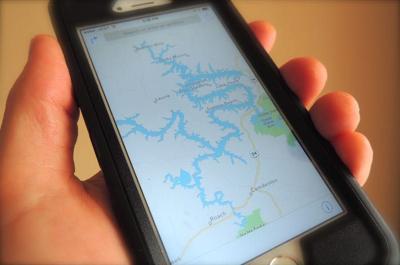

LAKE OF THE OZARKS, Mo. — You're not the only one using your cell phone. While you're making phone calls or even while the phone sits idle in your vehicle, government and private organizations are using it to track traffic patterns and measure demographics. And AirSage, one of the companies that has built the software to do it, is looking for more governments and businesses at the Lake willing to pay to track cell phone user patterns.
Representatives from AirSage made a presentation to the Lake of the Ozarks Council of Local Governments (LOCLG) board last fall in an effort to sell local municipalities technology that uses cell phone records and GPS data to track driver movements for the purpose of gathering information. AirSage calls it "The power of Where and When," and anyone public or private can have this data… for a price.
AirSage has patented population analytics that can track up to 15 billion location data points per day, covering one-third of the U.S. population.
At the Nov. 17 presentation, AirSage representatives said the data is “anonymous” and it can be used for targeted marketing, out of home media, tourism studies, equity research, insurance analytics, real estate site selection, transportation planning, and even emergency management.
According to Lake of the Ozarks Convention and Visitor Bureau Executive Director Tim Jacobsen, AirSage is still "pounding the pavement," trying to entice local governments and organizations to buy in to the product.
Laurie Mayor Scott Fahrer attended the LOCLG meeting and he reported his misgivings about the use of this type of technology at the November Laurie Board of Aldermen meeting. “I don’t like the idea of anyone tracking my cellphone,” Fahrer told the board. “I know that it is inevitable because we have opened Pandora’s box with the creation of this new technology. I do not believe that companies should be able to sell our private information without our permission.”
Osage Beach Mayor Penny Lyons also attended; she also went to a webinar presented by AirSage on Dec. 8. Lyons expressed her concerns over the privacy of the data that was collected. But she says AirSage representatives assured her that information was protected.
“They only have numbers. They don’t have names, addresses or telephone numbers. They are limited on what information they have access to,” Mayor Lyons said. “I can see it being useful for the Chambers of Commerce, the Convention and Visitor’s Bureau and the Tri-County Lodging Association.”
According to Rebecca Green, the TCLA is not currently using AirSage’s products, and there are no plans to begin using them.
Jacobsen confirmed the CVB is not using AirSage, but he said the main reason was price, not privacy. He thinks that the anonymity of the data accessed by the company puts it on par with a host of other data-trackers that offer organizations the chance to precisely target their marketing efforts—such as Google or Facebook.
"If you don’t do those things," he said, "you’re not doing what you need to do to get your fair share of the market." The Convention and Visitor Bureau focuses on promoting the Lake of the Ozarks as a year-round destination, and works with local organizations and governments to purchase targeted advertising to do so.
Last year, Cardinals radio listeners heard legendary broadcaster Mike Shannon promoting the Lake of the Ozarks in a CVB and TCLA ad buy; the bureau plans to run more ads on the Cardinals Radio Network this year.
But Jacobsen says he has no plans to add AirSage to the CVB's marketing lineup, saying the $10,000 price tag to gather a single sampling of data was simply not cost-effective.
"I think it’s a really valuable and neat… 'Wow, that would be really cool to know,'" he said. "The problem is, what is somebody going to do with that information?" And for the Lake area, he wondered, "When do you do it?"
MoDOT’s Traveler Info Map
The Missouri Department of Transportation uses this kind of data to help track traffic patterns and keep its Traveler Info Map updated to alert drivers about areas of traffic congestion. MoDOT doesn’t use AirSage, according to Traffic Management and Operations Engineer John Nelson, but does derive the data from similar technology.
Nelson said AirSage had approached the department and MoDOT was "impressed with their services," but currently isn’t under any active contract with the company.
Instead, MoDOT uses a data provider called “HERE”, which Nelson said provides "high-level" data about traffic patterns on major Missouri highways. The information comes in the form of an anonymous data stream, giving average traveler speed at various locations, as well as estimated travel times between locations.
Nelson said that information is not only anonymous, but it likely doesn’t come from just cell phones. "They don’t tell us how many vehicles that was based on, they don’t tell us where that data came from," he said, noting the data could also come from 3rd-party or in-vehicle navigation systems.
What Do You Think?
Are you comfortable with companies tracking anonymous cellphone use data to provide demographic and traffic information to governments and businesses?
The Technology
Although most new cell phones come equipped with GPS, the tracking technology AirSage uses does not depend on that. Instead, it takes the frequent signals that wireless phones (pings) send to towers and follows the movement of the phones from one tower to another. Then it overlays that data with highway maps to determine where the phones are and how fast they are moving, lumping thousands of those signals together can indicate traffic flow.
These towers are peppered across the country, and each tower services a small zone called a "cell." A typical cell is 10 square miles, but they can be smaller or bigger depending on the population of an area.
According to AirSage, this technology can be used to understand activity patterns such as home and work locations. With these locations, the company can estimate:
- An individual’s income category
- Sociological/demographic information
- Travel patterns and purposes
By synthesizing a full population, the company can leverage census data to expand its sample of 100 million devices to simulate the full population of the U.S.—about 314 million residents—in real time and historic data.
Governments have had the ability to measure traffic volumes and speeds for years. They can embed sensors in pavement, or mount scanners and cameras along the road. But those monitoring methods require the installation of equipment, which must be maintained, and can take only a small snapshot of traffic at a particular spot.
Population Analytics
AirSage currently offers four products:
- The Trip Matrix: Gathers data on the number of people and types of trips between two specific locations.
- Select Zone Analysis: The number of people and types of trips that go to, or come from, a specific location and where those trips began or ended.
- Arrivals and departures: The number of people that go to, or come from a specific location by time of day.
- Activity Density: (BETA) The aggregation of all Activity Points with an activity duration of five or more minutes in a geographic location.
AirSage can provide actual intelligence about points or areas of interest. For example a study was done at the Mall of America Metrodome in Minneapolis, Minnesota during a Vikings game on Oct. 7, 2012, between the hours of 2 and 7 p.m. The study revealed there were 14,275 unique devices, or 25 percent of the 57,562 in attendance.
AirSage also presented data collected from national park areas and bodies of water, including a map showing the home location of everyone who visited a certain park. Data was also collected from persons attending the American Cup 2013 including where they lived and their estimated income level.
According to AirSage.com, AirSage is regularly tested by independent security auditors to ensure the data coming in and going out is fully anonymous.
In addition, AirSage says they use proprietary technology that works passively with wireless providers' networks--nothing resides on the consumer's phone or slows the network. This means, according to AirSage, that there is never an impact on the carrier or the consumer.
The company states on their website that they are compliant with the Telecommunications Act of 1996; the Wireless Communications and Public Safety Act of 1999; FCC Proposed Rule-making following the CTIA petition to the FCC on Wireless Location Privacy Principles, November 22, 2000; the European Union Location Privacy, Article 9, amended July 12, 2000; and the individual privacy policies of their carrier partners.
But such assurances from companies like AirSage seem unlikely to quell everyone’s concerns. Fahrer expressed his discomfort with these kinds of cell-phone-user tracking technologies: "I don’t understand how they can track our phones and sell our information without the consumer giving them the authority to do so. And how are they going to use this information. It is disturbing to me that the cell phone companies are not just making money off selling the cell service, but they are also making money by tracking and selling our information. This has been going on since 2009, and I never really paid any attention to it, until it was brought to my front door."


