
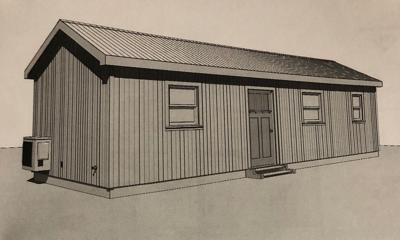
LAKE OZARK, Mo. — Construction of the first tiny homes in Lake Ozark should begin early next year after the board of aldermen cleared the way Tuesday night.
Aldermen adopted a Planning and Zoning Commission recommendation to approve a Special Use Permit for LCMC Enterprises, LLC, to build tiny homes within a C-2 (general commercial). The SUP was the final development step Matt Wright of LCMC had to meet before he can begin construction on School Road. He also will need to obtain a building permit and site approval from the Lake Ozark Fire Protection District.
Lake Ozark is the first community in the Lake area to tweak its Municipal Code to allow for the construction of tiny homes to address an affordable housing shortage. Typically, zoning regulations don’t allow residential buildings of less than 1,100 square feet. Tiny homes usually range from 300-800 square feet.
The escalating cost of construction and developing infrastructure (water, sewer and streets) can result in homes that are too expensive for service industry employees who often live elsewhere where infrastructure costs are minimal or don’t exist. Wright hopes to help meet those needs.
“I chose Lake Ozark because I live and work within the area and actually reside within a block from the development,” Wright explained recently. “The development is close to The Strip and close to a lot of jobs which would also make the trip to work very affordable for some of the future tenants. It could be a short walk or drive to work for some possible future tenants. Bottom line, there is a definite need for affordable housing in the area.”
Wright and city officials have worked together for several months to create rules and regulations that would guide quality construction and that would result in an attractive solution to the affordable housing challenges. He plans a “cluster” of tiny homes. The board of aldermen has adopted a set of ordinances specific to tiny homes.
Harrison Fry, the city’s assistant city administrator and community development director, has guided the city as it developed the tiny homes regulations.
"The city's tiny home code was built by reviewing the policies of 17 cities in 11 states. We feel confident that this is a safe and affordable option necessary for our community's growth, and this trend could fit in well in any town focused on community equity," Fry offered. “A smaller footprint has lower costs for the builder and for a tenant. An affordable option for housing gives those workers the chance to save for the future without worrying about having to leave the area to seek a good life.”
Mayor Gerry Murawski added, “This is a test project for us and the area. We have a housing shortage and we need projects like this. I think the issues can be controlled by developer.”
Tiny homes in Lake Ozark
A tiny home is a detached, self-contained dwelling unit with basic functional areas that support normal daily routines such as cooking, sleeping and sanitation. The units must be between 300 and 800 square feet in total floor area, not including lofts. They must be built on-site on a permanent foundation and cannot exceed one story (excluding lofts).
A cluster of tiny homes is one that allows for the flexibility for creative design and superior scenic quality through preservation of sensitive environmental areas and efficient use of land. Instead of a conventional subdivision, which traditionally results in buildings spaced evenly throughout the site, cluster developments allow for individual lot and setback requirements to be reduced so a group or “cluster” of units can be developed on a portion of the site. A cluster must include no fewer than four nor more than 16 units.
The central space used by all occupants of the cluster should include storm shelters, mail receptacles and community recreational areas.
Zoning expansion
The city’s zoning code has been expanded to include tiny homes in R-3 (multi-family residential) districts and C-2 districts which allow for R-3 uses. Doing so in this area on School Road simply expands the neighboring C-2 zoning.
•All tiny homes must be connected to public utilities.
•No more than three occupants will be allowed to live in the units.
•All cluster developments (4-16 homes) must comply with lot setbacks
•Cluster developments must be retained under common ownership including all tiny houses and common open spaces.
•Each unit should include at least two parking spaces with no on-street parking within the development.
•Stairways must not be less than 36 inches wide.
•Units must meet structural requirements as defined in the adopted ordinance.


