

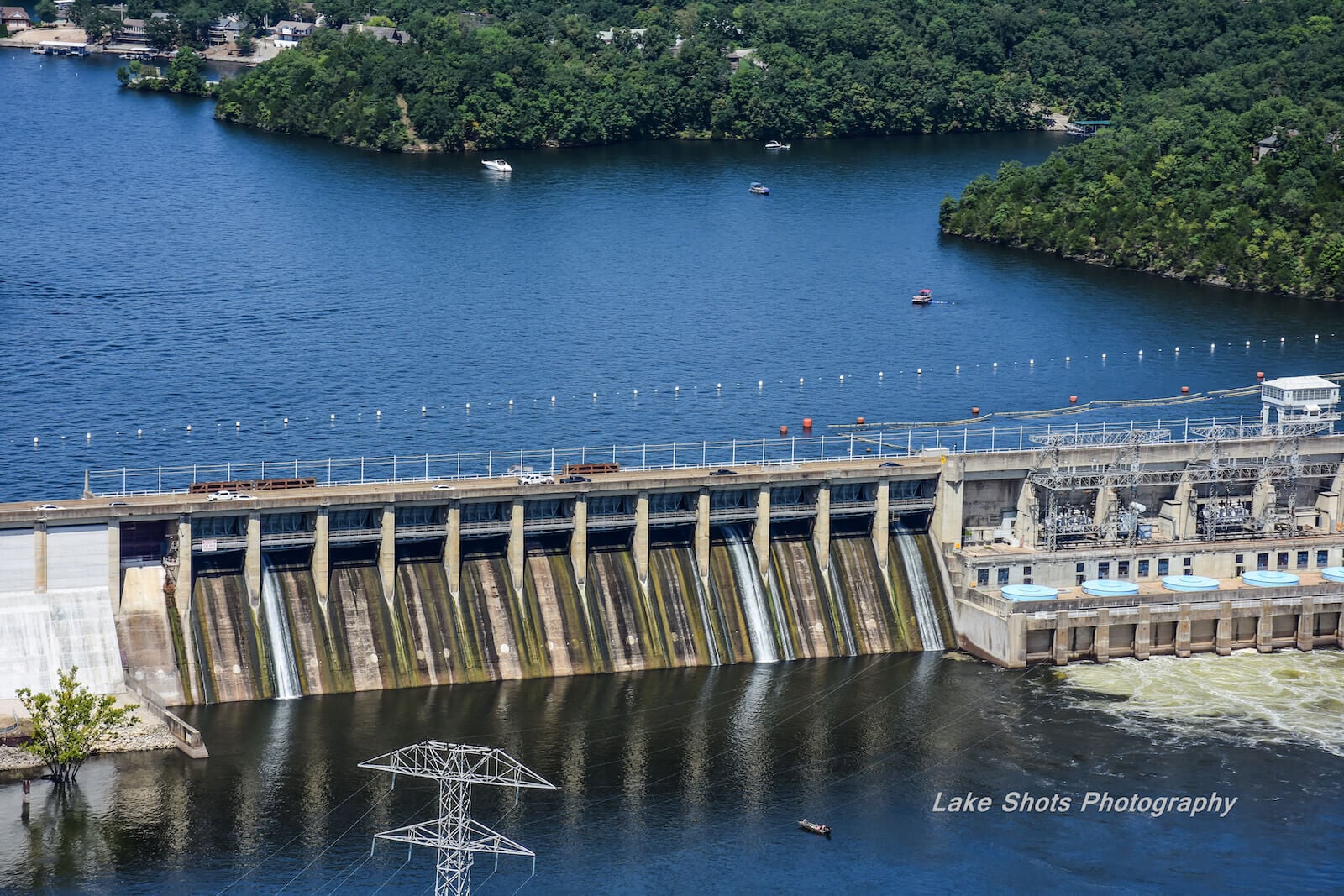
It’s a common experience for anyone who drives much in Lake Ozark. You’re headed across the Bagnell Dam bridge, staying away from a hard curb on your right. And then: a dump truck.
As your mirror misses the truck’s fenders by mere millimeters, you wonder, “Why can’t they widen this dam bridge?”
MoDOT Area Engineer Bob Lynch says there’s an answer to that question. In fact, there are three answers.
Reason #1: The Sidewalk
“The sidewalk interferes with widening the roadway,” Lynch said plainly. And removing that sidewalk would be a major change to the historic look of the dam. In 2008, Bagnell Dam was added to the National Register of Historic Places.

image courtesy of Todd Franklin
“The historical nature of the dam makes it challenging… because you’d be changing the historical aesthetics,” Lynch said. “So all of that is part of the equation.”
Reason #2: No More Wiggle Room
MoDOT actually did widen the driving surface in the 1980s, when curbing was removed from the Lake side of the bridge. That added six inches, and for these lanes, every inch counts! But Lynch notes the lanes actually do have the minimum required width—10 feet—for standard vehicle traffic. They likely just feel narrower because there are no shoulders.
“If you try to widen it you would have to just take away the sidewalk altogether,” Lynch said. But if the department opted to scrap the sidewalk in favor of wider driving lanes, it would entail some major structural work. The sidewalk sits on an overhang that would have to be re-engineered to carry vehicular traffic.
Reason #3: A Big Investment, For An Uncertain Future
The driving surface on the dam is quite literally a bridge, Lynch points out: “It’s very much a bridge attached to the dam.” There are girders on piers that sit on the dam, and a deck that vehicles drive on. That deck has been under major renovation during the fall and winter months: MoDOT closed it in September for rehab, with initial plans to reopen it before the end of 2021. The project turned out to be more complicated, and now the department just hopes to have the bridge done by the spring.
The investment required to widen the driving surface, Lynch said, would be substantial, and it would be on top of a bridge structure (the piers and girders) that—like any bridge—has a lifespan. And that lifespan means a major project on top of an aging structure might not be a wise use of limited resources.

Courtesy of the Missouri State Archives
Realistically, there won’t be a wider driving surface until there’s a completely new bridge, Lynch explained. “Over the years we’ve maximized what we can do with what’s out there,” he said. That's not a commentary on the dam structure itself: Ameren recently finished a $52 million reinforcement project, in which aging concrete was removed from the face of the dam, and the structure was reinforced through tensioned rods anchored into the bedrock. (Read more about that project below.) MoDOT just knows the actual pier-and-girder bridge system on top of the dam won't last forever.
But that's a project for another time. For now, Lynch says the 18-ton weight limit will keep most loaded vehicles—like semis and dump trucks—from coming across. That will make an immediate difference for drivers, and it will help prolong the life of the bridge, too.
Related Stories

LAKE OF THE OZARKS, Mo. — When will Bagnell Dam reopen to traffic? It’s the question nearly …

For its 85th birthday, Bagnell Dam is having some work done.

LAKE OZARK, Mo. — Aged concrete is being blasted off the face of Bagnell Dam by water jets, …

LAKE OZARK — Construction crews have poured the final yards of concrete and are completing f…


