
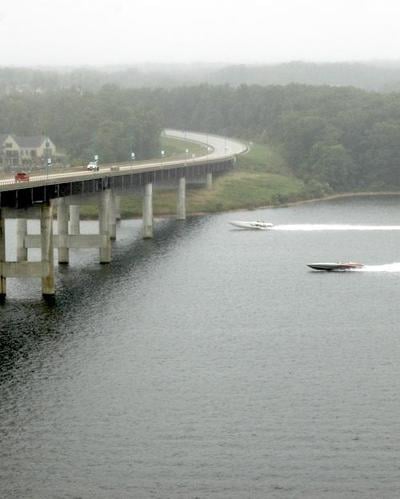

LAKE OF THE OZARKS, Mo. - The Lake of the Ozarks Community Toll Bridge Corporation was dealt a blow Friday. The United States Department of Agriculture did not approve a $41 million loan request to refinance the toll bridge and construct a straightened highway from the bridge to Route 5 on the west side of the lake.
According to insiders, the refinancing and infrastructure project designed to compliment the construction of the new Route 242 on the lake’s east side was on the USDA’s short list until the final days of loan eligibility when Congress pulled federal funding and redirected it toward a measure to stimulate job growth.
With much of the federal money gone, the package deal became too expensive.
While the feasibility of a $41 million loan at 4% is now off the table, the USDA has agreed to guarantee 90% of private loans to the Lake of the Ozarks Community Toll Bridge Corporation (LOCBC).
Some lending institutions have stepped to the plate but so far the private sector has yet to collectively produce an arrangement conducive to the retirement of $37 million in toll bridge bonds.
While the current interest rate on the bridge bonds is acceptable, the amortization is less than desirable during this period of declining toll revenue.
WHY SHOULD DRIVERS CARE?
If the toll bridge is privately refinanced, lenders will ultimately be in the driver’s seat to set toll rates.
While awaiting the USDA’s decision, consultants advising LOCBC projected an unavoidable 20% increase in tolls to drivers crossing the bridge even if the USDA loan went through - an increase from $2.50 to $3 during the season and probably $1.50 to $2 during the winter months. At the time, the consultants told the board that if the USDA loan fell through, which it now has, it recommended a 60% increase in tolls at the current traffic volume to reach a break-even point.
However, the board is cognizant of the impact a large toll hike would have on the number of drivers choosing to travel across the bridge.
Confident that an economic recovery will increase bridge usage, LOCBC is likely to continue supplying liquidity until the bridge grows to break-even - a goal currently short by $800,000-$900,000 a year.
A recent decline in revenue can be attributed to economic instability and a decline in travel. However, business minds knowledgeable of the issue also factor in the impact of the Highway 5 bypass through Camdenton, which opened in 2009.
A year-over-year comparison shows declining revenue at the toll bridge:
(Note: Each fiscal year ends on April 30)
2006: $3.5 million
2007: $3.7 million
2008: $3.8 million
2009: $3.2 million
2010: $2.9 million
WHAT HAPPENED WITH THE TRANSPORTATION DEVELOPMENT DISTRICT?
It has been shelved. The idea to create a Transportation Development District to acquire the bridge from LOCBC was a maneuver to structure ownership so the bridge would qualify for the $41 million loan from the USDA. Now that the loan has fallen through, there is no pressing need for the TDD.
HOW DID THE TOLL BRIDGE GET HERE?
The Lake of the Ozarks Community Bridge Corporation sold $40.1 million tax-exempt toll revenue bonds in 1996 to fund construction, contingency funding, capitalized interest and cost of issuance.
In 1998, LOCBC refinanced to lower debt service from 6.59% to 5.25%. The one-time advanced refunding program allowed LOCBC to borrow $43 at a lower monthly payment while getting a net present value benefit of several million dollars.
While the toll bridge has brought in $2.5-$3.5 million a year since its construction, LOCBC made interest-only payments on the borrowed money until 2006.
(J.B. Simpson is the editor of LakeExpo.com. Reach him at 573-216-4985 or LakeExpo@yahoo.com)


