
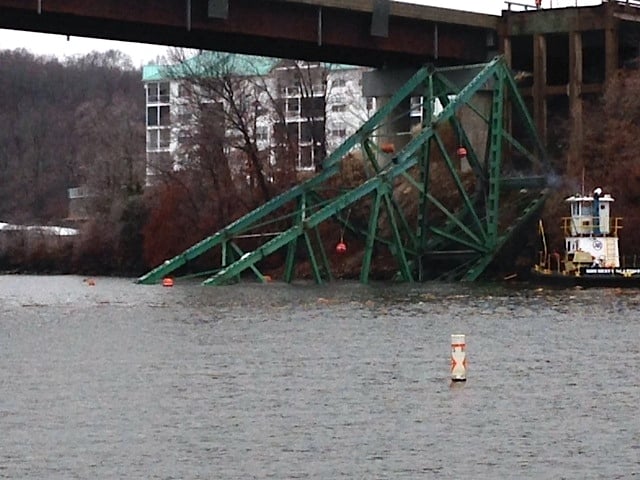
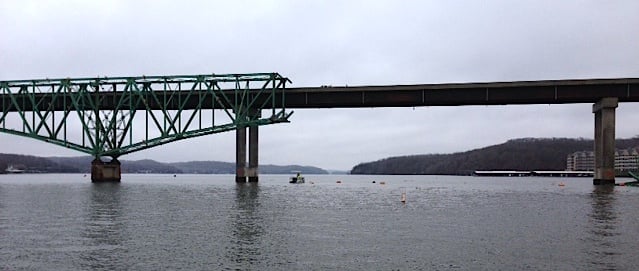

SUNRISE BEACH, Mo. — The second demolition of the old Hurricane Deck Bridge went off without a hitch on Saturday, Dec. 21, dropping a 740-foot section of the bridge, including one million pounds of steel, from the south span of the old bridge on Highway 5 in Sunrise Beach.
Some questioned if the demolition would take place with the icy weather conditions on Saturday. According to Gene McCoy, Customer Service Specialist with the Missouri Department of Transportation, once the charges are set, the demolition team has to blow them. “You can’t move or leave them,” McCoy said.
Traffic was stopped for 15 minutes on Highway 5 and one hour on the Lake of the Ozarks to protect traffic from the blasting. “The complications are different on water than on the road,” McCoy said.
Louder with more explosives
McCoy, who was present for the blasting, said he thought Saturday’s blast was louder and more visually appealing than the first blast, as 2.28 more pounds of explosives were used on the south span of the bridge. As the boom echoed across the water, individuals watching from boat shouted their approval as the demolition crew yelled, “Bridge in the water!” There were reports that people as far away as Gravois Mills and Climax Springs heard the blasts and nearby windows shook at the time of the explosion. The decibel level for each of the three blasts were said to be anywhere from 130-140 decibels—roughly equal to the sound of a 200-piece marching band or a military-grade aircraft takeoff.
Residents within 500 feet of the explosion were asked to remain indoors at the time of the blast.
The old bridge was eight spans long. Three spans were concrete girders and five spans were steel truss girders. Only the steel truss spans ill be removed by blasting. The upper concrete portion of the bridge and the road way were hauled off piece-by-piece on land.
The total length of the truss spans to be blasted is 2,180 feet. The first and second blast equaled approximately 740 feet each. The third blast in mid-January will demolish an approximately 700-foot middle section.
After the trusses are removed from the water, the concrete piers will be broken up and hauled off. Anything that remains under the water from the surface to 35 feet below normal pool will be broken into pieces by a track hoe with a large jack hammer on a barge and then picked up by a crane and taken out of the water for disposal. Anything below the 35-foot mark will stay at the bottom of the lake. All the steel will be removed.
The explosives
The blasting subcontractor is using a total of 111.72 pounds of explosives for all three blasts. 31.16 pounds of explosives were used on the first blast, 33.44 pounds were used on the second blast, and 47.12 pounds of explosives will be used on the third blast.
Explosives used in the blasts are linear-shaped charges specifically designed to cut steel. For the first blast, the detonating velocity is about 27,000 feet per second. The whole shot, from the push of the plunger to the detonation of the last charge, takes place in thirty-two thousandths of a second.
Approximately 3.26 million pounds of steel will be dropped into the Lake during the three blasts. Each of blasts one and two dropped about one million pounds. Approximately 1.28 million pounds of steel will drop into the Lake from the third blast.
The blasts will effectively have sliced the bridge into 38 pieces, which are 23 feet wide and range in length from 28–59 feet.
The next blast date has not be set, but it is expected to be somewhere in mid-January. “With the Christmas and New Year’s holidays we will allow a little more time,” McCoy noted.
The prime contractor on the new $32 million bridge replacement project is American Bridge Company, Inc. The blasting subcontractor is Duane Houkom, Inc.


