

Ask anyone in real estate-related business, and they'll tell you: the last couple of years have been kind of tough.
Not dead. But slower. And while the 2020-2022 real estate bonanza certainly skewed the baseline of "normal," it's fair to say that while real estate business hasn't been impossible the last couple of years, it's certainly been challenging.
Yes, home prices are still rising. But the national trend is that while homes above $750k are moving, and the balance of buyers has shifted strongly towards cash, home sales in lower-price tiers have struggled.
At Lake of the Ozarks, it's a little more nuanced:
On the plus-side...
• Total volume is up compared to the last two years and the Lake market appears poised to break the $1 billion mark again
• The average sale price for all listings is still climbing. That's either good or bad, depending on whom you ask.
But on the downside...
• Total transactions are down. They've been flat for the past few years, sitting around 2016-2017 levels.
• Condos have had a rough year. With well over 800 condo unit sales in 2020 and 2021, this year it will be only a little more than half of that. However, the average condo sale price has been climbing and is still at a record high. Again, good or bad, depending on whom you ask.
(Source: local MLS data.)
The National Association of Realtors thinks the national picture could change in 2026.

In an article published on Nov. 15, NAR made the case for a potential "double-digit jump" in home sales next year. The association says that jump would likely be fueled by an already trending increase in mortgage applications (signaling buyer confidence), expected lower interest rates (bringing more buyers off the sidelines), and homebuilders adding to supply.
One problem that doesn't seem likely to resolve itself soon, though, is the alarmingly high median age of first-time homebuyers. NAR wrote:
According to NAR’s newly released 2025 Profile of Home Buyers and Sellers, first-time home buyers dropped to an all-time low of 21%, well below their 40% norm. They’re also much older than in the past—a median age of 40.
Could the (hopefully) rising tide of 2026 lift all ships, including new homebuyers? Yes, but NAR acknowledges it won't help all buyers equally. NAR Deputy Chief Economist Jessica Lautz noted, “We have haves and have-nots. First-time home buyers are really struggling to get in, while those who have housing equity are building credit.”
Ready to buy a home or condo at Lake of the Ozarks? Shop listings at LakefrontExpo.com.
Thinking of selling? Contact LakeExpo Real Estate at (573) 693-1613 or click here to learn more.
The full NAR press release is below.
Real estate professionals may finally see a long-awaited surge in activity in 2026, with home sales poised for a potential double-digit jump.
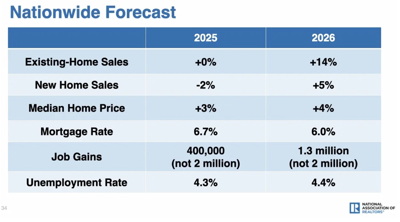
Lawrence Yun, chief economist at the National Association of REALTORS®, is forecasting a 14% nationwide increase with home sales for 2026, following 2025’s stagnating levels. New-home sales are also projected to rise 5% next year.
“Next year is really the year that we will see a measurable increase in sales,” Yun told attendees Friday at the Residential Economic Issues and Trends Forum during NAR NXT, The REALTOR® Experience, in Houston.
Rising sales won’t come at the expense of price stability either: “Home prices nationwide are in no danger of declining,” he said. NAR expects prices to climb 4% in 2026, supported by job growth and persistent supply shortages.
Early Momentum: Jobs, Mortgage Applications and Builder Activity
The groundwork for a rebound may already be forming. Mortgage applications are trending higher, job gains remain steady, homebuilders continue to add supply, and the record-breaking 43-day government shutdown—that could have delayed some recent home sales—is finally over, Yun said.
“Mortgage applications have been consistently above last year, implying that people’s desire to enter the market has been consistently positive,” Yun said. In the latest week, mortgage applications for home purchases surged 31% higher compared to a year ago, the Mortgage Bankers Association reported.
Mortgage Rates: A Slow Drift Downward
Mortgage rates remain one of the biggest constraints for buyers. After sitting around 7% at the beginning of the year, the 30-year fixed rate averaged 6.24% this week, according to Freddie Mac.
Yun expects gradual improvement ahead. “As we go into next year, the mortgage rate will be a little bit better,” Yun said. “It’s not going to be a big decline, but it will be a modest decline that will improve affordability.”
He forecasts rates to average around 6% in 2026, down from a roughly 6.7% overall average for this year.
While the Federal Reserve has initiated rate cuts, Yun cautioned mortgage rates are influenced by a wide mix of factors—including inflation, Treasury yields and federal borrowing—so buyers shouldn’t bet on 3% rates to return. Still, even minor decreases in mortgage rates could unlock substantial buyer activity, he said.
A Market of Haves and Have-Nots
But the path to a 2026 rebound won’t look the same across the market, as today’s housing market remains deeply uneven.
“The upper end of the market has been doing much better than the lower end,” Yun said, with robust inventory and strong financial markets fueling activity. Sales in the $750,000 to $1 million price range have seen some of the largest gains. Meanwhile, inventory remains constrained at lower price points.
Also at Friday’s session, NAR Deputy Chief Economist Jessica Lautz pointed to the widening gap between buyers with home equity and those trying to break into the market.
“We have haves and have-nots,” she said. “First-time home buyers are really struggling to get in, while those who have housing equity are building credit.”
According to NAR’s newly released 2025 Profile of Home Buyers and Sellers, first-time home buyers dropped to an all-time low of 21%, well below their 40% norm. They’re also much older than in the past—a median age of 40.
Young adults still aspire to homeownership, Lautz emphasized, but obstacles remain steep, like high rent, student loan debt and childcare costs. Better financial education about down payment assistance and special loan programs, like FHA, may help, she added.
Meanwhile, repeat buyers—especially baby boomers—are dominating the housing market, often buying with cash or tapping the substantial home-equity gains they’ve built over years of ownership.
Price Reductions Return as Days on Market Rise
With seasonal slowdowns setting in, sellers are rediscovering the importance of pricing correctly.
“It requires some price reduction in order to move the home,” Yun said. “Homes that sit on the market for long ... will need to reduce the price to attract buyers.”
MLS data shows price cuts rising as listings linger. Yun shared averages for reductions based on days on market:
0–14 days: 4.9% cut
15–30 days: 6.1% cut
31–60 days: 7.3% cut
61–90 days: 9% cut
91–120 days: 10.6% cut
Over 120 days: 13.8% cut
Temporary price dips may occur in local markets with rapid inventory growth, but Yun characterized these as short-term imbalances. Nationally, he expects a median 4% home-price gain in 2026, following an estimated 3% increase in 2025.
Job Growth, Inventory Trends and the 2026 Outlook
Despite talk about foreclosures ticking up, Yun said the housing market’s fundamentals remain solid, with mortgage delinquencies at historical lows, homeowners sitting on substantial equity and job growth continuing steadily.
So, while 2025 was mostly a stagnant year for housing, Yun believes the conditions for a meaningful recovery are falling into place for 2026.
Copyright NATIONAL ASSOCIATION OF REALTORS®. Reprinted with permission.


![[VIDEO]: Ferris Wheel Now Standing Tall At The Oasis](https://bloximages.chicago2.vip.townnews.com/lakeexpo.com/content/tncms/assets/v3/editorial/6/45/645bc455-286b-4556-b486-8f36b333dff4/6ab5949ebf5bf.preview.png?crop=1263%2C1263%2C0%2C60)
![Dinner With THIS View?! Inside 1932 Reserve At Lake Of The Ozarks [FLYTHROUGH]](https://bloximages.chicago2.vip.townnews.com/lakeexpo.com/content/tncms/assets/v3/editorial/b/40/b4047402-5958-4f34-92e1-36da52740fea/6aada39fabf69.preview.jpg?crop=1119%2C1119%2C240%2C0)


