

GASCONADE RIVER - OSAGE COUNTY, Mo. — A recovery team last weekend fought swift waters that killed an Owensville man in January. They battled the deadly current for eight hours to pull up the jon boat that capsized in the moments before Neal Turnbough's death.
On Jan. 30, 2015, Lyle Schultz and Neal Turnbough had been driving the 17-foot Alweld jon boat on the Gasconade River, near Morton’s Bluff, on Jan. 30, when it hit a rock and the motor failed. The boat sank in 12 feet of water. Schultz survived the incident, but Turnbough’s body was recovered from the river and he was pronounced dead early the next morning.
Commissioned by an insurance company to recover the boat, Captains Charles Meyer and Dave Anderson, of Lake Tow LLC, and Tim McNitt of Atlantis Dive & Dock Salvage LLC, traveled to the wreck site on Saturday, Feb. 7. Two local fishermen and friends of Turnbough's—Brad Jones and Craig Marquart—had agreed to assist the recovery team by lending their 17-foot jon boats equipped with jet engines: perfectly suited for running over shoals in extremely shallow water.
PHOTOS: Crew Recovers Sunken Boat In Swift Waters
A recovery team braved swift waters that killed an Owensville man on Jan. 30, as they worked for eight hours to pull up the jon boat that capsized in the moments before his death.
The following photos and captions are provided by Captain Charles Meyer, of Lake Tow LLC:
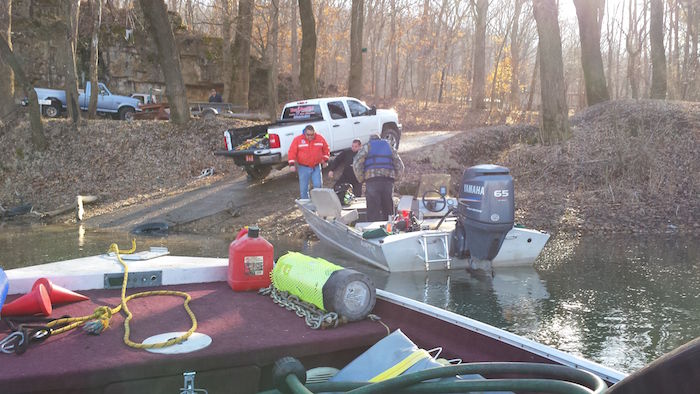
#1 - 0900 Loading equipment in two Jet boats.
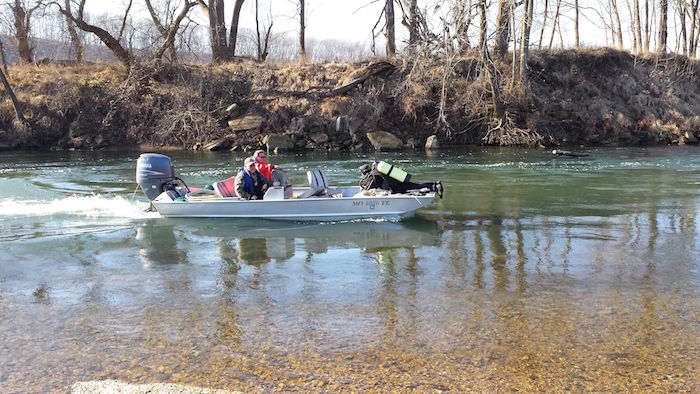
#2 - Preparing to drop Diver off on gravel bar near the wreck
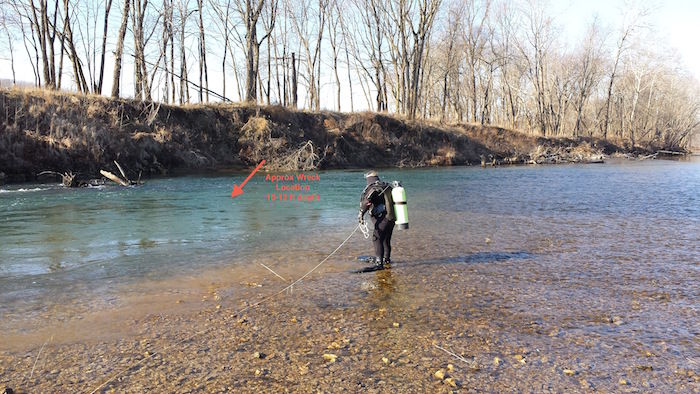
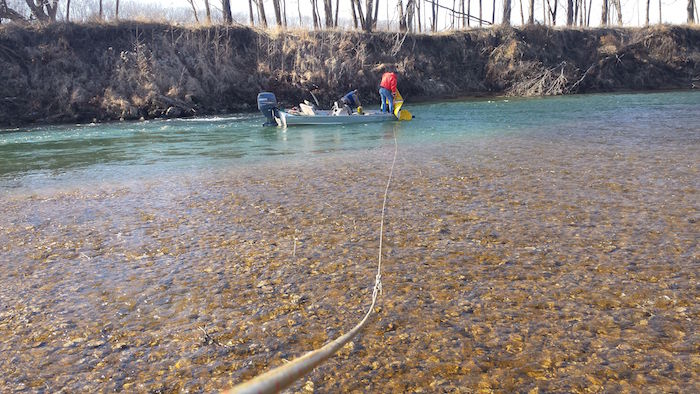
#3 - Diver McNitt works his way upstream along gravel bar, getting in to position to enter fast deep water and allow the swift current to carry him to the wreck and attach a line to it.
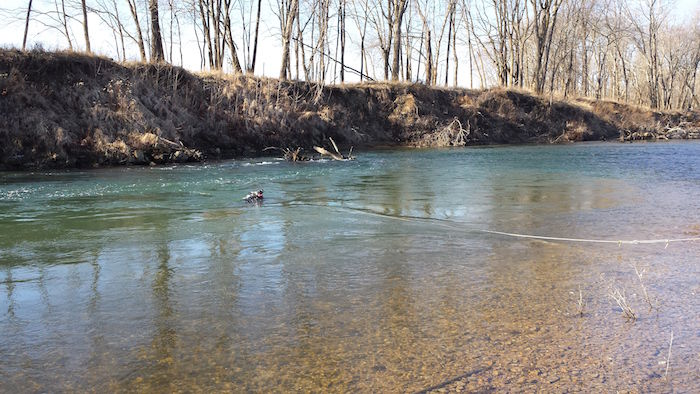
#4 - After successfully attaching line to wreck on first pass in fast water, McNItt pulls himself to shore, downstream from wreck.
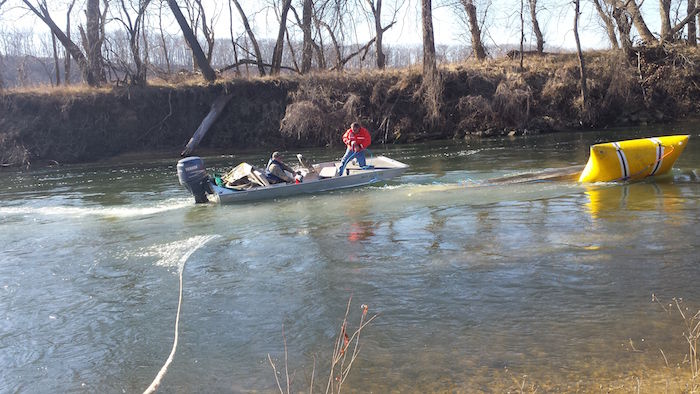
#5 - Boat hovers over McNitt, making first attempt to connect lift bag to the upside down wreck.
#6 - After several attempts the first bag is connected and inflated. Wreck begins to move downstream.
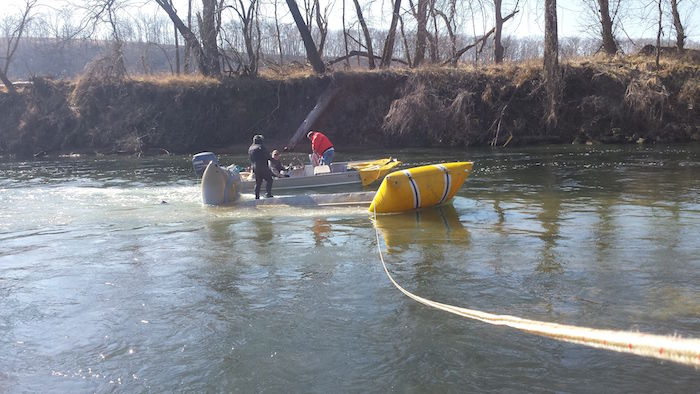
#7 - Starboard side of wreck nears surface, and begins to ground as water turns shallow.
#8 - McNitt has attached a 2nd bag to bow and later repeated attempts to roll vessel in swift water failed.
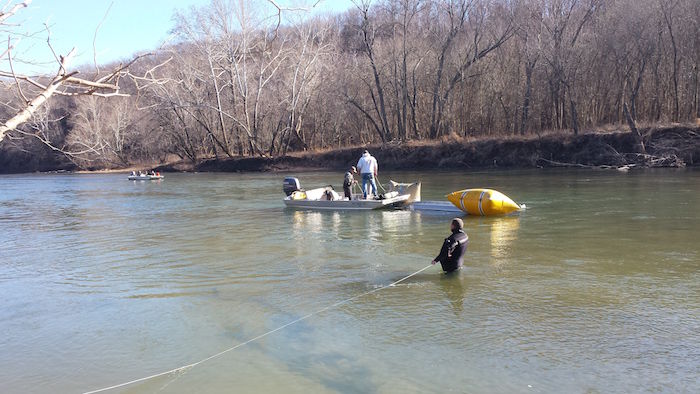
#9 - At 2:30 p.m (5 1/2 hours in to recovery) an Electric winch line, attached to tree on shore is run out to grounded wreck to winch it to shore. It had grounded on shallow shoals several times and could not be towed closer to shore.
#10 - After a struggle, crews were finally able to roll wreck and winch it to shore where de-watering begins. Wreck had to be pumped out completely to allow it to float high enough to clear the shallow rapids downstream on its way to ramp.
#11 - At 4:00 P.M., After nearly 7 non-stop hours in the water, an exhausted diver rests on the side of the wreck as pumping continues. Vessel is now beginning to float on its own.
#12 - At 4:30 P.M., Wreck in tow for ramp on the final leg of this adventure - the placid and calm looking water cleverly hides the risky and treacherous recovery story that began nearly 8 hours earlier on this river. It also quietly masks the terrible tragedy that began on that Sunday evening, January 31, 2015 with the loss of life of a 57 year old man. As we recovered this wreck with the help of several of his friends, their thoughts and prayers as well as ours were with Mr. Turnbough's family.
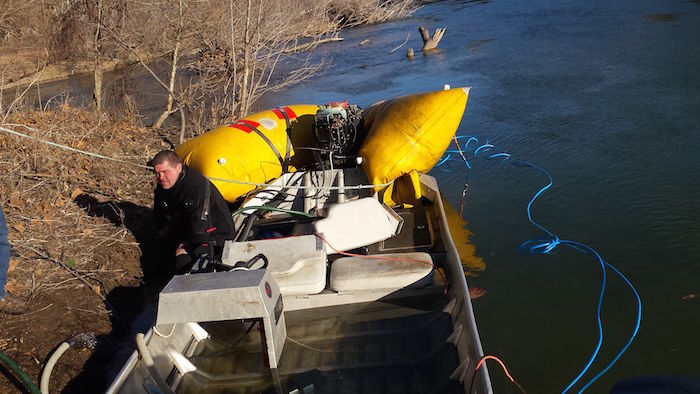

After surveying the wreck site, the team loaded the boats with pumps, lift bags, and salvage equipment and entered what Meyer described as "very dangerous conditions in fast-moving water."
The team worked for eight hours to pull up the boat, which was upside-down at the bottom of the river.
At one point, McNitt became trapped underneath the wrecked vessel.
"We nearly lost our diver," Meyer said, noting the recovery boats were nearly swamped multiple times, due to the swift current.
The team then met with a Missouri State Highway Patrol Trooper in Jefferson City so the MSHP could examine the vessel.
"The entire job took over 13 hours," Meyer said; he estimated the same task in the still waters of the Lake of the Ozarks would have taken an hour and a half.
He concluded, "As we recovered this wreck with the help of several of his friends, their thoughts and prayers as well as ours were with Mr. Turnbough's family."


