
How much is one species worth? Millions, according to the Missouri Department of Conservation.
The department has been working to build more fish-friendly bridges across central Missouri, specifically aimed at saving the Niangua Darter. More than $2 million has already spent, with at least another million planned.
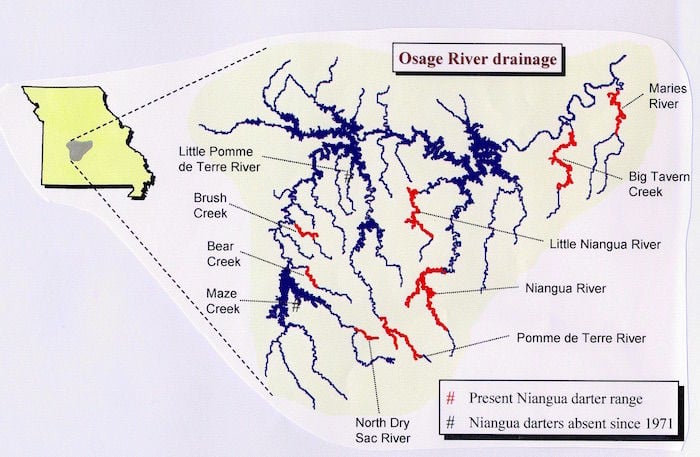
The Niangua Darter is a small fish listed as State Endangered and Federally Threatened by the U. S. Fish and Wildlife Service. The fish is originally from Missouri and lives nowhere else in the entire world. Today, eight populations survive, only in northern flowing tributaries in the Osage River basin—across just 13 of Missouri’s 114 counties. Geographically, that area is located just north of Springfield and extends up to Iberia.
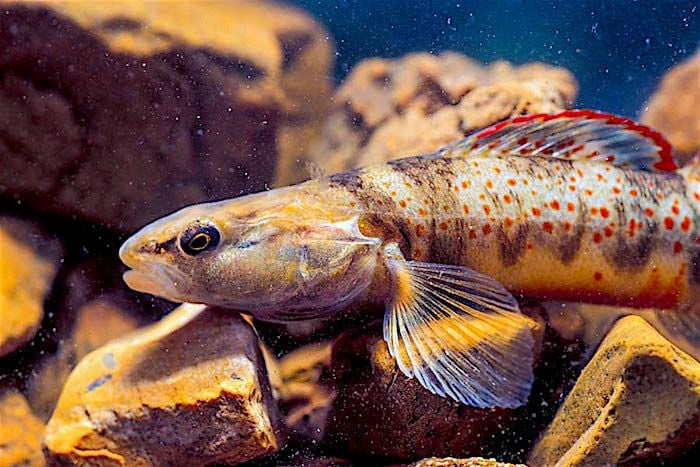
The Niangua Darter inhabits clear upland creeks and small- to medium-sized rivers with slight to moderate currents. They require constant flowing streams with silt-free gravel and rock bottoms. The fish is originally from Missouri and lives nowhere else in the entire world. Today, eight populations survive, only in northern flowing tributaries in the Osage River basin—across just 13 of Missouri’s 114 counties. Geographically, that area is located just north of Springfield and extends up to Iberia.
photo courtesy MDC
Two populations no longer exist. The MDC says more could vanish if barriers to the species’ movement and reproduction aren’t eliminated.
Why does the Darter matter? According to Craig Fuller, Missouri Department of Conservation Fisheries Management Biologist/Niangua Darter Recovery Team Leader, the Niangua Darter is a valuable “indicator species” which means the fish are highly sensitive to stream habitat and water quality. Healthy Darters signals healthy waters.
The funds spent to implement recovery efforts help ensure the fish does not die off. “Individually, maybe they are not all that important to humans or to the animal chain,” Fuller explained. “But here is how they are important; we can treat them much like we treat a canary in a coal mine: when the air is toxic they die. In the same way, when the water quality is bad, the Niangua Darter will die. These efforts ensure we are maintaining good water quality for people and animals, including safe water for drinking, bathing and recreation.”
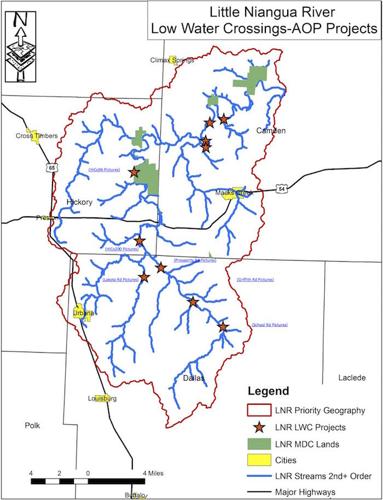
Ten low water road crossings initially identified as fish passage barriers have been replaced with low water bridges within the Little Niangua River watershed, near Lake of the Ozarks to protect the Niangua Darter Fish. The cost for these low water crossings so far, is $2,159,000.

Ten low water road crossings initially identified as fish passage barriers have been replaced with low water bridges within the Little Niangua River watershed, near Lake of the Ozarks to protect the Niangua Darter Fish. The cost for these low water crossings so far, is $2,159,000.
photo courtesy MDC
Additional projects are slated for other watersheds within the range of the Niangua Darter: one within the Little Niangua River, two within the Niangua River and two within the Tavern Creek watershed; the next five low water crossing replacement projects are slated to cost approximately $250,000 each, totaling an estimated $1.25 million.
When those are complete, the cost of saving the Niangua Darter will have reached around $3.4 million.
The work has been spearheaded by the MDC. But the department is working with dozens of federal, state, and local agencies and groups both to fund and coordinate the bridge-building projects.
Among them:
- Local Soil and Water Conservation Districts,
- The Missouri Natural Resources Conservation Service,
- The U.S. Fish and Wildlife Service,
- Missouri Department of Transportation,
- Federal Emergency Management Agency,
- US Army Corps of Engineers,
- Missouri Conservation Heritage Foundation,
- The American Recovery and Reinvestment Act
- Dallas, Hickory and Camden County Road and Bridge Districts.
Migration Problems
The Niangua Darter inhabits clear upland creeks and small- to medium-sized rivers with slight to moderate currents. They require constant flowing streams with silt-free gravel and rock bottoms.
Fuller says culvert pipes at low water crossings pose problems for the fish.
The pipes can get clogged with gravel or woody debris. “Many times if you look downstream you will see a pipe or culvert that sits above the surface of the water,” Fuller said. “Fish can’t jump into the pipe and continue on or pass through when the pipes are clogged or water is moving too fast.” Vented fords create fish passage barriers by changing elevation or velocity.
The MDC says replacing the vented fords with low water bridges and eliminating the pipes or boxes is the least expensive answer to removing barriers and facilitating fish passage.
Starting in 2004, for ten years, partners worked with the Dallas, Hickory and Camden County Road and Bridge Departments to tackle one crossing per year.
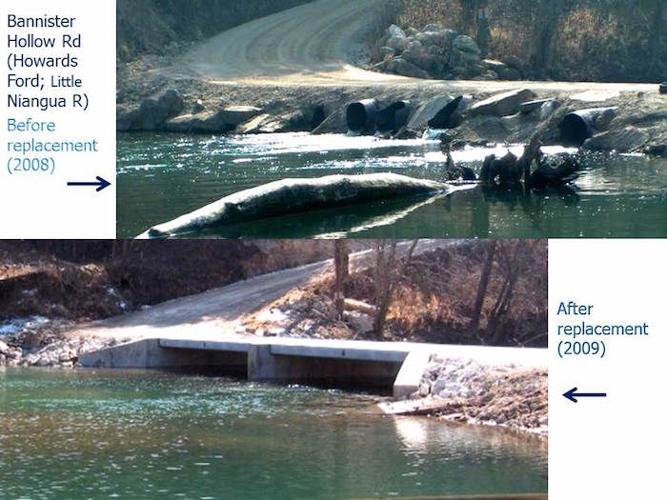
The ten bridges that have been constructed are all located in the Little Niangua River in those three counties. The four bridges constructed in Camden County are the Green’s Ford, Griswold’s Ford, Howard’s Ford and Bannister Ford, all north of Macks Creek. Those bridges—with the exception of Bannister Ford—were funded by MoDOT with LNR Region MoDOT Stream Mitigation Bank funds. The Hickory and Dallas County crossings were funded by Fisheries Operational Needs System (FONS).
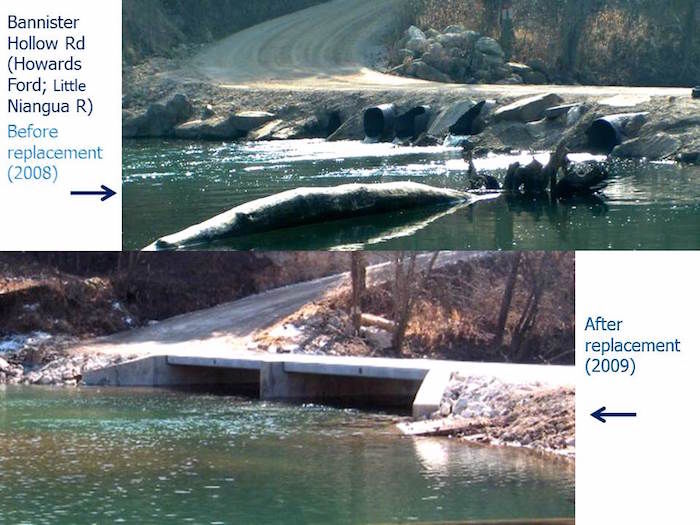
The ten low water bridges constructed throughout the Little Niangua River have created more than 55 miles of barrier-free stream flow. These crossings previously segregated individuals in Niangua Darter populations. Above: before and after photos of the Howard's Ford low water crossing.
The ten low water bridges constructed throughout the Little Niangua River have created more than 55 miles of barrier-free stream flow. These crossings previously segregated individuals in Niangua Darter populations.
A low water crossing in the Fiery Fork Conservation Area in Climax Springs will be constructed over winter 2016. The Missouri Department of Conservation has recently been working on two bridges in Dallas County and one on Tavern Creek in Miller County, South of Iberia.
Since the early evaluations, five additional low water crossings have been identified as creating barriers in the Niangua River watershed. Three are on the Niangua River and two are on Greasy Creek, a major tributary to the Niangua River. To date, two of the three projects on the Niangua River have been completed and a third is currently under construction. Partial funding has been secured for the two remaining crossings on Greasy Creek and both are planned to be completed by the end of 2017. Once all five are completed, more than 62 miles of contiguous stream habitat will exist on the Niangua River and Greasy Creek.
Fuller says that protecting and improving stream habitat and water quality will help recover the Niangua Darter while preserving our natural resources for future generations. He added that a comprehensive watershed approach is also needed to preserve stream health. Some of these can include:
- Healthy streamside corridors which can act as buffers and filters protecting streams from erosion and sedimentation
- Alternative water supplies for livestock and improved pasture management
- Gravel and sand removal guidelines that protect streamside vegetation and prevent channel alteration.
Federal, state and local officials say concern for water quality issues in the Niangua Darter’s territory means more attention is being given to water that ultimately flows into the Lake of the Ozarks.


