
A soundtrack of serenading spring peepers and endless stretches of mud signal to Ozarkians the slow awakening of spring has sprung. While we blink back the bright, warm sun, black bear mamas around the state prepare to emerge from their dens with cubs. But one female black bear that made Lake of the Ozarks headlines in 2017 will be cub-less this year.
Bear 1713 gained fame in the Lake area after exploring a Camdenton neighborhood for several days and entertaining neighbors. She is one of several dozen black bears that have been spotted on the outskirts of Missouri’s established black bear range. Researchers are specifically focused on female reproduction and cub survival rates as the bear population grows in Missouri. Bear biologists were eager to learn if our Lake of the Ozarks gal would be caring for cubs in her winter den. Her den was located, but Bear 1713 did not have any cubs, and she was out foraging.

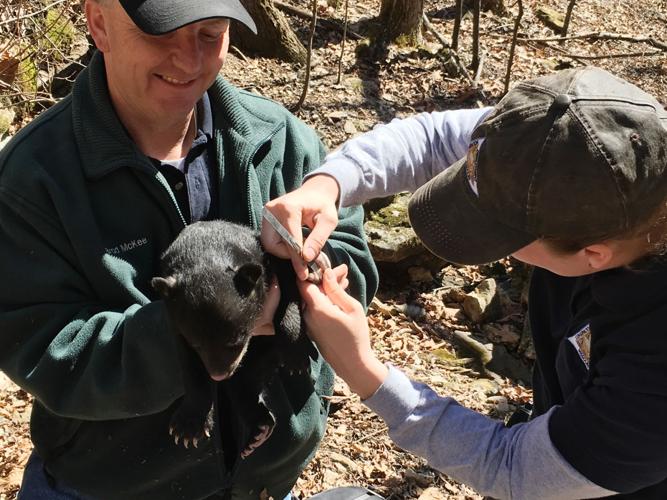
Missouri Department of Conservation Black Bear Researchers measuring a black bear cub's paw. Researchers weigh the cubs, take body measurements, determine sex and tag them with small tags microchips like the ones used on dogs and cats. Photo credit: Laura Conlee, Missouri Department of Conservation
Swipe Left?
It’s unknown why bear 1713 did not reproduce this year, but one possible reason is that she was not able to find a mate during the summer breeding season. Since she lives in a less dense bear population than her more southern counterparts, it may be more difficult for her to find a suitable partner.
Black bears also have a unique reproductive technique that can prevent an embryo from forming under certain conditions. They mate in the summer and cubs are born around January or February, but their gestation is only a few months long. If you’re doing the math and it’s not adding up, that’s because bears have the amazing ability to delay implantation of the egg until summer is over and the body knows whether she is healthy enough to carry a cub through winter.
If you’re not a biology geek, you'll want to skip this paragraph. For the nerds like me, I’ll break down the mechanics of delayed implantation, also called embryonic diapause. After breeding in the summer any fertilized egg, called a blastocyst, will begin cell division and then press the PAWS button (sorry, that one was too easy). Cell division temporarily halts while the blastocyst floats, unattached, in the bear’s uterus. After a full season of foraging and eating has taken place, the bear's body determines whether the female has enough body mass to live off of while hibernating, keeping in mind that she will need to keep her own body going, and grow and nurse the cub all without access to food in her den until spring comes. Implantation of the egg and cell division will resume under ideal conditions around November, with the cub(s) born around January. Mom then nurses cubs from within the den until spring when the whole family emerges.

LAKE OF THE OZARKS, Mo. — A female black bear sporting an awfully trendy tracking collar has…
Why Wasn't She In Her Den?
Bear hibernation isn't technically a true hibernation; instead, their metabolism is cut in half when food resources and temperatures are low. They can “sleep” for months without eating, drinking, defecating or urinating. This incredible environmental adaptation helps them survive the worst time of the year. They will also enter into a phase of "walking hibernation" when weather conditions do not warrant a full hibernation, which is what researchers think 1713 was doing.
Most of us think that bears den in caves, because... well, that's where most bears live in cartoons and video games. But in Missouri, bears actually have a number of options beyond caves. Bears, including 1713, often make a den from a blown-over tree root structure, by piling leaves and mud around it.
Is the Lake of the Ozarks Really Bear Country?
Are Black Bears Dangerous?

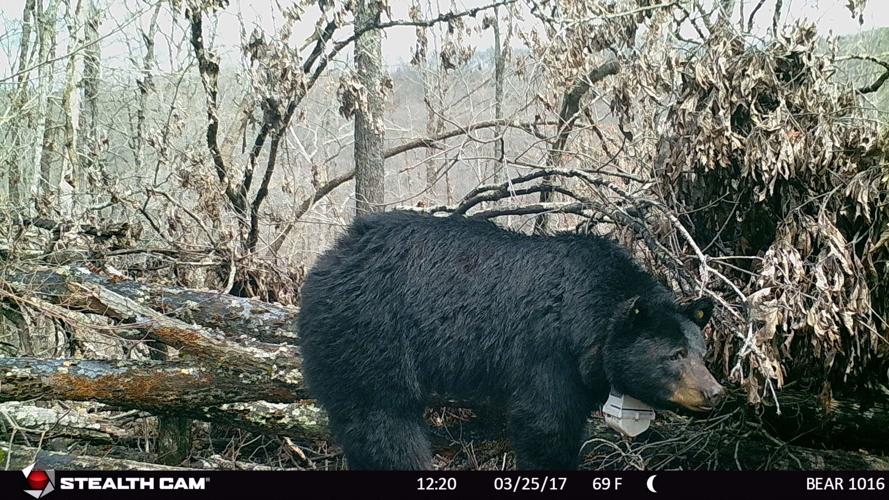
Missouri Black Bear with a tracking collar and identifying ear tags. Photo credit: Laura Conlee, Missouri Department of Conservation Trail Camera.


