
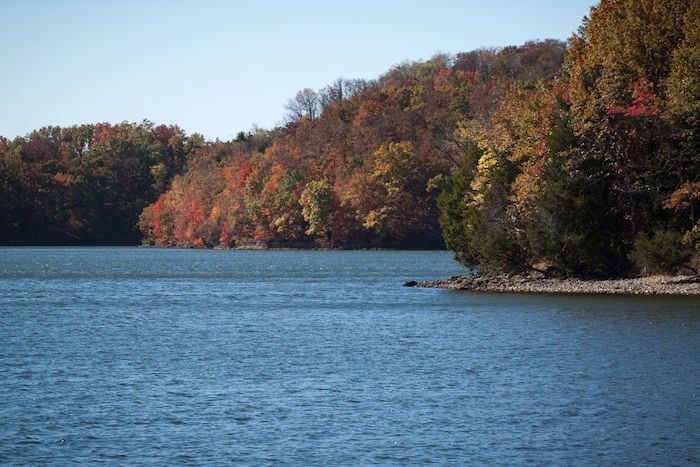
LAKE OF THE OZARKS, Mo. — In February of 2011 the Department of Natural Resources awarded a $740,000 grant to the Lake Ozarks Watershed Alliance (LOWA) for a four-year project to address storm water-related pollution affecting the Lake of the Ozarks. The project focused on non-point source pollution in the Buck Creek and Lick Branch sub-watersheds, which begin at Bagnell Dam and encompass the first 18.8 miles of the lake’s main channel as well as coves. This area was chosen largely because it is the most urbanized area of the lake. It includes Osage Beach, Lake Ozark, Laurie, Sunrise Beach and the Village of Four Seasons, which have experienced a 150 percent population increase from 1980 to 2000.
To form a baseline, during a 20-week period in 2011, water samples were taken by trained volunteers from three types of coves – coves where homes were primarily served by individual septic tanks, coves served by regional sewer plants and coves that were undeveloped. LOWA Project Manager Caroline Toole said samples were then tested for phosphorus and nitrogen, which are nutrients; total suspended solids – sediment; water clarity; and E. coli.
Because LOWA hoped to change the numbers and not just report them, in 2011, the organization also began a public awareness campaign that included demonstration projects, community education and outreach designed to encourage homeowners to participate in LOWA’s “Beautiful Yards for a Healthy Lake” project. Under the program, Trained Volunteer Evaluators (TVE) from the Master Naturalist and Master Gardener programs visited the homes and assessed the property, then helped homeowners build low-impact landscaping or rain gardens into their yard designs; use rain barrels to catch roof runoff and install rip-rap along their shorelines. For those in the focus area, the grant paid up to 40 percent of the total project cost up to a maximum of $5,000 and the partnering company discounted a portion of the bill up to a maximum of $500.
The second phase of the project began May 2014. Once a week for 20 weeks volunteers revisited the same coves as in 2011 to see if there was an improvement in water quality from the original samplings. However, this time one of the variables was changed. Toole said that starting the week of July 7, they started pumping septic tanks at the head of Lick Branch Cove.
“We sent letters and emails, we made phone calls and ended up getting in contact with every single homeowner. We ended up pumping 62 tanks – 48,500 gallons – at a cost of $5,410. A&A Septic, who did the pumping, made an in-kind donation of $2,790. It’s not official yet – all the samples haven’t been analyzed – but it looks like it might have made a difference,” Toole said, adding that the difference was small because none of the samples collected during the entire period showed high amounts of E. coli. “However, it might be enough of a difference to help the people in Rocky Mount get their sewer district.”
On May 23, 2011, samples taken in Cove 1 showed E. coli amounts of:
- Site 1A - 8.4 per 100 mL
- Site 1B - 6.3 per 100 mL
- Site 1C - 7.4 per 100 mL
- Site 1D – 4.1 per 100 mL
On May 20, 2014, samples in the same cove :
- Site 1A - 7.4 per 100 mL
- Site 1B - 3.0 per 100 mL
- Site 1C - 5.2 per 100 mL
- Site 1D - 11.0 per 100 mL
Although rainfall influenced the readings in early September 2014, numbers were down substantially in sites 1C and 1D. The 2011 and 2014 samples results can be found by visiting http://www.dnr.mo.gov/loz/loz-waterquality-study.htm.


