
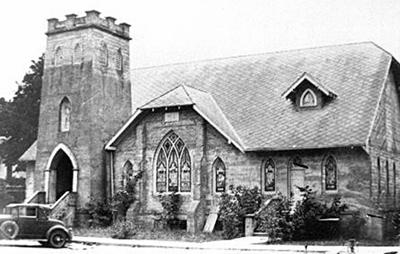



There seems to be an air of mystery when the subject turns to what is under the waters of the Lake of the Ozarks. After 80 years there are few folks around who clearly can remember what the Osage River valley looked like before it was inundated by the lake. And although a few old maps turn up from time to time, most of them provide little detail.
One of the more frequent stories that bear witness to this mystique is the sighting of a certain church steeple that can be seen just under the waves when the lake is low.
Like any genuine mystery, this one is a little vague. When pressed for details about it, the typical boathouse conversation goes like this:
“What is it?”
“It’s a church steeple.”
“Where?”
“Well, under the lake. You can see it when the lake’s down.”
“But where exactly is it?”
“It’s down there by….Oh, heck, you know—that cove.”
“What cove?”
“Gosh, I can’t remember. But everybody knows about it.”
“Have you seen it?”
“Naw. Well, maybe I did; I dunno. It’s been awhile. Heck, Joe’s seen it—ask him.”
Joe, in his turn, would refer the inquiry to Tom, or Bill, or Mary. Along the way, someone would add the interesting fact that not only is the steeple visible at times, but on quiet nights one can hear its bell softly ringing. And while many seem to know about this mysterious steeple and its bell, few have first-hand knowledge of its exact whereabouts. But recently a gentleman came forth who flatly stated in the presence of this writer that the church steeple is in Linn Creek Cove, where he has seen it in low water seasons, and where it dwells still, awaiting another droughty year to rise to within a few feet of the surface and boldly sound its bell.
This is an amazing revelation, and one that greatly adds to the lore of the lake. Imagine, a whole church down there under the waves, with its steeple eerily reaching upward through schooling fish and intermittent layers of green- and yellow-filtered light. But there are problems with this romantic vision.
The town of Old Linn Creek—lying on the bottom of the lake these eight decades—boasted of three churches in the last years of its existence. The Christian church was a simple, white, wood framed structure; the Baptist church was brick and wood. Both featured attached wooden bell towers. The somewhat larger Methodist church was built of stone, with a high vaulted roof and a stone bell tower that somewhat resembled a squared castle turret. All three churches were within a half-block of each other along Main Street. Today, that same stretch of Main Street is under 30 to 40 feet of water.
Before the old town of Linn Creek was abandoned to the rising lake in the early months of 1931, most of its one hundred-plus buildings were razed. The wooden ones were burned, including the Christian and Baptist churches with their bell towers; the stone and masonry structures were knocked down. The Methodist church was both burned and knocked down, but not before the stained glass windows, pews, flooring, and the bell were removed to be included in the new church just then a-building in the relocated Linn Creek.
Photographs taken during the winter of 1930-31 clearly depict the old town in various phases of destruction. Several of the photos were published in the book, Before the Dam Waters, by T. Victor Jeffries. One shows the gutted remains of the Methodist church with the underpinnings of its bell tower knocked out and a heavy cable attached through a hole in the upper portion of the steeple. The caption states that the tower is about to be pulled over. Another photograph, the most telling, was taken sometime later and clearly shows the area of town where the three churches once stood. Nothing taller than a man's head sticks up among piles of stacked bricks and broken rubble.
So what is it that people claim to see below the waves in Linn Creek cove? First of all, there is the “wanna-believe” factor. Folks want to believe that they see things in the water. As any fisherman or boater will attest, it’s common to imagine that one sees the bottom, even in the deepest part of the lake. It’s simply a mirage of sorts—a play of light and shadows on the surface and few feet below the surface. But it is a convincing illusion.
Too, there are a couple of structures that look like church steeples jutting out of the water at other locations around the lake. One of them is the lighthouse at mile marker 38. It sits atop a low jetty that extends out a considerable distance from shore. At certain vantage points the jetty is nearly invisible and the lighthouse appears to rise directly out of the lake. And in profile it looks like a steeple.
Then there is the old iron smelter in Bollinger Creek Cove. It’s an impressive stone structure that seems entirely out of place half-submerged along the shoreline. It very closely resembles the shape of the old Methodist church bell tower, though it’s located miles upstream from Linn Creek Cove.
And what of the claim that a bell tolls from under the waves? Bells don’t resonate underwater. Slap two metallic items together underwater and the resulting sound is more like a muffled “clunk.”
Given, then, the available evidence and it would appear that the mystery of the submerged church steeple and its ringing bell—like many rumored tales—is nothing more than a collection of misunderstood facts. Someone sees an illusion of light playing on the water; someone else chances upon the old smelter and wonders about its origin; yet another person comes across photos of Old Linn Creek and imagines the buildings still standing down there. The stories are told and retold—and combined, and embellished. Eventually a mysterious legend is born.
That is the convenient way of explaining it. But consider one other.
The bell still tolls, though not from under the waves. It rings from the new church, located four miles up the valley. And when, through unexplained means, its heralding chime echoes over the very spot where the old church once stood, it can stir the soul with a powerful and tangible sense of the past.
When people hear the faint pealing of the bell and then see the watery outline of a steeple long removed—and believe that what they are sensing is real—they may in fact be unknowing witnesses to something quite extraordinary.
There is so much more to this world than our minds can grasp, and we are often too quick to dismiss the inexplicable. The old Methodist church was a place of profound emotion. Consider the prayers that were offered up from that hallowed spot—prayers of joy and grief; heartfelt prayers of petition and of thanks that defined the special moments of a lifetime. Though the building was reduced to rubble a lifetime ago, might not the spirit of the place dwell there even now?
That, dear reader, may be the only plausible explanation for the legend of the phantom steeple. Maybe it is there after all.
Happy Halloween!


![[VIDEO]: Ferris Wheel Now Standing Tall At The Oasis](https://bloximages.chicago2.vip.townnews.com/lakeexpo.com/content/tncms/assets/v3/editorial/6/45/645bc455-286b-4556-b486-8f36b333dff4/6ab5949ebf5bf.preview.png?crop=1263%2C1263%2C0%2C60)

