
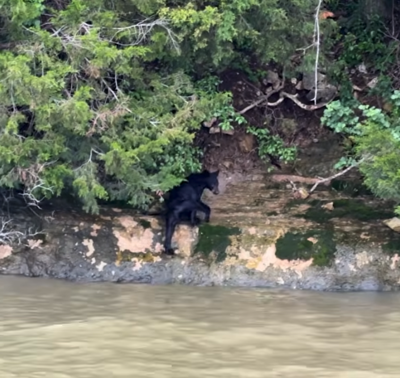
The Lake community has been abuzz with photos, videos, and tales of bear sightings over the past few weeks.
Black bears are nothing new at Lake of the Ozarks; although the species had been essentially absent in the region for decades, black bears have been making a comeback and are being seen more frequently throughout the state.
LakeExpo's Robby Bruewer spoke with Maddie Est, of the Missouri Dept. of Conservation, about why the sightings seem to be more frequent, and what Lake residents ought to do if they see a bear.
The interview is republished below, with slight edits for readability.

Cyler Jackson from Performance Boat Centers shares with LakeTV his wild first-hand account of nearly hitting a black bear swimming across the main channel at Lake of the Ozarks.
Q: Are you seeing an increase in black bear sightings around the Lake of the Ozarks?
Maddie Est (MDC): We do typically see a higher number of interactions in populated areas during the spring. As bears come out of hibernation, they're starting to look for food, so it's not uncommon for us to hear about an increase in sightings. It just happens to be the Ozarks this time.
Q: We've received several videos of bears in different areas. Are those likely different bears, and do you have any way of tracking them?
Maddie: It depends. We have conducted population studies that involved marking and identifying black bears, but not every bear in the state is marked. When it comes to sightings, unless we're able to visually confirm that a bear has been tagged in the past, it can be difficult to determine whether it's the same bear or a different one.
As for numbers, black bears are most commonly found in the Ozarks, particularly around the Mark Twain National Forest. Their range generally extends from the Arkansas border diagonally toward the St. Louis area through the core Ozarks. However, bears can show up nearly anywhere in the state. Often, those wandering bears are younger animals looking for a place to establish themselves.
Q: One of the videos showed a bear swimming in the Lake. Is that unusual?
Maddie: I don't know that I would call it unusual. I'd say it's unique. I have very rarely seen video like that. Usually when we receive footage of black bears, it's near dumpsters or other areas where food sources are available. So I wouldn't say it's unheard of, but it is pretty cool.
Q: What should someone do if they see a bear near their home, especially if they have kids or pets?
Maddie: First and foremost, when we know bears are in the area, we recommend removing any food sources. Bears, like any living thing, need food to survive, and if they find an easy source—such as trash cans, bird feeders, or pet food—they're likely to return.
If a bear is hanging around, secure those food sources and the bear will typically move on to find food elsewhere.
We also recommend giving bears plenty of space. That's true for any wildlife. Most wild animals are not interested in interacting with people. If you leave them alone and give them room, the odds are they'll do the same.
MDC also accepts bear reports. If you spot a bear, you can visit mdc.mo.gov to find your local contact and report the sighting. We can help guide you through any steps that may be appropriate for your specific situation.
Q: Are these sightings the result of bears being relocated by the Missouri Department of Conservation, or is this a natural population increase?
Maddie: Black bears were once abundant in Missouri, but by the mid-1800s they had become very rare. By 1931, they were believed to have been extirpated from the state.
In 1958, Arkansas began reintroducing bears, and over time we started seeing more sightings in Missouri. In the early 2000s, as bear numbers continued to increase, MDC began discussing ways to better understand the state's population.
In 2010, we launched a population study and determined there were around 300 bears in Missouri at that time. Researchers also conducted genetic studies and found something very interesting. In Webster and Douglas counties in south-central Missouri, there was still a small remnant of Missouri's historic bear population, in addition to bears that had expanded northward from Arkansas.
That showed us bears may not have been completely extirpated from Missouri the way we once thought.
Since then, Missouri's black bear population has continued to grow. That's one reason MDC established a highly regulated black bear hunting season in 2021. The goal is to manage the population while ensuring it continues to grow at a sustainable rate.
Q: So these recent sightings are simply part of a growing bear population?
Maddie: Yes, that's correct. It's part of the population continuing to expand and grow.
Interviewee: Maddie Est, Media Specialist, Missouri Department of Conservation.


