
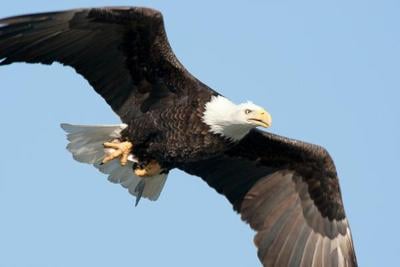
Ameren Missouri customers and local bird population will both benefit from recent upgrades near the Osage Energy Center. While crews were installing new transmission lines, they also installed state-of-the-art flight diverters to prevent collisions between birds and high-voltage lines. The work will protect wintering bald eagles as well as other species who live in or migrate through the Lake area.
Video courtesy of Ameren Missouri
Ameren Missouri conducted an environmental assessment that recommended installing flight diverters every 30 feet along the new power lines. Utilizing a specially designed drone, more than 300 highly reflective markers have already been installed on power lines. Each diverter can glow in the dark, offering around-the-clock visibility. Most bird collisions happen in low light conditions.
“Just as anglers enjoy the stretch of the Osage River below the dam, so do birds," said Kurt Rakers, supervising engineer at Ameren Missouri. "These diverters provide protection in all conditions to reduce the possibility of contact with power lines. The reflectors do not restrict the birds from hunting or any other activity."
The efforts at Osage Energy Center are part of Ameren’s companywide program to protect avian populations at transmission and distribution (T&D) facilities. The program was developed in cooperation with the U.S. Fish and Wildlife Service (USFWS) and includes commitments to:
- Retrofit facilities at highest risk of avian incidents or wherever incidents occur.
- Develop avian-safe standards for all new T&D construction projects.
- Train Ameren Missouri line, engineering, and support co-workers on avian-safe practices.
- Report any incidents to the USFWS.
- Invest in avian health partnerships, such as support of bird rehabilitation centers like the World Bird Sanctuary and Illinois Raptor Center.
“We have been intentional about taking protective measures to protect birds throughout our region,” added Randy Hunt, supervising engineer at Ameren Missouri. “Our avian protection programs have resulted in reduced avian-related incidents within our service territory and have become a model for other utilities.”


