


The Lake of the Ozarks hosts many unlikely guests and odd transients. Through twists of geography, and our proximity to the Mississippi river, we are blessed to be along the migratory path of a huge variety of water fowl and “Sea Birds.” In our little corner of the Midwest, birders can observe species that are more evocative of the North Atlantic and Gulf Coasts than they are of the Ozark Mountains.
When I was a kid growing up in Northern California, one of my favorite sea birds to watch was the pelican. Pelicans are such a great illustration of the concept of dichotomy in nature. They are absolutely fabulous in flight, soaring effortlessly in the thermal and wind currents that rise up along coastal cliffs and off the faces of waves. And yet they are almost ridiculous on the ground, as if all three Stooges had been genetically grafted to Jerry Lewis in some secret Monsanto DNA lab. How awesome, then, to find these same birds here at the Lake of the Ozarks!
Each year from March into June, The American White Pelican (Pelecanus erythrorhynchos, for those of you who still enjoy Latin) heads north on its migration along the Mississippi Flyway. The pelican depends heavily on Missouri’s lakes and rivers for places to rest and eat, gathering strength along the way. We don’t see young pelicans here at the Lake; what we get are the adults on their way to the nesting grounds of the Northern Midwest, Canada, and the Western states.
Pelicans in flight resemble nothing so much as a majestic image of ancient Pterodactyls. With their wingspan of nine-and-a-half to 10 feet (which is the second largest in North America, behind the California Condor), their slow and steady wing beat, the elongated beak, and their ballet-like use of air currents, they conjure for me the perfect image of grace that I associate with the bygone winged dinosaurs. On the ground, the White Pelican is a lumbering, waddling, feathered clown, the virtual opposite of its in-flight persona. On the water, they are almost swan-like in their effortless swimming… except when fishing! These contrasts are what I find most interesting and endearing in the pelican.
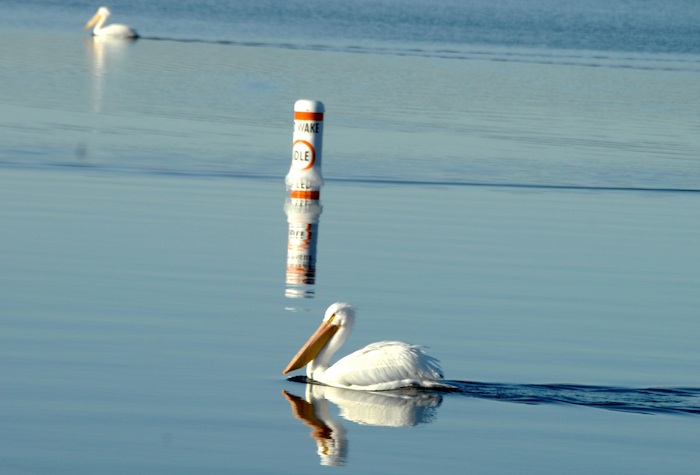
A White Pelican putters past a No Wake buoy, along Pelican Point at the 6 Mile Marker of the Lake of the Ozarks.
When hunting, White Pelicans work in groups to herd fish, rounding them up into tight schools, before scooping them up in their massive beaks. Pelicans swimming in a line make a great ruckus of splashing feet and wings to get the fish moving in the right direction, and may even work as two or more lines of birds converging on each other to trap fish in the middle. The characteristic skin pouch at the base of a pelican’s beak can hold up to four gallons of water at a time, which is more than four times the volume of its stomach. Excess water is expelled from the corners of the mouth before fish are swallowed.
Birds of this size, up to 30 lbs, need a lot of food. Pelicans consume up to four pounds of fish, crawfish, and amphibians each day. Although the Pelican has it all over human anglers, they mostly eat non-game species such as shad, chub, and catfish: their bad reputation for damaging commercial and sport fisheries is largely unearned. Lake of the Ozarks anglers have little to fear from their presence.
At one time, White Pelicans flew through the Ozarks in flocks numbering in the thousands. The Lewis and Clark expedition noted pelicans resting on sand bars along the Mississippi River too numerous to count. Populations declined until the 1960s, but have rebounded and stabilized over the past several decades. While the thousands-strong flocks have not returned, flocks of up to 200 are not unheard of.
The good news is that pelican season has come round again! With the Lake finally thawed out, a group of over forty of these birds was spotted yesterday at—where else?—Pelican Point at the 6 Mile Marker. Even if they are not a portent of the (hopefully!) coming and eagerly anticipated spring, they are a great diversion for birders and non-birders alike. Watch for them fishing in the shallows, soaring along cliff faces, and staggering like drunken sailors down docks. These guys are truly remarkable and well worth taking some time to get to know.


