

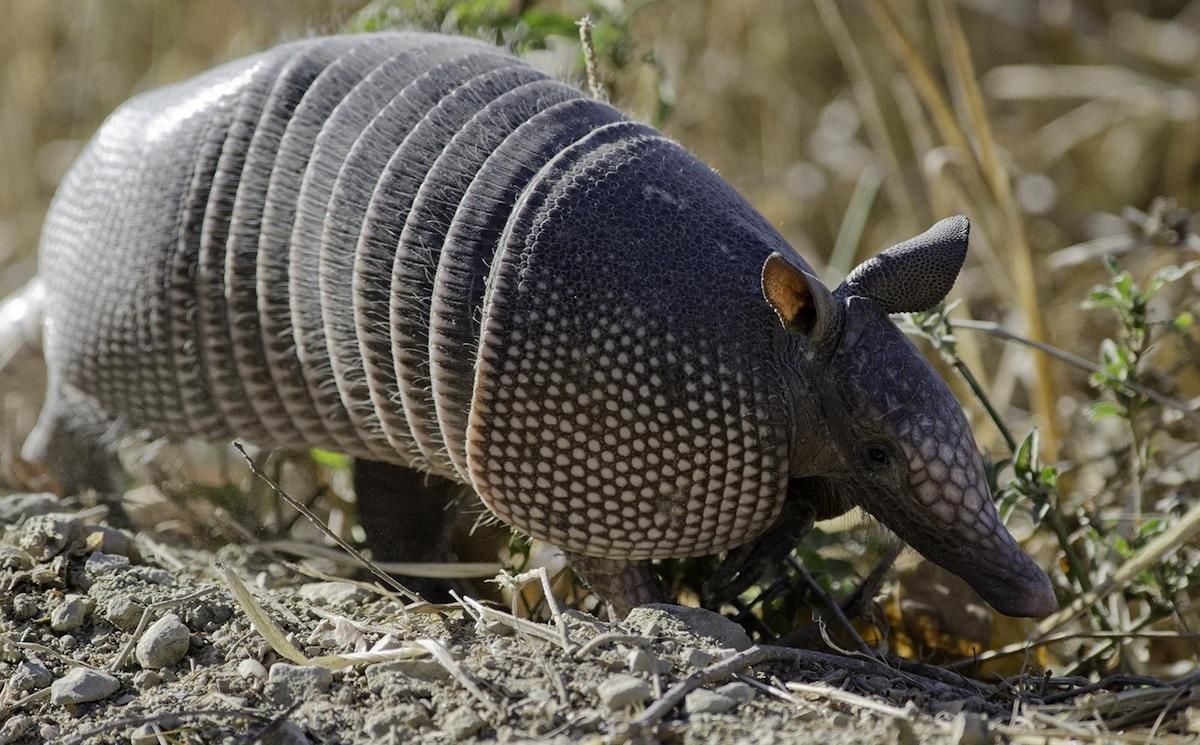
Talk to someone who grew up in central Missouri, and they'll tell you: a few decades ago, armadillos were nowhere to be found! But now they're here, and though they're a frequent candidate for roadkill, these little diggers have a curious history.
Missouri is known for its temperature extremes: it can be awfully hot in the summer, and brutally cold in the winter. And while some Missouri animals are well adapted to tolerate the cold in particular—like squirrels and black bears—others, like the armadillo, seem to survive despite major disadvantages.
The nine-banded armadillo that now calls Missouri home is actually native to rainforest habitat in South America. They arrived in the United States sometime in the 19th century in two different ways: one population came in through Texas after crossing the Rio Grande and a second was introduced in Florida. Because they eat just about any insects or grubs, armadillos adapted well in the U.S. Being nocturnal, they spend their evenings rooting around, a bit chaotically, looking for worms, ants and other invertebrates. These night-loving nit-wits are not the brightest bulbs of the animal kingdom, but they do have a few unique tricks up their nearly hairless sleeves that make them contenders for some of the most oddball critters in the Ozarks.
1. All Puffed Up. They crossed the Rio Grande: quite a feat for a mammal that generally weighs less than 15 pounds and has claws for digging through dirt, not meant for swimming. How'd they pull it off? Armadillos can float! They are able to inflate their intestines to help them float across rivers.

2. And Exhale... They can also do the very opposite, sinking to the bottom of a riverbed and walking across the bottom, which is only useful if they can hold their breath for a while... and they can do that: for up to six minutes. That skill comes in handy when they are rummaging around in the dirt for food.
3. Hibernation... Sorta. Being native to South America, winter's cold forces armadillos to hunker down to survive. Technically they are mammals, but their hair is sparse and hardly visible, so for warmth they stay in burrows several feet deep. Those digging-claws enable them to burrow deep down, where the ground heat lets them survive in a state of semi-hibernation. But armadillos can't really hibernate, and they can’t store much fat, so as soon as winter offers a sunny day, these South American critters come out for some snacking before retreating from the cold again!
video by Allison Jungheim, Senior Keeper, Como Zoo, St. Paul Minnesota
In the winter, Missouri has enough warm spells that armadillos get occasional chances to get out, stretch their legs, and forage for some delicious delicacies of the dirt. Many scientists suspect that Missouri may be at the northernmost limit to the armadillo's habitat because they wouldn't be able to tolerate the cold any further north... but only time will tell.
Missouri does not have a hunting or trapping season on the nine-banded armadillo because it is not native to the state. State regulations allow property owners the right to kill an armadillo that is causing damage to their property. If you’d prefer to rehome your problem armadillo, there is also a very helpful video here showing you how to live trap and relocate them to a more desirable spot. Just remember that wherever they are, armadillos will want to dig, so your neighbors might not take too kindly if you evict your pesky armadillos onto their property!


