
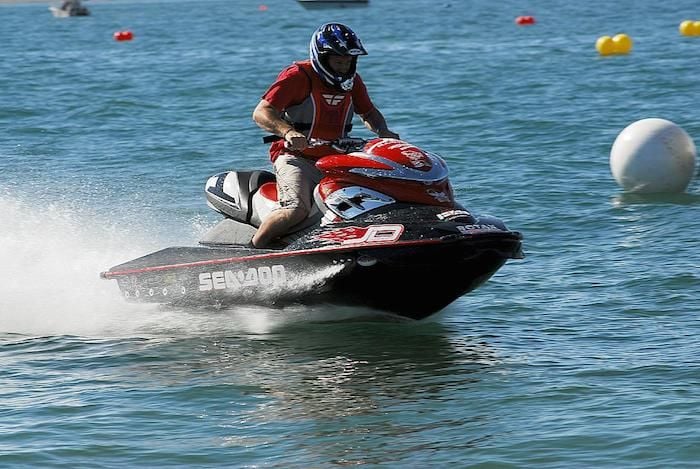
Dan O’Keefe says he is coming to the Shootout to win Top Gun in the PWC 5 division, and he intends to break some records in the process.
O’Keefe is aiming for 100 mph on a PWC. That would break his—and the Shootout’s—PWC course record of 95 mph.
If anyone can do it, O’Keefe can. He won every Shootout race he entered in the PWC 5 division from 2002–2009, posting a faster speed every year.
“I took off a couple of years to give someone else a chance,” O’Keefe joked. He came back to win the Top Gun trophy in his division in 2012, and again in 2013, on a modified Yamaha FZR.
If those stats aren’t enough for O’Keefe’s resumé, consider this: he is an eight-time, undefeated, world champion in the HydroDrag Racing Series and is undefeated in 177 consecutive side-by-side races. The series consists of side-by-side drag races for 660 feet. At a 2012 race, O’Keefe broke 100 mph, going from 0 to 100 in 6.2 seconds. Unofficially, during practice runs, he says he has seen 104 mph.
This year, O’Keefe raced at the RIVA Racing HydroDrag Spring Nationals: WaterTop Unlimited’s first-ever APBA-sanctioned, PWC drag race event. The course premiered a new innovation in PWC racing, with the unveiling of the “WaterTop Launch Pad” starting system. This stationary launch pad utilizes a drop-bunk system that lifts the PWCs out of the water to the point where only the jet-pump touches the surface. An explosion of water marks the start of the race as each competitor barrels down a two-lane, 1/8-mile course. O’Keefe won two championship trophies at that event.
Needless to say, Dan O’Keefe is “that guy” all the other racers hope doesn’t show up.
And his speed at the Shootout has not gone unnoticed. O’Keefe gained world-wide attention last year with his 95-mph run.
“Last year, I said I would be happy with anything over 90 mph, and then I looked down and saw my GPS at 97 mph,” O’Keefe said. (The Shootout radar read 95 mph.) “A million things rushed through my head, and that’s when I knew all my hard work paid off,” he added.
Originally from St. Louis, O’Keefe owns Jet Draft Racing, where he builds handmade, high-performance watercraft for clients all over the world. His clients include two royal riders: the Prince of Qatar and the Prince of Dubai.
“I give them something that other builders can’t: handmade, precision products. My testing and results are better than store-bought,” O’Keefe said, with the confidence of a undefeated world champion.
He and his wife Joanne have one son, Owen. The family lives in St. Louis, but every week, O’Keefe commutes to work at Glencove Marine. Lake PWC-owners have a world-champion mechanic in their backyard.
Winning
O’Keefe says he consistently wins because he approaches PWC racing with surgeon-like precision. “Every aspect has to be perfect,” he said. “From the… race preparation, to how you treat the watercraft, to the equipment and the fuel you use.” That meticulous strategy needs only his trophy case as proof of its efficacy.
“If one thing is wrong, there can be a snowball effect and you will lose. I think outside the box, analyzing things over and over, learning how each part works with the other,” he said. O’Keefe’s work also gives him an advantage: building race-worthy PWC’s offers a deep level of knowledge about what components compliment each other.
Before 2009, O’Keefe won all his world titles on a Sea Doo. In 2012 he switched to a Yamaha, and he still dominated every world championship he set his sights on.
Though O’Keefe’s PWC is modified, he says even the newest units coming straight off the assembly line go so fast that there is a gentlemen’s agreement with the manufacturers to install a rev-limiter to keep them from going over 70 mph.
Technique
He typically competes in eight races a year, but O’Keefe says he likes the Shootout the best. There, the smallest watercraft at the event race in the roughest water: in the morning, when boats filled with spectators are still arriving and jockeying for position.
“We lay it out on the line when we run our PWCs in the rough water. There were a few times last year I thought I was going over. It gets exceptionally difficult on a PWC after you get to 90 mph,” O’Keefe said.
Riding a jet ski in rough water is physically taxing, but O’Keefe has always been athletic. During high school he competed in track, soccer and baseball.
“Technique is everything in racing,” he mused. “Your stance can make you win or lose: you need to get up on the front of the boat and get locked in.”
Competition
In addition to his 100-mph goal, O’Keefe may need to keep his eyes on a couple of competitors this year.
One of them is a racer he sponsors: PWC 5 racer Rick Rose. His 2009 Yamaha FZR has already seen 95 mph, but Rose was knocked out of the 2013 competition when he blew two cylinders.
Another contender is Greg Surdyke, who didn’t compete last year due to an injury but says he plans to race in 2014. Surdyke will bring two PWCs, a modified 2014 Yamaha FZ to enter the PWC 5 division, and a stock Yamaha VXR for the PWC 4 division.
Even with competitors at his heels, O’Keefe’s legacy is sure to endure. The International Jet Sport Boat Association (IJSBA) has said when he announces his retirement, the group intends to induct him into the IJSBA Hall of Fame.
Thankfully for Shootout fans, O’Keefe says he is not quite ready to hang up his racing helmet. And that means we may see firsthand how it looks for a PWC to go over 100 mph.


