
It has been 25 years since Islamic terrorists attacked the United States, flying into the Twin Towers and Pentagon, killing nearly 3,000 people. While that day is vivid for many, there are millions Americans who are too young to recall the day that changed our nation.
A quarter-century later, we look back at what happened that morning, remember some of the heroes who emerged from tragedy, and share how people can honor those who were lost.
History
On a Tuesday morning, as Americans started their day like usual, more than a dozen al-Qaeda terrorist hijacked four planes on a suicide mission. For some, a twist of fate—or God's providence depending on how you view it—kept them away from the places that would soon be attacked.
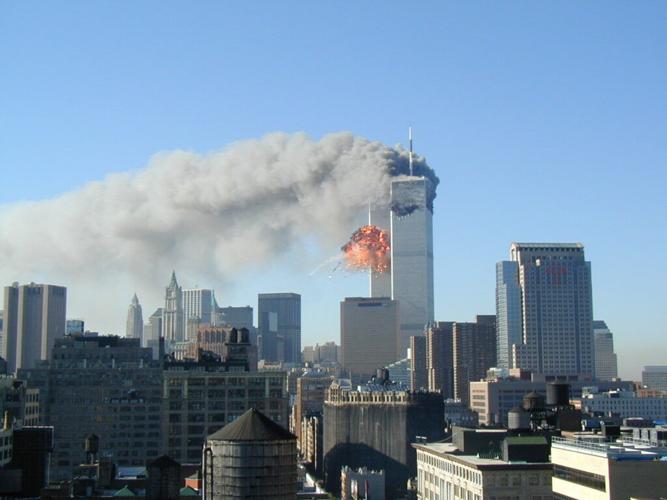
At 8:46 a.m., American Airlines Flight 11 crashed into the World Trade Center's North Tower. Everyone aboard the flight was killed, while hundreds of people were trapped above the impact zone.

At 9:03 a.m., United Airlines Flight 175 crashed into the World Trade Center's South Tower, killing everyone aboard and many more inside the building.
At 9:37 a.m., American Airlines Flight 77 crashed into the Pentagon. In addition to the 64 people aboard the plane, 125 people inside the Pentagon were killed.
At 9:59 a.m., the South Tower of the World Trade Center collapsed.
At 10:03 a.m., United Airlines Flight 93 crashed into a field near Shanksville, Pennsylvania, after passengers and crew members fought back against the hijackers. Investigators believe the hijackers intended to strike a target in Washington, D.C.
At 10:28 a.m., the North Tower collapsed.

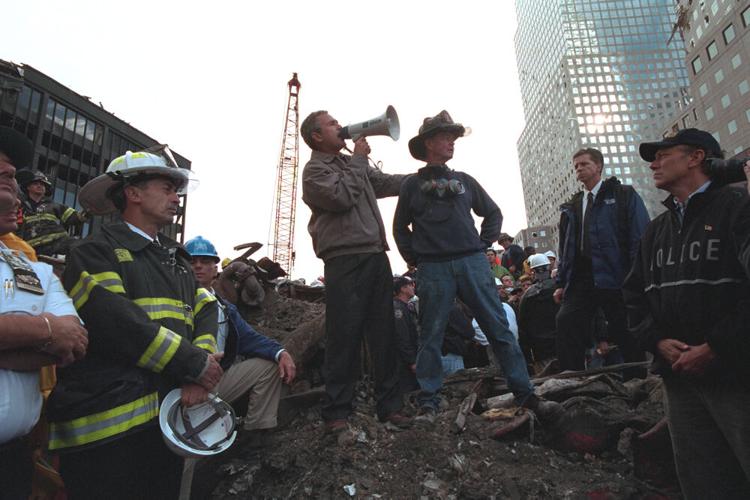
Standing Atop Rubble with Retired New York City Firefighter Bob Beckwith, President George W. Bush Addresses Approximately 400 Police, Firemen and Rescue Workers by Bullhorn at the Site of the Collapsed World Trade Center in New York City. September 14, 2001.
The attacks killed 2,977 people and injured thousands more. Among those killed were hundreds of firefighters, law enforcement officers, and other first responders.
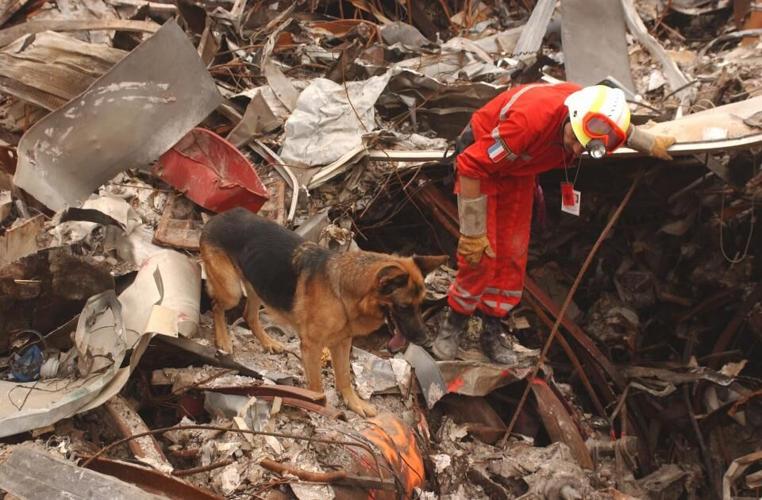
In a matter of hours, New York's skyline changed and the nation was left scarred. Rescue crews, heavy equipment, and search dogs descended on Ground Zero in the effort to find survivors and recover those who had been lost.

Search and rescue dog and handler from France on September 23, 2001.
The attacks also launched the United States into what became known as the Global War on Terror. President George W. Bush's administration sent U.S. forces into Afghanistan, while the federal government made sweeping changes to intelligence, national security, and aviation security.
The effects continued long after Sept. 11. Toxic dust and debris spread across Lower Manhattan, exposing first responders, workers, and residents to contaminants that have been associated with long-term health problems.
Air travel changed drastically as well. The Transportation Security Administration didn't exist on Sept. 11, 2001. Congress created the TSA later that year as the federal government overhauled aviation security.
Heroism
The violence and loss of Sept. 11, 2001, are only part of the story. The attacks also produced national patriotism and countless acts of courage — from first responders running toward burning buildings to ordinary people helping strangers escape.

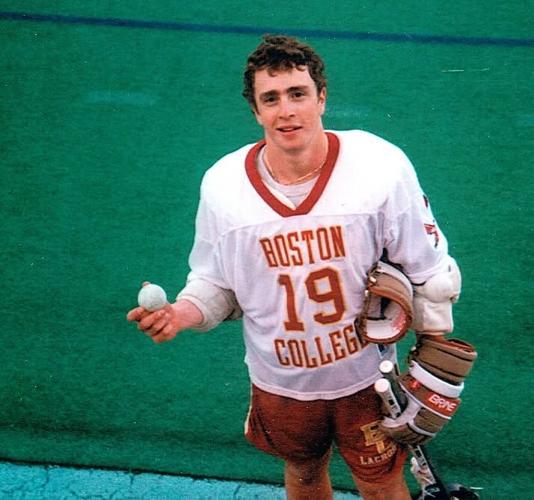
Among the many individual stories of heroism was that of 24-year-old Welles Crowther, who became known as “the man in the red bandana.”
Crowther was working as an equities trader in the South Tower when Flight 175 struck. According to the 9/11 Memorial & Museum, survivors recalled a man with a red bandana covering his nose and mouth appearing through the smoke on the 78th-floor sky lobby. He directed survivors toward a stairway and repeatedly returned to help others.
Crowther did not survive the collapse. Months later, after survivors began describing the mysterious man in the red bandana, his mother recognized the description as her son. Crowther, a volunteer firefighter, had carried a red handkerchief since childhood.
Survivor Judy Wein, whom Crowther helped rescue, later described the magnitude of what he did.
“People can live 100 years and not have the compassion, the wherewithal to do what he did.”
Four flights--American 11, United 175, American 77, and United 93--took off the morning of September 11, 2001 unaware of the life-changing events to follow and fate that would forever intertwine them.
In Season 1, Episode 1, "9/11: Four Flights."
ABOUT THE HISTORY CHANNEL:
The HISTORY® Channel, a division of A+E Global Media, is the premier destination for historical storytelling. From best-in-class documentary events, to a signature slate of industry leading nonfiction series and premium fact-based scripted programming, The HISTORY® Channel serves as the most trustworthy source of informational entertainment in media.
Copyright Notice: This video and my YouTube channel contain dialog, music, and images that are property of The HISTORY® Channel. You are authorized to share the video link and channel, and embed this video in your website or others as long as a link back to our YouTube Channel is provided.
© 2025 The HISTORY® Channel
Twenty-five years later, retired NYPD Emergency Service Unit officer Gregory Welch told Firehouse.com that his memories of 9/11 are also shaped by what he witnessed the following day.
“What can we take out of 9/11? The best thing was 9/12,” Welch recalled. “We came together, and everybody in the country took up the job of supporting New York.”
“It was a beautiful thing to experience,” he continued. “There were American flags everywhere you looked. I wasn’t alone. The whole city, the whole country was on board. We saw it. And it was amazing.”
Honor
Americans continue to honor the victims, survivors, and first responders in communities across the country.

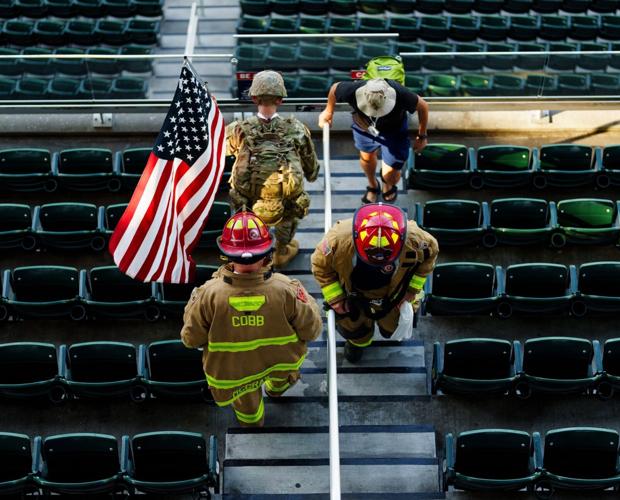
More than 1,000 people came together at Truist Park, home of the Atlanta Braves, for the annual Patriot Day 9/11 Memorial Stair Climb in September 2026.
For first responders, remembrance often carries a particular significance. One tradition that has spread nationwide is the 9/11 Memorial Stair Climb. Firefighters, police officers, EMS personnel, and members of the public climb the equivalent of 110 stories — the height of the World Trade Center towers — usually carrying the name of a first responder who died that day.
One tribute illuminated the skies over New York Harbor ahead of the anniversary this year. On Sept. 9, Sky Elements Drones unveiled a memorial featuring 2,977 lights — one for every person killed in the 9/11 attacks.
The lights recreated the Twin Towers at full architectural scale over the harbor. The public art installation was developed with input from 9/11 family members, survivors, and the responder community as an act of remembrance.
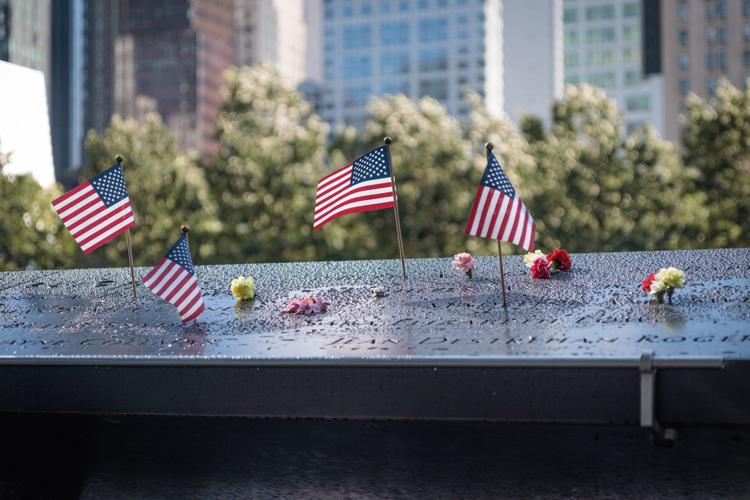
But remembrance doesn't have to involve a large ceremony. Visiting a 9/11 memorial, teaching younger generations about the attacks and sacrifices of first responders, or simply taking time to remember those who were lost are other ways to mark the anniversary.
For those who don't remember Sept. 11 — or want to learn more about the nearly 3,000 people who lost their lives — the National September 11 Memorial & Museum has created resources for the 25th anniversary, including ways to commemorate the day and learn more about the attacks and their lasting impact.

At Lake of the Ozarks, the anniversary will be marked with a tribute honoring those who lost their lives in the war that followed.
The Global War on Terror Remembrance Wall is at the Lake this weekend, featuring more than 7,000 names of U.S. service members who died during the Global War on Terror.
The wall will be displayed at Hy-Vee in Osage Beach from Friday through Sunday and will be accessible 24 hours a day. According to LakeSide Warriors President and retired U.S. Marine Dustin Dixon, this is the first time the traveling wall has been brought to Missouri.
The impact of 9/11 will never go away. It continues through the memory of those who lost their lives, the heroes who stepped up, and the generations that must learn the story of this tragic day. However you memorialize Sept. 11, the promise remains the same: never forget.


