

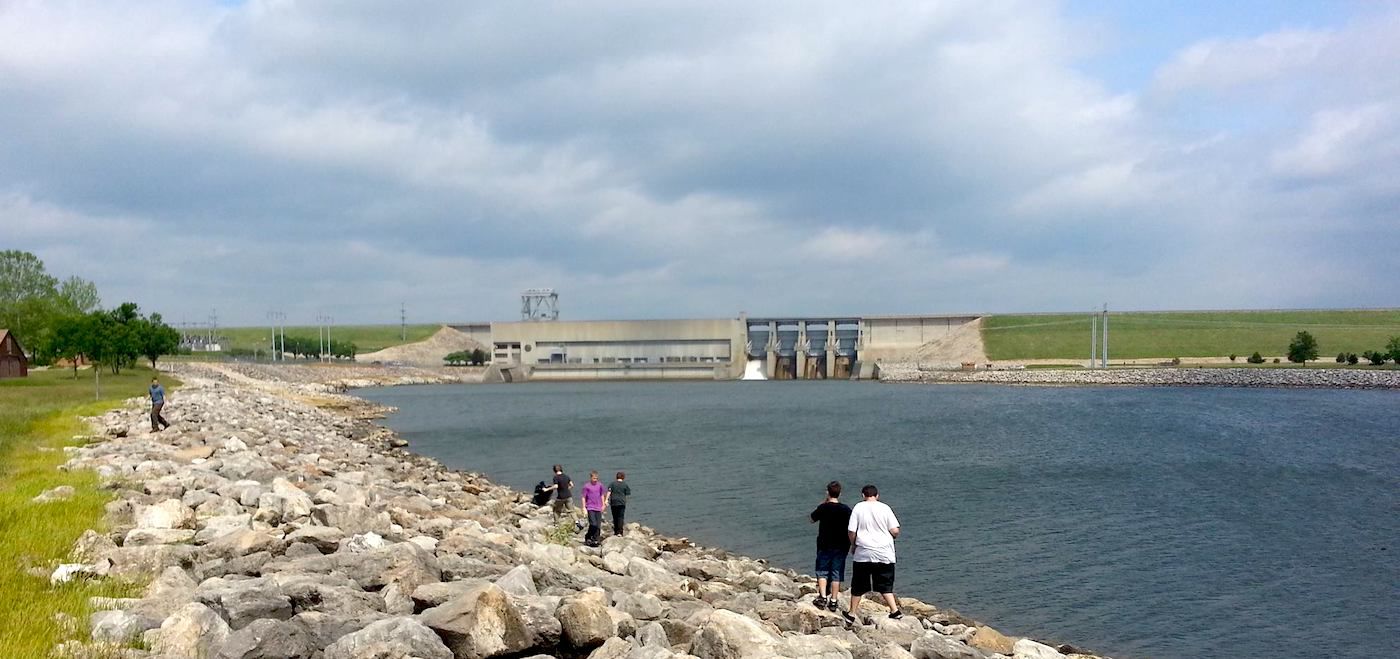
Truman Dam, which stands between Truman Lake and Lake of the Ozarks, has been categorized as a potentially unsafe dam, in a risk assessment study conducted in 2018 by the Army Corps of Engineers.
The Harry S. Truman Dam received the assignment of a Dam Safety Action Class (DSAC) 2 Rating. According to the Corps of Engineers, a DSAC 2 Rating is Urgent (Unsafe or Potentially Unsafe) and is characterized as “Failure Initiation Foreseen or Very High Risk.”
According to Harry S. Truman Dam Safety Program Manager Pendo Duku, that rating is a general assessment based on specific concerns. In the case of Truman Dam, the high population numbers downstream and the potential for an extreme rain event are the primary concerns. "Population is greatest concern to us," Duku said.
Bagnell and Truman Dam operators conduct periodic safety drills to train for various potential causes of dam failure. Here's some LakeExpo.com coverage of training exercises from a decade ago (story continues below) :
JEFFERSON CITY, Mo. — Bagnell Dam at Missouri’s Lake of the Ozarks and Harry S. Truman Dam a…

The stage is set - it’s the Fourth of July, lake levels are high and there’s rain in the for…
DSAC 2 Description by the Army Corps of Engineers:
“DSAC Class II Urgent (Unsafe or Potentially Unsafe) – Characteristic: Failure Initiation Foreseen or Very High Risk. Dams where failure could begin during normal operations or be initiated as the consequence of an event. The likelihood of failure from one of these occurrences, prior to remediation, is too high to assure public safety; or the combination of life or economic consequences with probability of failure is very high.”
Duku said Truman Dam was performing adequately on Tuesday, March 5, and he expected it to continue to do so. “It is currently operating as designed. However, there is a potential that a strong rain could cause some issues. ‘Potential’ is the key word here,” Duku emphasized in a telephone interview. “You have to go in-depth to truly understand how the project would perform.”
Duku said Truman Dam received the “2” rating because of the potential that an extreme rainfall event could cause an influx into the lake that could overflow the dam. “It is a likelihood—however very low—that we cannot ignore,” he said. “We need to be vigilant in how we manage that risk.”
Duku did not have a ready estimate of the amount of rain it would take for a rain event to be classified as an extreme rain event. However, Truman Dam has proven its ability to hold back significant water, protecting Lake of the Ozarks from even more catastrophic flooding that it already sustained in the flood of December 2015: the worst flood Lake of the Ozarks had seen in 30 years. Truman flooded 16 feet above its normal level of 706 feet of elevation. In May of 2017, Truman went 18 feet above normal to protect Lake of the Ozarks after massive amounts of rain runoff put Lake of the Ozarks 1.5 feet above its normal full pool level of 660 feet.

LAKE OF THE OZARKS, Mo. — After a big boating weekend at Lake of the Ozarks, Bagnell Dam ope…

LAKE OF THE OZARKS, Mo. – In the wake of the worst flood at the Lake in 30 years, Bagnell Da…
View the Corps of Engineers' Truman Dam Safety Facts Sheet
Who would be affected?
According to Duku, the Corps of Engineers wants to be open and transparent with the large population located below the dam, due to the potential for overtopping during an extreme flood.
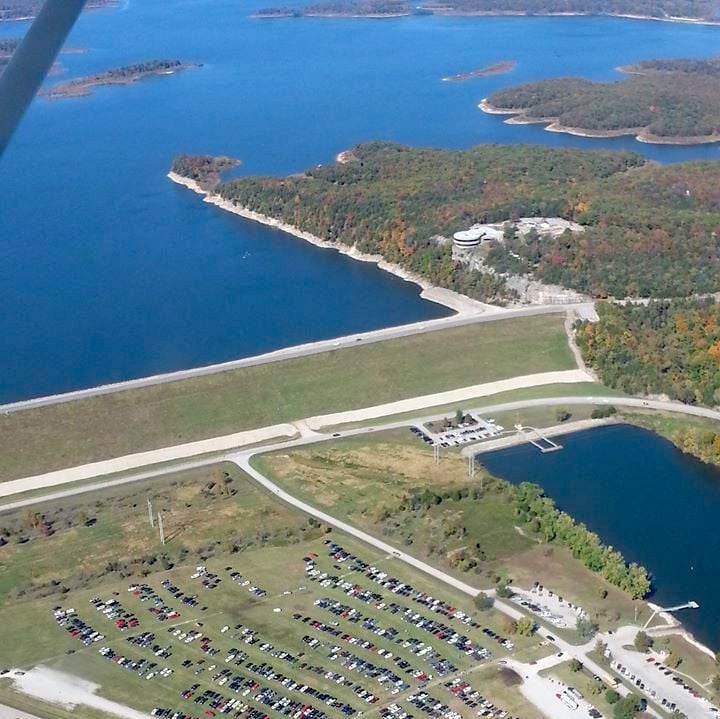
Should the dam breach with a full reservoir during a rare flood event or experience major spillway or outlet works flows, the primary areas impacted would stretch across the state of Missouri, from Warsaw, through the Lake of the Ozarks region, and ending in Carroll, Ill.
In the weekend's catastrophic flooding and subsequent high lake levels, docks have begun to break away from the shore on the Lake of the Ozarks. The dock depicted above reportedly collided with the Highway 54 bridge on the Niangua Arm of the Lake of the Ozarks.
Video by Mark Ellifson
The potential for loss of life in such an incident is highest within a couple of miles of the dam, but loss of life concerns remain substantial beyond 60 miles downstream of the dam. Advanced warning of problems and events plays a major role in protecting life and property.
How Long to Impact?
According to the Corps of Engineers, in the case of a rare flood event and dam breach, actual flood arrival times would depend on specific flooding and failure conditions and may differ from the following estimated flood arrival times:
-Warsaw: 2 hours, with a peak elevation of 739.5 ft.
-Bagnell Dam: 9 hours, with a peak elevation of 699.8 ft
-St. Charles: 108 hours, with a peak elevation of 455.2 ft.

LAKE OF THE OZARKS, Mo. — The Lake of the Ozarks has crested, as Ameren Missouri reported wa…

LAKE OF THE OZARKS, Mo. — In 2015, the Lake of the Ozarks has seen two of its 10 worst flood…
Community Awareness & Open House Meeting
The Corps of Engineers is working to raise community awareness and thereby mitigate risk, so they will host a community open house from 5 to 7 p.m. on Wednesday, March 13 at the Harry S. Truman Dam Visitor’s Center in Warsaw, Mo. The open house will consist of open dialogue regarding risk awareness between the community and the Corps of Engineers personnel. The intent of the presentation will be to inform the community of the potential risks and how the Corps of Engineers is mitigating and communicating those risks.
All interested parties are encouraged to attend. Camden County Emergency Management Agency will livestream the open house on their Facebook page.
Corps of Engineers will discuss, at the March 13 public meeting, how they manage risk. “We are working to communicate effectively with the public on how we manage risk and how the community contributes to managing risk, because it is a partnership,” Duku said.
To his knowledge, there has never been a dam that received a “5” rating, with no concerns. Also, to his knowledge the Harry S. Truman Dam has never been breached.

WARSAW, Mo. — The Lake of the Ozarks has dropped below full pool, after floodgates were open…

UPDATE: Mountain Grove Fire Dept. Facebook page reports Lily Lake is receding and the dam mi…
The open house will promote emergency preparedness and share information on evacuation readiness and communicate dam risk to the population-at-risk located downstream. Lake staff and subject matter experts will be in attendance to answer questions regarding the risk evaluation, emergency preparedness, powerhouse repairs, and other ongoing projects. Representatives from the Benton County emergency management office will be in attendance to share information on the RAVE Alert emergency mass notification system that is a partnership between the Corps of Engineers and Benton County.
Dam Safety Program
The Corps of Engineers’ Dam Safety Program uses a risk-informed approach to manage its portfolio of more than 700 dams, and stresses that public safety is their top priority. The Dam Safety Program seeks to ensure that dams owned and operated by the Corps do not present unacceptable risks to people, property, or the environment, with the emphasis on protecting people.
Dam Safety Classifications, ranked from 1 to 5 (information via U.S. Army Corps of Engineers):
DSAC Class 1 Urgent and Compelling (Unsafe) – Characteristic: Critically Near Failure or Extreme High Risk. Dams where progression toward failure is confirmed to be taking place under normal operations, and the dam is almost certain to fail under normal operations within a time frame from immediately to within a few years without intervention; or the combination of life or economic consequences with probability of failure is extremely high.
DSAC Class 2 Urgent (Unsafe or Potentially Unsafe) – Characteristic: Failure Initiation Foreseen or Very High Risk. Dams where failure could begin during normal operations or be initiated as the consequence of an event. The likelihood of failure from one of these occurrences, prior to remediation, is too high to assure public safety; or the combination of life or economic consequences with probability of failure is very high.
DSAC Class 3 (High Priority Conditionally Unsafe) – Characteristic: Significantly Inadequate or Moderate to High Risk. Dams that have issues where the dam is significantly inadequate, or the combination of life, economic or environmental consequences with probability of failure is moderate to high.
DSAC Class 4 Priority (Marginally Safe) – Characteristic: Inadequate with Low Risk. Dams are inadequate with low risk such that the combination of life, economic or environmental consequences with a probability of failure is low, and the dam may not meet all essential Corps of Engineers engineering guidelines.
DSAC Class 5 Normal (Adequately Safe) – Characteristic: Residual Risk Considered Tolerable
Dams considered adequately safe, meeting all essential agency guidelines, and the residual risk is considered tolerable.
Risks associated with dams in general
Dams reduce, but do not eliminate the risk of economic and environmental damages and loss of life from flood events. When a flood exceeds the reservoir's storage capacity, large amounts of water may have to be released that could cause damaging flooding downstream. A fully-functioning dam could be overtopped when a rare, large flood occurs, or a dam could breach because of a deficiency, both of which pose risk of property damage and life loss. This means there will always be flood risk that has to be managed. To manage these risks, Corps of Engineers has a routine program that inspects and monitors its dams regularly. Corps of Engineers implements short- and long-term actions, on a prioritized basis, when unacceptable risks are found at any of its dams.
What residents should know
Dams do not eliminate all flood risk, so it is important that residents downstream from the dam are aware of the potential consequences should the dam breach, not perform as intended, or experience major spillway or outlet works flows. The very high risk in Warsaw, Mo. and the related consequences further downstream, warrant increased efforts on the part of Corps of Engineers, local emergency management officials, and residents to heighten awareness of the potential flood risk associated with the dam.
Dams are designed to pass large amounts of water on a regular basis, and this means there will always be flood risk that has to be managed. (See the chart below).
Recommendations for Residents | Harry S. Truman Dam Facts |
| Estimated consequences with rare flood event and breach:
Estimated consequences with rare flood event and no breach:
|
About Harry S. Truman Dam
The Harry S. Truman Dam was designed and built by the U.S. Army Corps of Engineers, Kansas City District and completed in 1978. Corps of Engineers operates Harry S. Truman Dam for flood damage reduction, hydroelectric power generation, recreation, water quality, water supply, and fish and wildlife.
The main components of the project are a compacted-earth embankment section which serves as the main water barrier, a concrete gated spillway structure that allows controlled water flow out of the dam, and a hydroelectric powerhouse.
During normal operations, Truman Lake is kept at a relatively consistent level (referred to as conservation pool). Should heavy rains occur in the spring or at any other time, surface water runoff is stored in the lake until the swollen streams and rivers below the dam recede and can handle the release of stored water without damage to lives, property or the environment. Sometimes water must be released to protect the dam’s integrity even though streams and rivers may have already reached or exceeded their capacity.

LAKE OZARK, Mo. — After nearly a month, the Bagnell Dam floodgates have been closed.
Benefits associated with Harry S. Truman Dam
Truman Dam has provided $103.2 million in average annual flood damage reduction since placed into service. During the 1993 flood, officials estimate the dam prevented $260 million in flood damages. The dam provides 1,500 acre-feet of water, and the annual water supply benefit is about $886,300. Annual recreational benefits to the area are estimated to be about $22.4 million.
For additional information about dam safety and living with dams, please visit:
https://www.usace.army.mil/Missions/Civil-Works/Dam-Safety-Program/
-- -- --
Sources:
nwk.Corps of Engineers.army.mil
National Inventory of Dams (NID) No. MO20725 2018
Harry S. Truman Fact Sheet 2018


![[VIDEO]: Ferris Wheel Now Standing Tall At The Oasis](https://bloximages.chicago2.vip.townnews.com/lakeexpo.com/content/tncms/assets/v3/editorial/6/45/645bc455-286b-4556-b486-8f36b333dff4/6ab5949ebf5bf.preview.png?crop=1263%2C1263%2C0%2C60)

![Dinner With THIS View?! Inside 1932 Reserve At Lake Of The Ozarks [FLYTHROUGH]](https://bloximages.chicago2.vip.townnews.com/lakeexpo.com/content/tncms/assets/v3/editorial/b/40/b4047402-5958-4f34-92e1-36da52740fea/6aada39fabf69.preview.jpg?crop=1119%2C1119%2C240%2C0)


